


Kavakavaresin
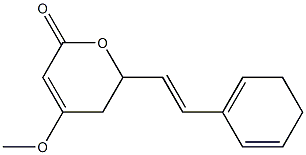
- CAS No.
- 9000-38-8
- Chemical Name:
- Kavakavaresin
- Synonyms
- Kavalactone;KAWA;KAVARESIN;Kava extrac;KAVAEXTRACTS;Cavanolactone;Kavakavaresin USP/EP/BP;Kava extract kava lactone;Kava Extract, 30% by HPLC;TIANFU-CHEM- Kavakavaresin
- CBNumber:
- CB11074733
- Molecular Formula:
- C14H16O3
- Molecular Weight:
- 232.27504
- MDL Number:
- MFCD02112945
- MOL File:
- 9000-38-8.mol
- MSDS File:
- SDS
| InChI | InChI=1S/C14H16O3/c1-16-13-9-12(17-14(15)10-13)8-7-11-5-3-2-4-6-11/h3,5-8,10,12H,2,4,9H2,1H3/b8-7+ |
|---|---|
| InChIKey | OMNGEVNATYFZGG-BQYQJAHWSA-N |
| SMILES | C1(/C=C/C2C=CCCC=2)OC(=O)C=C(OC)C1 |
| Toxicology and Carcinogenesis | Toxicology and Carcinogenesis Studies of Kava Kava Extract (CASRN 9000-38-8) in F344/N Rats and B6C3F1 Mice (Gavage Studies) |
| IARC | 2B (Vol. 108) 2016 |
SAFETY
Risk and Safety Statements
| Hazardous Substances Data | 9000-38-8(Hazardous Substances Data) |
|---|
Kavakavaresin price
| Manufacturer | Product number | Product description | CAS number | Packaging | Price | Updated | Buy |
|---|---|---|---|---|---|---|---|
| Biosynth | FK170267 | Kavakavaresin | 9000-38-8 | 0.5kg | $962.5 | 2026-06-04 | Buy |
| Biosynth | FK170267 | Kavakavaresin | 9000-38-8 | 1kg | $1512.5 | 2026-06-04 | Buy |
| American Custom Chemicals Corporation | RES0000599 | KAVAKAVARESIN 95.00% | 9000-38-8 | 5MG | $499.36 | 2021-12-16 | Buy |
Kavakavaresin Chemical Properties, Uses, Production
Description
Kava or Piper methysticum is a shrub of the pepper family,
native to Micronesia, Melanesia, and Polynesia. There are
approximately 150 different cultivars with different content
and composition of active ingredients, consequently resulting
in different intoxicating effects after ingestion. On
average, the kava lactones account for 3–20% of dry weight
of the kava root and have relatively low solubility in water.
The active components of kava are mostly contained in the
lipid-soluble resin where the lactones account for approximately
96%.
lactones varies according to the plant parts and the kava species
used for extraction. The aerial parts of the shrub contain
a relatively higher amount of alkaloids and are generally
avoided in traditional preparations.
Traditionally, extractions are made with cold water or
coconut milk from macerated dry or fresh root. Due to the low
water solubility of the lactones, commercial kava products
such as herbal supplements are made from organic solvents
(i.e., acetone and ethanol).
During the 1990s, kava became very popular in Western
countries resulting in increased import and demand. Following this popularity boom, a number of suspected kava-induced
hepatotoxic events were reported. Kava preparations were
banned in a number of European countries and the US Food
and Drug Administration (FDA) issued warnings.
Uses
Aqueous extracts from the root of kava has been used for
centuries in the South Pacific. The extract is used as a ceremonial
and intoxicating drink, but has also been used as a medicine for
various illnesses, including migraines and bladder disorders.
The pharmacologically active compounds are the kava lactones,
which allegedly possess analgesic, anticonvulsive, spasmolytic,
and antimycotic effects.
In Western countries, organic kava extracts have gained
popularity in the twentieth century as herbal supplements for
treating anxiety and insomnia.
Biological Activity
Kavakavaresin is a synthetic drug that inhibits the activity of the polymerase chain reaction.
Toxicity evaluation
Mechanisms of action to explain kava’s pharmacological and
toxicological properties are still incompletely understood.
Known side effects are relatively mild and include allergic
reactions and gastrointestinal complaints. Kava dermopathy is
a well-recognized symptom in heavy kava users. It appears after
weeks of ingestion as a scaly rash; however, the skin returns to
normal upon cessation. There is an apparent dose–response
relationship and the prevalence in heavy kava users has been
reported to be 78%.
Amore serious issue is suspectedkava-induced hepatotoxicity.
This has resulted in extensive studies of kava lactones, chalcones,
and alkaloids. To date, there are no indisputable explanations
and, due to the lack of dose dependency, kava-induced hepatotoxicity
has been classified as idiosyncratic, possibly with
involvement of the immune system.
Ninety-three cases of suspected kava-induced hepatotoxicity
have been reviewed by the World Health Organization (WHO).
However, in most cases the information was inadequate to
determine whether hepatotoxicity was caused by kava. The
reported symptoms were hepatitis, hepatic failure, cholestatic
hepatitis, jaundice, abnormal hepatic function, and cirrhosis.
The outcome in seven of the reviewed cases was death and 14 of
the cases resulted in liver transplant. The mean duration to
onset was 111 days and positive rechallenge tests were seen in
five patients.
The form of kava use in the South Pacific and in Aboriginal
communities is apparently not associated with the hepatotoxicity
reported in Western countries. Elevated liver enzymes (gammaglutamyl
transferase (GGT) and alkaline phosphatase (ALP))
have been reported in these kava users, consuming an average
118 g week-1. The symptoms were reversible upon cessation.
Involvement of glutathione (GSH) and possibly depletion
of endogenous GSH has been proposed to be involved in the
toxic mechanism. A recent study revealed that in vitro toxicity
of kava and acetaminophen (APAP) was intensified by coadministration.
Toxicity of APAP is due to formation of a reactive
metabolite causing depletion of GSH. The increase in
toxicity when kava was coadministered suggests that GSH
somehow could be involved in detoxification of kava.
The possibility of kava acting as an inhibitor of specific
metabolic enzymes has been investigated. In vitro results have
shown that kava is indeed capable of altering the metabolic
capacity of a number of P-450 enzymes; however, the relation
to hepatotoxicity remains unclear.
Flavokavains have been identified as the most potent
cytotoxic compounds in kava. Recently, the flavokavains
gained attention as they have shown apoptotic effects on cancer
cells. Among others, the targets include nuclear factor kappa
beta (NF-kB), Bax, reactive oxygen species, and growth arrest
and DNA-damage-inducible protein (GADD153). Like the
lactones, these compounds have very low solubility in water.
Thus, an organic extract would be expected to contain much
higher concentrations than an aqueous extract. The toxicity of
flavokavains is yet to be examined in vivo.
Poor quality kava products have been accused of being
involved in the increased prevalence of kava-induced hepatotoxicity
in Western countries. Due to the popularity boom,
aerial parts of the shrub allegedly have been included in the
material used to produce commercial kava preparations.
Aerial parts are generally avoided in the South Pacific as they
contain a relatively high amount of alkaloids such as pipermethystine,
which has been reported to decrease cellular
ATP levels and mitochondrial membrane potential and
induce apoptosis in human HepG2 cells. Pipermethystine
has, however, not been identified in commercial products in
clinically significant amounts.
Another aspect of poor quality kava has recently been
addressed. It has been proposed that, due to high temperatures
and humidity in the South Pacific, mold would be able to
develop rapidly in kava plant material not stored correctly. It
has been suggested consequently that hepatotoxins including
aflatoxins could be present in poor quality kava plant material.
Kavakavaresin Preparation Products And Raw materials
Raw materials
Preparation Products
| Supplier | Tel | Country | ProdList | Advantage | |
|---|---|---|---|---|---|
| Shaanxi xintianyu Biotechnology Co., Ltd. | 17749282610 17749282610 | 3673489399@qq.com | China | 979 | 58 |
| Shaanxi xintianyu Biotechnology Co., Ltd | 029-32565555 18690085745 | 3002805869@qq.com | China | 745 | 58 |
| Shaanxi Jianchuang Biotechnology Co., Ltd. | 13335389838 | 3305337057@qq.com | China | 220 | 58 |
| Shaanxi xintianyu Biotechnology Co., Ltd. | 029-32565555 18710500080 | 1064976462@qq.com | China | 413 | 58 |
| Shaanxi xinyanghe Biotechnology Co., Ltd | 13992003250 | 6432366@qq.com | China | 396 | 58 |
| Xunteng International Trading Co.,Limited | China Hong Kong | 876 | 55 | ||
| Shanghai Synchem Pharma Co., ltd | 21-619849051-1 18521059765 | synchempharma@aliyun.com | China | 4988 | 55 |
| Shanghai SuperLan Chemcial Technique Centre | 0-2022843681 15618226720 | chaolaichem@foxmail.com | China | 9996 | 58 |
| Shenzhen Simeiquan Biotechnology Co. Ltd | 18126413629 0755-23311925 2355327053 | abel@ycgmp.com | China | 5101 | 58 |
| Shenzhen Sendi Biological Technology Co., Ltd. | 18124570582 TEL:0755-23574479 2355327139 | siliao02@yccreate.com | China | 6102 | 58 |
View Latest Price from Kavakavaresin manufacturers
| Image | Update time | Product | Price | Min. Order | Purity | Supply Ability | Manufacturer | |
|---|---|---|---|---|---|---|---|---|
 |
2026-09-11 | Kava extract
9000-38-8
|
1kg | 98% | 1000kg | Changsha Staherb Natural Ingredients Co., Ltd. | ||
 |
2026-08-25 | Kavakavaresin
9000-38-8
|
1kg | 0.99 | 1000kg | Shaanxi Xianhe Biotech Co., Ltd | ||
 |
2026-05-22 | Kavalactones
9000-38-8
|
1kg | 99.8% | 1000 kg | BINBOBIO CO., LTD. |
-
- Kava extract
9000-38-8
- 98%
- Changsha Staherb Natural Ingredients Co., Ltd.
-
- Kavakavaresin
9000-38-8
- $0.00
- 0.99
- Shaanxi Xianhe Biotech Co., Ltd
-
- Kavalactones
9000-38-8
- $0.00
- 99.8%
- BINBOBIO CO., LTD.
