


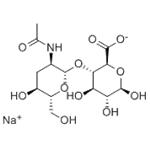
Hyaluronic acid

- CAS No.
- 9004-61-9
- Chemical Name:
- Hyaluronic acid
- Synonyms
- HYALURONIC ACID SODIUM;Hyaluronic acid powder;Hyaluronate Acid;acid hyaluronic;HYALURONIC ACID (SODIUM HYALURONATE);aluronic acid、HA;hyaluronic acid filler;Sodium Hyaluronate MMW;Hyaluronic acid, bovine vitreous humor;Mucoitin
- CBNumber:
- CB1176690
- Molecular Formula:
- C14H22NNaO11
- Molecular Weight:
- 403.31
- MDL Number:
- MFCD00131348
- MOL File:
- 9004-61-9.mol
- MSDS File:
- SDS
- TDS File:
- TDS
| storage temp. | −20°C |
|---|---|
| solubility | H2O: 5 mg/mL, clear, colorless |
| form | Lyophilized Powder |
| color | White |
| Odor | Odorless |
| optical activity | -70~-80 |
| Water Solubility | Soluble in water. |
| Major Application |
3D bioprinting tissue engineering (Hydrogels) |
| Cosmetics Ingredients Functions |
SKIN CONDITIONING ANTISTATIC MOISTURISING HUMECTANT |
| Cosmetic Ingredient Review (CIR) | Hyaluronic acid (9004-61-9) |
| InChIKey | MAKUBRYLFHZREJ-IUPJJCKZNA-M |
| SMILES | [C@@H]1(O[C@H]2[C@H](O)[C@H]([C@H](O)O[C@@H]2C(=O)[O-])O)O[C@H](CO)[C@@H](O)C[C@H]1NC(=O)C.[Na+] |&1:0,2,3,5,6,9,15,18,21,r| |
| LogP | -6.623 (est) |
| CAS DataBase Reference | 9004-61-9 |
| EWG's Food Scores | 1 |
| FDA UNII |
HYALURONIC ACID (NON-ANIMAL STABILIZED) (B7SG5YV2SI) HYALURONIC ACID (S270N0TRQY) |
| NCI Drug Dictionary | hyaluronic acid |
| ATC code | D03AX05,M09AX01,R01AX09,S01KA01,S01KA51 |
| EPA Substance Registry System | Hyaluronic acid (9004-61-9) |
| UNSPSC Code | 51202002 |
| NACRES | NA.23 |
SAFETY
Risk and Safety Statements
| Hazard Codes | B |
|---|---|
| Safety Statements | 22-24/25 |
| WGK Germany | 3 |
| RTECS | MT7250000 |
| F | 3-10 |
| TSCA | TSCA listed |
| Hazardous Substances Data | 9004-61-9(Hazardous Substances Data) |
Hyaluronic acid price More Price(32)
| Manufacturer | Product number | Product description | CAS number | Packaging | Price | Updated | Buy |
|---|---|---|---|---|---|---|---|
| TCI Chemical | H1807 | Hyaluronic Acid from Bacteria | 9004-61-9 | 1G | $179 | 2026-04-30 | Buy |
| Usbiological | H7980-11K | Hyaluronic Acid PurifiedbyProteinGaffinitychromatography. | 1ml | $631 | 2026-06-03 | Buy | |
| Biosynth | YH182872 | Hyaluronic acid from Bacteria | 9004-61-9 | 0.25g | $243.38 | 2026-06-05 | Buy |
| Biosynth | YH182872 | Hyaluronic acid from Bacteria | 9004-61-9 | 0.5g | $389.4 | 2026-06-05 | Buy |
| Biosynth | YH182872 | Hyaluronic acid from Bacteria | 9004-61-9 | 1g | $649 | 2026-06-05 | Buy |
Hyaluronic acid Chemical Properties, Uses, Production
Forms and nomenclature
dietary supplements; face creams; serums; eye drops; injections
Hyaluronic Acid
Hyaluronic acid is a completely transparent, non-adhesive, water-soluble and grease-free acid mucopolysaccharide. Its molecular weight is between a few hundred thousand to millions, and it makes up the dermis layer of the skin. Its unique molecular structure and physicochemical properties has many important physiological functions inside the body, such as lubricating joints, adjusting vascular permeability, adjusting proteins, diffusing and transporting water electrolytes, and promoting wound healing. Hyaluronic acid has a unique water retention effect and has the best known natural moisturizing properties, making it the ideal natural moisturizer.
Hyaluronic acid is an essential drug in ophthalmic “sticky surgeries”. It is used in cataract surgery, in which its sodium salt remains in the anterior chamber to maintain depth in the anterior chamber and ensure a clear surgical view. It reduces the occurences of postoperative inflammation and complications, thus improving the vision-correcting effects of the surgery. It is also used in complicated retinol detachment surgery. Hyaluronic acid has a low molecular weight and is considered the ideal natural moisturizing agent, so it is used as an additive in high-end makeup and as a moisturizer in creams, gels, lotions, masks, and serums.
It is also used medically as a moisturizer to improve moisture retention and lubrication, and it also expands capillaries and improves skin health. For example, hyaluronic acid with a low molecular weight can be used as a lubricant in surgeries (such as knee surgery), while those with high molecular weight can be used as surgical lubricant and as a substitute for vitreous in ophthalmic surgery.
Benefits
Hyaluronic acid’s main functions include:
- Has excellent affinity to water and can regroup water within tissue for better retention and lubrication.
- Folds to form a three-dimensional network and produces physiological effects, including producing fluid resistance, maintaining water balance and bodily stability, influencing macromolecule solubility, structure, chemical balance and system osmotic pressure, preventing the spread of pathogens, and promote the condensation of collagen fiber secretory substances.
- Forms polymers with inseparable proteins to maintain tissue shape and size and to ensure reversible tissue compression resistance.
- Affects macrophages, adherent cells, lymph cells, and natural killer cells.
- Serves as an important part of interstitial fluid and is mainly metabolized in the liver. Liver fiber activity increases HA synthesis; combined with reduced function during cirrhosis, blood HA levels may increase abnormally.
Side effects
Studies show that hyaluronic acid with lower molecular weights penetrates deeper into the skin, which can cause inflammation.
Chemical Properties
Hyaluronic acid is white amorphous solid, odorless and tasteless, hygroscopic. It is soluble in water and insoluble in organic solvents. The specific rotation of the aqueous solution is -70°-80°. The most prominent is a high viscosity characteristics, the viscosity of its solution, when the following conditions, an irreversible decline can occur: pH below or above 7; hyaluronidase is present; many reducing substances such as cysteine, pyrogallic gallic acid, ascorbic acid, or the presence of heavy metal ions; (4) ultraviolet light, electron beam irradiation, and so on. A polymer consisting of the disaccharide repeating unit of (1→3)-2-acetamido-2-deoxy-β-D-glucose-(1→4)-O-β-D-glucuronide, which on hydrolysis produces a hexosamine (e.g., glucosamine) and a glucuronide (e.g., glucuronide). Originally used only as a biochemical reagent, it has now become a biochemical drug with high clinical value. It is widely found in nature in various tissues of animals: connective tissue, umbilical cord, skin, human serum, cockles, synovial fluid of joints, brain, cartilage, vitreous body of the eye, human urine, chicken embryo, rabbit oocytes, arteries and veins in the wall. Hyaluronic acid is often bound to proteins and coexists with other mucopolysaccharides. In vitreous and synovial fluid, it exists in a solubilized form, and in cockles and umbilical cords as a gel.
Uses
Hyaluronic acid is a naturally derived, non - immunogenic, non - adhesive glycosaminoglycan that plays a prominent role in various wound - healing processes, as it as it is naturally angiogenic when degraded to small fragments. Hyaluronic acid promotes early inflammation which is critical for initiating wound healing, but then moderates later stages of the process, allowing matrix stabilization and reduction of long term inflammation. Hyaluronic acid is a main source for pharmaceutical, medical and cosmetic application.
Uses
Synovitis agent (veterinary).
Uses
hyaluronic acid is a glycosaminoglycan component. Hyaluronic acid occurs naturally in the dermis. It is thought to play a critical role in healthy skin by controlling the physical and biochemical characteristics of epidermal cells. It also regulates general skin activity, such as water content, elasticity, and the distribution of nutrients. Its water-absorption abilities and large molecular structure allow the epidermis to achieve greater suppleness, proper plasticity, and turgor. Hyaluronic acid is a natural moisturizer with excellent water-binding capabilities. In a solution of 2 percent hyaluronic acid and 98 percent water, the hyaluronic acid holds the water so tightly that it appears to create a gel. However, it is a true liquid in that it can be diluted and will exhibit a liquid’s normal viscous flow properties. When applied to the skin, hyaluronic acid forms a viscoelastic film in a manner similar to the way it holds water in the intercellular matrix of dermal connective tissues. This performance and behavior suggests that hyaluronic acid makes an ideal moisturizer base, allowing for the delivery of other agents to the skin. Manufacturers claim that the use of hyaluronic acid in cosmetics results in the need for much lower levels of lubricants and emollients in a formulation, thereby providing an essentially greaseless product. Furthermore, its ability to retain water gives immediate smoothness to rough skin surfaces and significantly improves skin appearance. For the benefits of hyaluronic acid to be realized in a cosmetic, the product needs to be applied on a regular basis as it is broken down in skin within 24 to 48 hours of application. note, this is not the case with hyaluronic acid injections as the technology used is different.
Definition
hyaluronic acid: A glycosaminoglycan(mucopolysaccharide) that ispart of the matrix of connective tissue.Hyaluronic acid binds cells togetherand helps to lubricate joints.It may play a role in the migration ofcells at wounds; this activity ceaseswhen hyaluronidase breaks downhyaluronic acid.
Definition
ChEBI: A mucopolysaccharide composed of N-acetylglucosamine and glucuronic acid subunits. It is found in the connective tissues of vertebrates.
brand name
Equron [Veterinary] (Fort Dodge Animal Health); Legend (Bayer Animal Health); Synacid [Veterinary] (Schering-Plough Animal Health).
Veterinary Drugs and Treatments
Hyaluronic acid is a natural complex sugar of the glycosaminoglycan family and is a long-chain polymer containing repeating disaccharide units of Na-glucuronate-N-acetylglucosamine. Hyaluronic acid is indicated for use as a surgical aid in cataract extraction (intra-and extracapsular), IOL implantation, corneal transplant, glaucoma filtration and retinal attachment surgery. In surgical procedures in the anterior segment of the eye, instillation of hyaluronic acid serves to maintain a deep anterior chamber within corneal endothelium and other surrounding tissues. Furthermore, its viscoelasticity helps to push back the vitreous face and prevent formation of a postoperative flat chamber. In posterior segment surgery hyaluronic acid serves as a surgical aid to gently separate, maneuver and hold tissues. Hyaluronic acid creates a clear field of vision thereby facilitating intra- and post-operative inspection of the retina and photocoagulation.
Hyaluronic acid Preparation Products And Raw materials
| Supplier | Tel | Country | ProdList | Advantage | |
|---|---|---|---|---|---|
| Jinan Rouse Industry Co., Ltd. | 0531-0531-82929600 18615510361 | sale@rousechem.com | China | 175 | 58 |
| QINGDAO WANYUAN MOUNTAIN BIOTECH CO.,LTD | 0532-0532-66720179 15092119928 | cuiningning@bionutrichem.com | China | 71 | 58 |
| Nantong puyue biomedical Co., Ltd | 0513-0513-0513-89158300 18014392889 | sales@puyerbiopharma.com | China | 4956 | 58 |
| GlycoSciTech Co. Ltd, Jinan, China | 15253181073 | 3285589724@qq.com | China | 157 | 58 |
| HUARONG(GUANGDONG) PHARMACEUTICAL CO.,LTD | 13751168070 19925801629 | sales2@huarongpharma.com | China | 177 | 58 |
| Taoeng (Shandong) Chemicals Co., Ltd. | 15244440883 15244440883 | 2905712029@qq.com | China | 102 | 58 |
| J & K SCIENTIFIC LTD. | 18210857532 18210857532 | jkinfo@jkchemical.com | China | 96815 | 76 |
| Meryer (Shanghai) Chemical Technology Co., Ltd. | 4006356688 18621169109 | market03@meryer.com | China | 40202 | 62 |
| INTATRADE GmbH | +49 3493/605464 | sales@intatrade.de | Germany | 3563 | 66 |
| future industrial shanghai co., ltd | 400-0066400 13621662912 | sales@jonln.com | China | 1989 | 65 |
Related articles
- Hyaluronic acid powder benefits for face skincare manufacturer
- Hyaluronic acid is a non-sulfated, naturally occurring non-protein glycosaminoglycan, and play a role in the treatment of opht....
- Nov 4,2026
- Functions and effects of Hyaluronic acid on the skin
- Hyaluronic acid is a natural active ingredient that belongs to the class of polysaccharides that can be produced by fermenting....
- Jul 24,2024
- Hyaluronic acid: Uses; Biological function; Side effects and Benefits
- Hyaluronic acid (HA) is a natural substance found in the eyes, joints and skin. It acts as a cushion and lubricant in joints a....
- Dec 27,2023
Related Questions
Ask a questionView Latest Price from Hyaluronic acid manufacturers
| Image | Update time | Product | Price | Min. Order | Purity | Supply Ability | Manufacturer | |
|---|---|---|---|---|---|---|---|---|
 |
2026-11-18 | Hyaluronic acid
9004-61-9
|
0.99 | RongNa Biotechnology Co.,Ltd | ||||
 |
2026-11-18 | Hyaluronic acid
9004-61-9
|
$139.00-1076.00 | 1g | 0.99 | 10kg | Shanghai UCHEM Inc. | |
 |
2026-11-18 | Hyaluronic acid
9004-61-9
|
$75.00-100.00 | 1kg | 99% | 5000Ton | HEBEI SHENGSUAN CHEMICAL INDUSTRY CO.,LTD |
-
- Hyaluronic acid
9004-61-9
- 0.99
- RongNa Biotechnology Co.,Ltd
-
- Hyaluronic acid
9004-61-9
- $139.00-1076.00
- 0.99
- Shanghai UCHEM Inc.
-
- Hyaluronic acid
9004-61-9
- $75.00-100.00
- 99%
- HEBEI SHENGSUAN CHEMICAL INDUSTRY CO.,LTD
