


Sodium polyacrylate
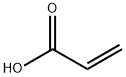
- CAS No.
- 9003-04-7
- Chemical Name:
- Sodium polyacrylate
- Synonyms
- PAAS;POLY(SODIUM ACRYLATE);Poly(acrylate sodium) (15% Aq.);POLY(ACRYLIC ACID), SODIUM SALT;2-Propenoicacid,homopolymer,sodiumsalt;polyco;2100 Mw;rhotexgs;FAVORPAC;Viscomate
- CBNumber:
- CB9741267
- Molecular Formula:
- C3H4O2
- Molecular Weight:
- 72.06
- MDL Number:
- MFCD00147949
- MOL File:
- 9003-04-7.mol
- MSDS File:
- SDS
- TDS File:
- TDS
| Density | 1.32 g/mL at 25 °C |
|---|---|
| refractive index |
n |
| storage temp. | 2-8°C |
| form | powder |
| Specific Gravity | 1.23 |
| PH Range | 6 - 9 |
| Odor | Odorless |
| PH | 6-9 |
| Appearance | Colorless to light yellow Liquid |
| Hydrolytic Sensitivity | 0: forms stable aqueous solutions |
| Stability | Stable, but moisture sensitive. |
| Cosmetics Ingredients Functions |
FILM FORMING SKIN CONDITIONING - EMOLLIENT BINDING ABSORBENT VISCOSITY CONTROLLING HAIR FIXING EMULSION STABILISING SKIN CONDITIONING |
| InChI | InChI=1S/C3H4O2/c1-2-3(4)5/h2H,1H2,(H,4,5) |
| InChIKey | NIXOWILDQLNWCW-UHFFFAOYSA-N |
| SMILES | C(=O)(O)C=C |
| Substances Added to Food (formerly EAFUS) | POLYACRYLIC ACID, SODIUM SALT |
| FDA 21 CFR | 173.310; 173.340; 173.73;175.105; 176.170; 176.180;176.200; 177.1200; 177.1210 |
| EWG's Food Scores | 2-3 |
| FDA UNII | 285CYO341L |
| EPA Substance Registry System | Sodium polyacrylate (9003-04-7) |
| UNSPSC Code | 41116107 |
| NACRES | NA.25 |
SAFETY
Risk and Safety Statements
| Symbol(GHS) |  GHS07 |
|---|---|
| Signal word | Warning |
| Hazard statements | H319 |
| Precautionary statements | P305+P351+P338-P280-P337+P313 |
| PPE | dust mask type N95 (US), Eyeshields, Gloves |
| Hazard Codes | Xi |
| Risk Statements | 36/37/38-36 |
| Safety Statements | 26-36 |
| WGK Germany | 3 |
| RTECS | WD6826000 |
| F | 3 |
| TSCA | TSCA listed |
| HS Code | 39069090 |
| Storage Class | 11 - Combustible Solids |
Sodium polyacrylate price More Price(26)
| Manufacturer | Product number | Product description | CAS number | Packaging | Price | Updated | Buy |
|---|---|---|---|---|---|---|---|
| Sigma-Aldrich | 416010 | Poly(acrylic acid, sodium salt) solution average Mw ~1,200, 45 wt. % in H2O | 9003-04-7 | 100ml | $78.4 | 2026-04-30 | Buy |
| Sigma-Aldrich | 416010 | Poly(acrylic acid, sodium salt) solution average Mw ~1,200, 45 wt. % in H2O | 9003-04-7 | 500ml | $286 | 2026-04-30 | Buy |
| Biosynth | FP168348 | Poly(acrylic acid, sodium salt) solution - average molecular weight 15000, 35% in water | 9003-04-7 | 0.1kg | $236 | 2026-06-04 | Buy |
| Biosynth | FP168348 | Poly(acrylic acid, sodium salt) solution - average molecular weight 15000, 35% in water | 9003-04-7 | 0.25kg | $472 | 2026-06-04 | Buy |
| Biosynth | FP168348 | Poly(acrylic acid, sodium salt) solution - average molecular weight 15000, 35% in water | 9003-04-7 | 0.5kg | $708 | 2026-06-04 | Buy |
Sodium polyacrylate Chemical Properties, Uses, Production
Description
Sodium polyacrylate(90039-04-7) is the sodium salt of polyarylic acid. As a chemical polymer, it has various kinds of application in consumer products. It is capable of absorbing extremely high amount of water which can reach up to as much as 200 to 300 times its mass; therefore, it is used in agriculture industry and is infused in the soil of many plants to maintain the moisture of plant. It can be commonly used as a sequestering agent, or chelating agent in many detergents. It can also be used as a thickening agent to be used in diapers and hair gels because of its high capability of absorbing and holding water. Furthermore, it can be included in the coatings of sensitive electrical wiring to remove moisture in the wires.
Dispersant
Sodium polyacrylate(9003-04-7) is a commonly used dispersant, also known as 2-sodium acrylate homopolymer, S sodium polyacrylate. It is colorless or light yellow viscous liquid in room temperature, and non-toxic, alkaline, insoluble in organic solvents such as ethanol, acetone but easily soluble in water and aqueous sodium hydroxide. However, for aqueous solution of calcium hydroxide, magnesium hydroxide, due to the increase of alkaline metal ions, it is first dissolved and then precipitated. It can work without entrustment under alkaline conditions or being concentrated for several folds with molecular weight of about 500-3000. It can disperse the microcrystalline or sediment of calcium carbonate, calcium sulfate salts into the water without precipitation, and thus achieving the purpose of preventing entrustment. Besides used as the descaling dispersant in power plants, chemical plants, fertilizer plants, refineries and air conditioning systems, cooling water system, it is also widely used in industries like paper and textile, ceramics, paints, building materials. When used as a paper coating dispersant, it has a relative molecular mass in 2000-4000. When coating concentration is 65% to 70%, it can still have a good rheology and aging stability. The product in molecular weight from 1000 to 3000 is used as water quality stabilizer as well as scaling control agent of concentrated black liquor. Products with molecular weight higher than 100,000 is used as coatings thickener and water retention agent, which can increase the viscosity of synthetic emulsion such as carboxylated styrene-butadiene latex and acrylate emulsion latex and prevent the water from being separated out as well as maintain the stability of the coating system . Product of molecular weight of 1 million or more can be used as a flocculant. It can also be used as super absorbent polymer, soil conditioners, as well as a thickening agent and emulsion dispersant in the food industry.
The molecular structure of sodium polyacrylate molecule is water soluble linear polymers. Small molecular weight molecule is as liquid with large molecule counterparts shown as solid. Solid product is shown as a white powder or granules, and is odorless, water-swellable, and soluble in aqueous caustic soda. Moreover, it is extremely hygroscopic. It is a polymer compound containing hydrophilic and hydrophobic groups. It is slowly soluble in water and form a highly viscous transparent liquid whose 0.5% solution having a viscosity of about 1000cp with the viscosity being not as swelling as CMC and sodium alginate. But owing to the ion phenomenon of many anionic groups in the molecule makes the molecular chain being longer, increasing the apparent viscosity to form highly viscous solution. It has a viscosity which is 15-20 times as high as sodium carboxymethyl cellulose (CMC) and sodium alginate. It has a high alkali resistance with viscosity changing only little and it is also non-perishable. Heat treatment, neutral salts, and organic acids have very small effects on its viscosity. However, it has increased viscosity upon alkaline condition. Intense heating to 300 degrees will not cause decomposition of it. Due to its property as a kind of electrolyte, it is vulnerable to acids and metal ions which cause the decrease of viscosity. In case of more than a sufficient amount of divalent metal ions (e.g. aluminum, lead, iron, calcium, magnesium, zinc), it will form insoluble salt which cause intermolecular crosslink and thus gelation and further precipitation. But it is still as solution upon a low amount of divalent metal ion, making it be able to be used as detergent additives which play a role in preventing soil re-deposition.
Food grade sodium polyacrylate
In abroad, it has begun to apply sodium polyacrylate(9003-04-7) for being used in a variety of food for thickening, gluten and preservation since 1960s. In 2000, the Ministry of Health of china also officially approved it as a food grade thickener.
Application limitation: According to China's food additive standards.
The applications of food grade sodium polyacrylate used are as follows:
1. being used as a thickener in foods has the following effects:
(1) Enhance the adhesion ability to raw flour protein.
(2) Make starch particle to combine with each other and dispersion penetrate into the mesh structure of the protein.
(3) Form dough with a dense texture and being smooth in its glossy surface.
(4) It forms a stable dough colloid for preventing soluble starch exudation.
(5) It has a strong water-holding capacity which can make moisture be uniformly maintained in dough and prevent drying.
(6) It can be used to improve the dough extensibility.
(7) Make the raw material in the oil component be stably dispersed into the dough.
2. it is used as the electrolyte for protein interactions, change the protein structure, and enhance food viscoelasticity and improve the organization.
3. Application examples:
(1) Bread, cakes, noodles, macaroni, improve utilization of raw materials, improve the taste and flavor with the amount of 0.05%.
(2) Fish paste-like products, canned food, dried seaweed, etc., to strengthen its organization, to keep fresh flavor, enhanced sense of smell.
(3) Sauce, tomato sauce, mayonnaise, jam, cream, soy sauce, thickeners and stabilizers.
(4) Fruit juice, wine, etc., dispersants.
(5) Ice cream, Kara honey Seoul sugar, improve taste and the stability.
(6) Frozen food, aquatic products, surface jellies (preservation).
4. Owing to its slow dissolution rate in water; it can be pre-mixed with sugar, powdered starch syrup, emulsifier, etc., to improve the dissolution rate.
5. Sodium polyacrylate can be used as sugar, salt, beverage clarifying agent (polymer coagulant).
The above information is edited by the Chemicalbook of Dai Xiongfeng.
Toxicity
LD50> 10g/kg (mice by mouth).
Subacute test: rat 0.5g/kg/day or less, and for 6 months without exception.
Limited use
GB 2760-2000: various types of food, 2.0 g/kg. The maximum amount was defined by 0.2% in Japan (1993).
Chemical Properties
White powder, odorless. Water-swellable, soluble in aqueous caustic soda.
Uses
1. It can be used as a corrosion scale inhibitor, water stabilizer, paint thickener and water retention agent, flocculants, drilling mud treatment agent.
2. The agent is used for the circulating cooling water treatment for equipment copper material with a excellent scale effect. At the amount of 100 mg/L, it can form chelate with the scale-forming ions in water of medium hardness and further flow with water, and can prevent the formation of iron oxide scale.
3. It can be used as a thickener and stabilizer in butter products, cream, tomato sauce. It can also be used as a dispersing agent in fruit juice, wine and spirits. It can improve the sense of taste of ice cream, and enhance its stability. It can also be used as surface freezing glue for freezing products and aquatic products, and can also play a role in preservation. It can also alter protein structure and enhance the viscoelasticity of food, and thus further improving the organization.
4. Thickener.
It has many functions in food as following: (1) Enhance the adhesion ability to raw flour protein. (2) Make starch particle to combine with each other and dispersion penetrate into the mesh structure of the protein. (3) Form dough with a dense texture and being smooth in its glossy surface. (4) It forms a stable dough colloid for preventing soluble starch exudation. (5) It has a strong water-holding capacity which can make moisture be uniformly maintained in dough and prevent drying. (6) It can be used to improve the dough extensibility. (7) Make the raw material in the oil component be stably dispersed into the dough. 2, it is used as the electrolyte for protein interactions, change the protein structure, and enhance food viscoelasticity and improve the organization. Application Example: (1) Bread, cakes, noodles, macaroni, improve utilization of raw materials, improve the taste and flavor with the amount of 0.05%. (2) Fish paste-like products, canned food, dried seaweed, etc., to strengthen its organization, to keep fresh flavor, enhanced sense of smell. (3) Sauce, tomato sauce, mayonnaise, jam, cream, soy sauce, thickeners and stabilizers. (4) Fruit juice, wine, etc., dispersants. (5) Ice cream, Kara honey Seoul sugar, improve taste and the stability. (6) Frozen food, aquatic products, surface jellies (preservation). 4, Owing to its slow dissolution rate in water; it can be pre-mixed with sugar, powdered starch syrup, emulsifier, etc., to improve the dissolution rate. 5, Sodium polyacrylate can be used as sugar, salt, beverage clarifying agent (polymer coagulant).
5. It can be used as a filtrate reducer in solid drilling industry.
6. This product is a good anion detergent and dispersants which can be combined with other water treatment agent compound used for oil field water, cooling water, boiler water treatment at high pH and at high concentration process without scaling.
Production methods
1. Add deionized water and 34 kg of isopropanol chain transfer agent to the kettle separately and heat it to 80~82 °C. Add drop wise 14 kg of ammonium per-sulfate aqueous solution and 170 kg of acrylic monomers. After completion of dropping, perform the reaction for 3 h; cool to 40 °C; add 30% aqueous NaOH solution to a pH value of 8.0 to 9.0 and then have water and isopropanol been distilled to get the final liquid products. Spray dry to give a solid product.
2. Acrylate or acrylic acid is reacted with sodium hydroxide to get sodium acrylate, remove the alcohol by-produced; concentrate; adjust the pH, and undergo polymerization reaction to get the final product with the catalysis of ammonium per-sulfate.
3. Acrylic acid and sodium hydroxide is reacted to get sodium acrylate monomer, and then polymerize into sodium polyacrylate with ammonium per-sulfate as the catalyst.
4. Add sodium polyacrylate (with molecule weight: 1000~3000) to the reaction vessel to obtain 30% aqueous solution.
References
https://en.wikipedia.org/wiki/Sodium_polyacrylate
http://www.livestrong.com/article/458401-what-is-sodium-polyacrylate-how-is-it-used/
Description
Sodium polyacrylate, also known as waterlock, is a sodium salt of poly acrylic acid with the chemical formula [-CH2-CH(COONa)-]n and broad application in consumer products. It has the ability to absorb as much as 200 to 300 times its mass in water. Sodium polyacrylate is anionic polyelectrolytes with negatively charged carboxylic groups in the main chain. While sodium neutralized poly acrylic acids are the most common form used in industry, there are also other salts available including potassium, lithium and ammonium.
Chemical Properties
faintly grey crystalline solid
Uses
Scale inhibitor, builder in detergents, aid in soap and detergent processing and control of water hardness.
Uses
sodium polyacrylate is a suspending agent, stabilizer, and emulsifier.
Uses
Absorbent for aqueous-based spills. Retention and slow release aid for water.
Application
Sodium poly acrylate and other derivatives of polyacrylic acid have a wide variety of commercial and industrial uses that include:
Sequestering agents in detergents. ( By binding hard water elements such as calcium and magnesium, the surfactants in detergents work more efficiently.).
Definition
ChEBI: An organic sodium salt which is a macromolecule composed of repeating sodium acrylate units.
General Description
Poly(acrylic acid sodium salt) is a hydrophilic polymer, which can find wide applications in the production of consumer productslike diapers, because of its ability to absorb many more times its mass in water.
Safety Profile
An eye irritant. When heated to decomposition it emits toxic fumes of Na2O.
Solubility in organics
Water
Purification Methods
Commercial polyacrylamide is first neutralised with an aqueous solution of NaOH, and the polymer is precipitated with acetone. The precipitate is redissolved in a small amount of water and freeze-dried. The polymer is then repeatedly washed with EtOH and water to remove traces of low-molecular-weight material, and finally dried in vacuum at 60o [Vink J Chem Soc, Faraday Trans 1 75 1207 1979]. It has also been dialysed overnight against distilled water, then freeze-dried. Sodium poly( -L-glutamate). Wash it with acetone, dry it in a vacuum, dissolve it in water and precipitate it with isopropanol at 5o. Impurities and low-molecular-weight fractions are removed by dialysis of the aqueous solution for 50hours, followed by ultrafiltration
Sodium polyacrylate Preparation Products And Raw materials
Raw materials
1of2
Preparation Products
1of2
| Supplier | Tel | Country | ProdList | Advantage | |
|---|---|---|---|---|---|
| caiwei | 13338976321 | 864355939@qq.com | China | 2435 | 58 |
| Guangdong wengjiang Chemical Reagent Co., Ltd. | 0751-2815987 13927875076 | 3007432263@qq.com | China | 9999 | 58 |
| Hubei Zhonglong Kangsheng fine chemical Co.,Ltd | 027-83850299 15827297403 | 2315383731@qq.com | China | 999 | 58 |
| Shaanxi Chenming Biotechnology Co., Ltd | 15529026321 | 2709392183@qq.com | China | 1133 | 58 |
| Shandong Pingju Biotechnology Co., Ltd | 18613662662; 18613662662 | 2708672464@qq.com | China | 1146 | 58 |
| Xi'an Jinxiang Pharmaceutical Accessories Co., Ltd. | 029-19991803015 19991803015 | 1309520151@qq.com | China | 438 | 58 |
| Hebei Lihua Biotechnology Co. , Ltd. | 15127018080 | 3119446261@qq.com | China | 484 | 58 |
| Jiangsu Dongju Biotechnology Co. , Ltd. | 15152114979 | 2805239892@qq.com | China | 519 | 58 |
| Shandong Guanqing Food Ingredients Co., Ltd. | 15138924569 15138924569 | 2551887798@qq.com | China | 123 | 58 |
| Tianjin Zhongxin Chemtech Co., Ltd. | 022-66880623 | sales@tjzxchem.com | China | 612 | 60 |
Related articles
- Sodium polyacrylate: Uses in Cosmetics and Agriculture
- Sodium polyacrylate has the ability to absorb large amounts of water, which is useful for skincare and soil water retention.
- Sep 12,2026
- Water absorption and application of sodium polyacrylate
- Sodium polyacrylate is a superabsorbent polymer, capable of absorbing hundreds of times its own mass in water.
- Dec 21,2023
View Latest Price from Sodium polyacrylate manufacturers
| Image | Update time | Product | Price | Min. Order | Purity | Supply Ability | Manufacturer | |
|---|---|---|---|---|---|---|---|---|
 |
2026-09-18 | Sodium polyacrylate
9003-04-7
|
1kg | 98% | 100 T/Month | Hebei Qujie Technology Co., Ltd. | ||
 |
2026-09-18 | Sodium polyacrylate
9003-04-7
|
$900.00-999.00 | 99% | 5000 | HEBEI SHENGSUAN CHEMICAL INDUSTRY CO.,LTD | ||
 |
2026-09-18 | Sodium polyacrylate
9003-04-7
|
1KG | 99%min | 30tons/month | WUHAN FORTUNA CHEMICAL CO., LTD |
-
- Sodium polyacrylate
9003-04-7
- 98%
- Hebei Qujie Technology Co., Ltd.
-
- Sodium polyacrylate
9003-04-7
- $900.00-999.00
- 99%
- HEBEI SHENGSUAN CHEMICAL INDUSTRY CO.,LTD
-
- Sodium polyacrylate
9003-04-7
- 99%min
- WUHAN FORTUNA CHEMICAL CO., LTD
9003-04-7 (Sodium polyacrylate ) Related Search:
1of4
