|
|
| | sauristolactam Basic information |
| Product Name: | sauristolactam | | Synonyms: | sauristolactam;Sauristolactam (Saurolactam);Sauristolactam (Synonyms: Saurolactam);Saurolactam;Dibenz[cd,f]indol-4(5H)-one, 2-hydroxy-1-methoxy-5-methyl- | | CAS: | 128533-02-8 | | MF: | C17H13NO3 | | MW: | 279.29 | | EINECS: | | | Product Categories: | | | Mol File: | 128533-02-8.mol | 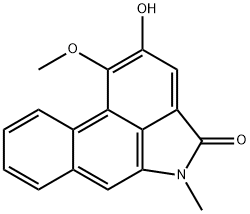 |
| | sauristolactam Chemical Properties |
| Melting point | 276 °C | | Boiling point | 579.0±50.0 °C(Predicted) | | density | 1.403±0.06 g/cm3(Predicted) | | pka | 8.75±0.20(Predicted) |
| | sauristolactam Usage And Synthesis |
| Uses | Sauristolactam, a natural aristolactam isolated from aerial portions of Saururus chinensis, has significant neuroprotective activity against glutamate-induced toxicity in primary cultured rat cortical cells[1]. Sauristolactam also inhibits the receptor activator of nuclear factor-κB ligand (RANKL)-induced osteoclastogenesis and has the potential to inhibit osteoclast differentiation[2]. | | References | [1] Kim SR, et al. Aristolactam BII of Saururus chinensis attenuates glutamate-induced neurotoxicity in rat cortical cultures probably by inhibiting nitric oxide production. Planta Med. 2004 May;70(5):391-6. DOI:10.1055/s-2004-818964
[2] Li Z, et al. Saurolactam Inhibits Proliferation, Migration, and Invasion of Human Osteosarcoma Cells. Cell Biochem Biophys. 2015 Jul;72(3):719-26. DOI:10.1007/s12013-015-0523-x |
| | sauristolactam Preparation Products And Raw materials |
|