- MACULOSIN
-

-
2025-12-25
- CAS:4549-02-4
- Min. Order: 1gram
- Purity: 99%
- Supply Ability: 10kg
|
| | MACULOSIN Basic information |
| Product Name: | MACULOSIN | | Synonyms: | MACULOSIN;CYCLO(-PRO-TYR);A-19C;Antibiotic A-19C;Antibiotic ML-1532II;Cyclo(L-Tyr-L-Pro-);ML-1532II;(3S,8aS)-3-(4-hydroxybenzyl)-2,3,6,7,8,8a-hexahydropyrrolo[1,2-a]pyrazine-1,4-quinone | | CAS: | 4549-02-4 | | MF: | C14H16N2O3 | | MW: | 260.29 | | EINECS: | | | Product Categories: | | | Mol File: | 4549-02-4.mol | 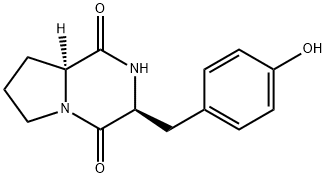 |
| | MACULOSIN Chemical Properties |
| Melting point | 156-159 °C | | Boiling point | 581.4±43.0 °C(Predicted) | | density | 1.36±0.1 g/cm3(Predicted) | | storage temp. | -15°C | | solubility | DMF: soluble; DMSO: soluble; Ethanol: soluble; Methanol: soluble | | form | A solid | | pka | 9.92±0.15(Predicted) | | color | White to off-white |
| | MACULOSIN Usage And Synthesis |
| Description | Maculosin is a diketopiperazine metabolite produced by A. alternata, L. capsici, Streptomyces, and the Gram-negative, nonobligate predator bacterial strain 679-2. It acts as a host-specific phytotoxin, inducing formation of weeping necrotic lesions in leaves of spotted knapweed (C. maculosa) when used at a concentration of 10 μM. Maculosin reduces the growth of the plant pathogenic bacteria X. axonopodis and R. solanacearum (MICs = 31.25 μg/ml) as well as the pathogenic oomycetes P. cactorum, P. capsici, P. cinnamomi, P. infestans, and P. ultimum when used at concentrations ranging from 10 to 100 mg/ml. Maculosin also inhibits the growth of M. luteus, M. smegmatis, S. cerevisiae, C. albicans, C. neoformans, and A. niger when used in combination with pyrrolnitrin or banegasin. | | Uses | Cyclo(L-Pro-L-Tyr) (maculosin) is a diketopiperazine formed by the fusion of tyrosine and proline, reported as a secondary metabolite of fungi and bacteria. In Pseudomonas aeruginosa, cyclo(L-Pro-L-Tyr) is capable of activating N-acylhomoserine lactones (AHLs). Cyclo(L-Pro-L-Tyr) is also capable of activating or antagonizing other LuxR-based quorum-sensing systems. While the mode of action of cyclo(L-Pro-L-Tyr) is not known, its activity suggests the existence of cross talk among bacterial signalling systems. Cyclo(L-Pro-L-Tyr) was identified as a host-specific toxin produced by Alternaria alternata on spotted knapweed. | | Uses | Cyclo(L-prolinyl-L-tyrosine) is a diketopiperazine derivative isolated from Bacillus thuringiensis and Bacillus endophyticus. | | Definition | ChEBI: A homodetic cyclic peptide that is a dipeptide composed of L-proline and L-tyrosine joined by peptide linkages. | | References | [1] A C STIERLE G A S J H Cardellina. Maculosin, a host-specific phytotoxin for spotted knapweed from Alternaria alternata.[J]. Proceedings of the National Academy of Sciences of the United States of America, 1988: 8008-8011. DOI: 10.1073/pnas.85.21.8008
[2] G. PUOPOLO. Lysobacter capsici AZ78 produces cyclo(l-Pro-l-Tyr), a 2,5-diketopiperazine with toxic activity against sporangia of Phytophthora infestans and Plasmopara viticola[J]. Journal of Applied Microbiology, 2014, 117 4: 1168-1180. DOI: 10.1111/jam.12611
[3] PAKORN WATTANA-AMORN . Antibacterial activity of cyclo(L-Pro-L-Tyr) and cyclo(D-Pro-L-Tyr) from Streptomyces sp. strain 22-4 against phytopathogenic bacteria[J]. Natural Product Research, 2016, 30 17: Pages 1980-1983. DOI: 10.1080/14786419.2015.1095747
[4] CODY C CAIN. Synergistic antimicrobial activity of metabolites produced by a nonobligate bacterial predator.[J]. Antimicrobial Agents and Chemotherapy, 2003, 47 7: 2113-2117. DOI: 10.1128/aac.47.7.2113-2117.2003 |
| | MACULOSIN Preparation Products And Raw materials |
|