|
|
| | (2S)-OMPT Basic information |
| Product Name: | (2S)-OMPT | | Synonyms: | SHELRVLEXVWOAY-JNYXYQEXSA-N;(2S)-OMPT (triethylamine);(2S)-OMPT (triethylamine), in ethanol:chloroform (1:1), 98%;(2S)-OMPT (triethylamine), in ethanol:chloroform (1:1), 98% | | CAS: | 1217471-69-6 | | MF: | C34H73N2O6PS | | MW: | 668.992 | | EINECS: | | | Product Categories: | | | Mol File: | 1217471-69-6.mol | 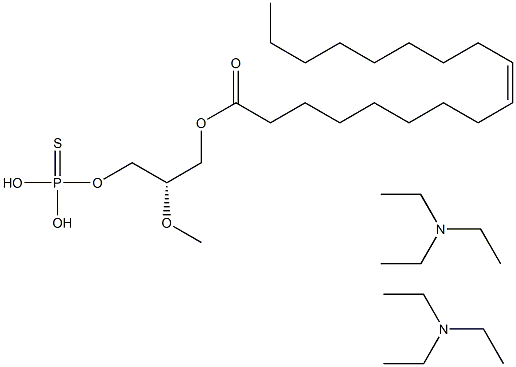 |
| | (2S)-OMPT Chemical Properties |
| solubility | DMF: 30 mg/ml; DMSO: 30 mg/ml; Ethanol: 30 mg/ml; PBS (pH 7.2): 10 mg/ml | | form | Liquid | | color | Colorless to light yellow |
| | (2S)-OMPT Usage And Synthesis |
| Description | Lysophosphatidic acid (LPA) is a potent lipid mediator that elicits its effect through four distinct receptors - LPA1/EDG-2, LPA2/EDG-4, LPA3/EDG-7 and LPA4/GPR23.1,2 OMPT is a selective agonist of the lysophosphatidic acid 3 (LPA3) receptor. It exhibits EC50 values of 68 nM and >6.8 μM for calcium mobilization in LPA1 and LPA2-expressing Sf9 cells, respectively.3 The (2S)-OMPT enantiomer is 5- to 20-fold more active than (2R)-OMPT in calcium release assays in both LPA3-transfected Sf9 and rat hepatoma Rh7777 cells.4 | | Uses | (2S)-OMPT (triethylamine), in ethanol:chloroform (1:1), 98%, is commonly used as a ligand in asymmetric catalysis, especially in the enantioselective synthesis of bioactive molecules such as amino acids and drugs. (2S)-OMPT triethylamine has unique chemical properties that allow it to selectively bind certain metal complexes and activate them in a way that favors the formation of specific enantiomers. | | References | 1. Chun, J., Goetzl, E.J., Hla, T., et al. International union of pharmacology. XXXIV. Lysophospholipid receptor nomenclature Pharmacol. Rev. 54,265-269(2002).
2. Niu, S.L., Mitchell, D.C., and Litman, B.J. Trans fatty acid derived phospholipids show increased membrane cholesterol and reduced receptor activation as compared to their cis analogs Biochemistry 44,4458-4465(2005).
3. Hasegawa, Y., Erickson, J.R., Goddard, G.J., et al. Identification of a phosphothionate analogue of lysophosphatidic acid (LPA) as a selective agonist of the LPA3 receptor J. Biol. Chem. 278(14),11962-11969(2003).
4. Qian, L., Xu, Y., Hasegawa, Y., et al. Enantioselective responses to a phosphorothioate analogue of lysophosphatidic acid with LPA3 receptor-selective agonist activity J. Med. Chem. 46,5575-5578(2003). |
| | (2S)-OMPT Preparation Products And Raw materials |
|