|
|
| | HAMI 3379 Basic information |
| Product Name: | HAMI 3379 | | Synonyms: | 3-(((1S,3S)-3-Carboxycyclohexyl)carbamoyl)-4-(3-(4-(4-(cyclohexyloxy)butoxy)phenyl)propoxy)benzoic acid | | CAS: | 1245653-57-9 | | MF: | C34H45NO8 | | MW: | 595.73 | | EINECS: | | | Product Categories: | | | Mol File: | 1245653-57-9.mol | 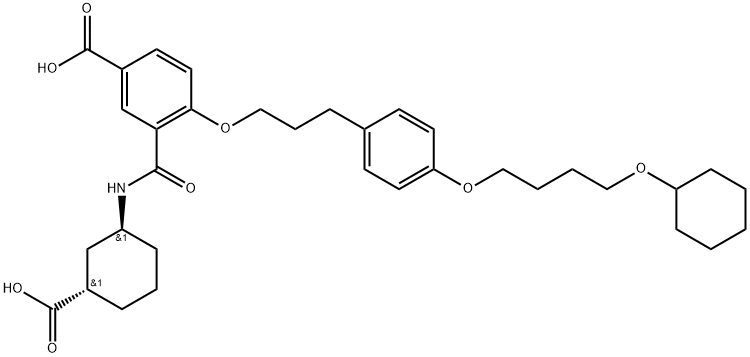 |
| | HAMI 3379 Chemical Properties |
| solubility | DMF: 20 mg/ml; DMF:PBS(pH 7.2)(1:1): 0.5 mg/ml; DMSO: 20 mg/ml; Ethanol: 5 mg/ml | | form | A crystalline solid | | color | White to off-white |
| | HAMI 3379 Usage And Synthesis |
| Description | HAMI3379 is a cysteinyl leukotriene 2 (CysLT2) receptor antagonist (IC50 = 37.9 nM in a radioligand binding assay).1 It is selective for CysLT2 over CysLT1 (IC50 = >30 μM in a radioligand binding assay). HAMI3379 inhibits calcium mobilization induced by leukotriene D4 (LTD4; ) or leukotriene C4 (LTC4; ) in CHO cells expressing human CysLT2 (IC50s = 3.8 and 4.4 nM, respectively). It reverses the LTC4-induced increases in perfusion pressure and decreases in contractility in isolated Langendorff-perfused guinea pig hearts in a concentration-dependent manner. HAMI3379 (0.1 mg/kg) prevents decreases in body weight and neurological deficit scores in a rat model of S. pneumoniae-induced meningitis, as well as reduces infarct volume in a rat model of cerebral ischemia brain injury induced by middle cerebral artery occlusion (MCAO).2,3 It also prevents increases in airway hyperresponsiveness in a mouse model of ovalbumin-induced asthma when administered at a dose of 10 mg/kg.4 | | Uses | HAMI 3379 is a potent and selective CysLT2 receptor antagonist. HAMI 3379 has a protective effect on acute and subacute ischemic brain injury, and attenuates microglia-related inflammation[1][2]. | | in vivo | HAMI 3379 (0.025-0.4 mg/kg; ip) with 0.1-0.4 mg/kg significantly reduces the infarct volume and percentage increase in the ischemic/contralateral hemispheric ratio[2].
HAMI3379 (0.1 mg/kg; ip) administered at 0 and 1 h after reperfusion reduces infarct volume, attenuated brain edema, reduced neurological score, and increased holdingangle[2].
| Animal Model: | Male Sprague-Dawley rats (250-300 g) after MCAO[2] | | Dosage: | 0.025, 0.05, 0.1, 0.2, 0.4 mg/kg | | Administration: | IP | | Result: | Significantly reduced the infarct volume and percentage increase inthe ischemic/contralateral hemispheric ratio (an index ofbrain edema) with 0.1-0.4 mg/kg.
Significantly reduced the neurological deficit score.
|
| | IC 50 | CysLT2 | | References | 1. Wunder, F., Tinel, H., Kast, R., et al. Pharmacological characterization of the first potent and selective antagonist at the cysteinyl leukotriene 2 (CysLT2) receptor Br. J. Pharmacol. 160(2),399-409(2010).
2. Yu, S., Chen, X., Li, X., et al. Neuroprotective effects of CysLTR antagonist on Streptococcus pneumoniaeinduced meningitis in rats Exp. Ther. Med. 24(1),443(2022).
3. Shi, Q.J., Wang, H., Liu, Z.X., et al. HAMI 3379, a CysLT2R antagonist, dose- and time-dependently attenuates brain injury and inhibits microglial inflammation after focal cerebral ischemia in rats Neuroscience 291,53-69(2015).
4. Trinh, H.K.T., Suh, D.-H., Nguyen, T.V.T., et al. Characterization of cysteinyl leukotriene-related receptors and their interactions in a mouse model of asthma Prostaglandins Leukot. Essent. Fatty Acids 141,17-23(2019). |
| | HAMI 3379 Preparation Products And Raw materials |
|