AMI-193 manufacturers
- AMI-193
-

- $38.00
-
2026-07-15
- CAS:510-74-7
- Purity: 99.65%
- Supply Ability: 10g
|
| | AMI-193 Basic information |
| Product Name: | AMI-193 | | Synonyms: | 8-[3-(4-FLUOROPHENOXY)PROPYL]-1-PHENYL-1,3,8-TRIAZASPIRO[4.5]DECAN-4-ONE;8-[3-(4-FLUOROPHENOXY)PROPYL]-1-PHENYL-1,3,8-TRIAZASPIRO[4.5]-DECANONE;AMI-193;1-Phenyl-8-[3-(4-fluorophenoxy)propyl]-1,3,8-triazaspiro[4.5]decane-4-one;Fluroxyspiramine;R 5808;1,3,8-Triazaspiro[4.5]decan-4-one, 8-[3-(4-fluorophenoxy)propyl]-1-phenyl-;AMI-193, 10 mM in DMSO | | CAS: | 510-74-7 | | MF: | C22H26FN3O2 | | MW: | 383.46 | | EINECS: | | | Product Categories: | Serotonin receptor | | Mol File: | 510-74-7.mol | 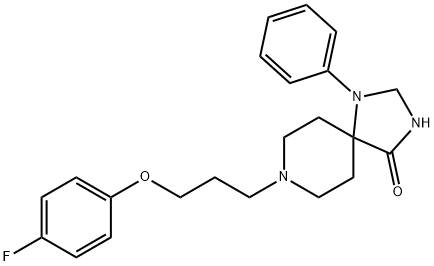 |
| | AMI-193 Chemical Properties |
| Melting point | 176 - 179°C | | storage temp. | Store at RT | | solubility | DMSO (Slightly), Methanol (Slightly) | | form | White solid. | | color | Off-White to Pale Yellow |
| | AMI-193 Usage And Synthesis |
| Uses | AMI-193 is a selective 5-HT2A and D2DR receptor antagonist. Endoplasmic reticulum (ER) stress inducer; Also, it is derived from 4-Fluorophenol (F595325), which is a fluorinated phenolic compound with various applications as an starting reagent for the synthesis of pharmaceutical goods. | | Definition | ChEBI: An azaspiro compound that consists of 1,3,8-triazaspiro[4.5]decan-4-one having a phenyl group attached to N-1 and a 3-(4-fluorophenoxy)propyl attached to N-8. Selective 5-HT antagonist, which binds to 5-HT2 sites as potently as spipero
e but has lower affinity for 5-HT2C receptors. Also a high affinity D2 receptor antagonist (Ki = 3 nM). Lacks the disruptive effect of spiperone on animal behaviour. | | Biological Activity | Selective 5-HT antagonist, which binds to 5-HT 2 sites as potently as spiperone but has lower affinity for 5-HT 2C receptors. Also a high affinity D 2 receptor antagonist (K i = 3 nM). Lacks the disruptive effect of spiperone on animal behavior. | | in vivo | AMI-193 (0.003-0.01 mg/kg; i.m.) dose-dependently decreases response rate in monkeys under a fixed-interval (FI) schedule of stimulus termination[2].
AMI-193 (0.003-0.01 mg/kg; i.m.) attenuates the discriminative-stimulus effects of cocaine in drug-discrimination experiments[2].
AMI-193 (0.003-0.01 mg/kg; i.m.) reduces response rate under a second-order schedule of i.v. self-administration of cocaine (0.1 mg/infusion)[2]. | Animal Model: | Adult male squirrel monkeys (850-1300 g)[2] | | Dosage: | 0.003, 0.01 mg/kg | | Administration: | I.m. on Tuesday, Wednesday, and Thursday the following week | | Result: | Decreased the response rate.
The rate-decreasing effects were reversed by cocaine.
|
| | IC 50 | 5-HT2 Receptor: 2 nM (Ki); D2 Receptor: 3 nM (Ki); 5-HT1A Receptor: 50 nM (Ki); D1 Receptor: 2530 nM (Ki); 5-HT1C Receptor: 4300 nM (Ki) | | references | [1]. czoty pw, howell ll. behavioral effects of ami-193, a 5-ht(2a)- and dopamine d(2)-receptor antagonist, in the squirrel monkey. pharmacol biochem behav, 2000, 67(2): 257-264.
[2]. ismaiel am, de los angeles j, teitler m, et al. antagonism of 1-(2,5-dimethoxy-4-methylphenyl)-2-aminopropane stimulus with a newly identified 5-ht2- versus 5-ht1c-selective antagonist. j med chem, 1993, 36(17): 2519-2525.
[3]. luparini mr, garrone b, pazzagli m, et al. a cortical gaba-5ht interaction in the mechanism of action of the antidepressant trazodone. prog neuropsychopharmacol biol psychiatry, 2004, 28(7): 1117-1127. |
| | AMI-193 Preparation Products And Raw materials |
|