|
|
| | endocrocin Basic information |
| Product Name: | endocrocin | | Synonyms: | endocrocin;1,6,8-Trihydroxy-3-methyl-9,10-dioxo-9,10-dihydroanthracene-2-carboxylic acid;9,10-Dihydro-1,6,8-trihydroxy-3-methyl-9,10-dioxo-2-anthracenecarboxylic acid;2-Anthracenecarboxylic acid, 9,10-dihydro-1,6,8-trihydroxy-3-methyl-9,10-dioxo- | | CAS: | 481-70-9 | | MF: | C16H10O7 | | MW: | 314.25 | | EINECS: | | | Product Categories: | | | Mol File: | 481-70-9.mol | 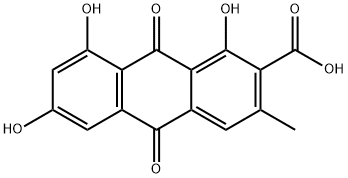 |
| | endocrocin Chemical Properties |
| Melting point | 318 °C (decomp)(Solv: acetic acid (64-19-7)) | | Boiling point | 679.7±55.0 °C(Predicted) | | density | 1.715±0.06 g/cm3(Predicted) | | pka | 1.63±0.20(Predicted) |
| | endocrocin Usage And Synthesis |
| Uses | Endocrocin, an anthraquinone, is a fungal secondary metabolite. Endocrocin is a potent chemotaxis inhibitor with immunosuppressive properties[1][2]. | | Definition | ChEBI: A trihydroxyanthraquinone that is 9,10-anthraquinone which is substituted by a carboxy group at position 2, a methyl group at position 3, and hydroxy groups at positions 1, 6, and 8. | | References | [1] Berthier E, et al. Low-volume toolbox for the discovery of immunosuppressive fungal secondary metabolites. PLoS Pathog. 2013;9(4):e1003289. DOI:10.1371/journal.ppat.1003289
[2] Lim FY, et al. Genome-based cluster deletion reveals an endocrocin biosynthetic pathway in Aspergillus fumigatus. Appl Environ Microbiol. 2012 Jun;78(12):4117-25. DOI:10.1128/AEM.07710-11 |
| | endocrocin Preparation Products And Raw materials |
|