- G15
-
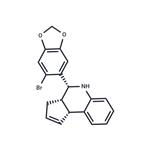
- $33.00
-
2026-08-20
- CAS:1161002-05-6
- Purity: 98.46%
- Supply Ability: 10g
|
| | (3aS*,4R*,9bR*)-4-(6-Bromo-1,3-benzodioxol-5-yl)-3a,4,5,9b-3H-cyclopenta[c]quinoline Basic information |
| Product Name: | (3aS*,4R*,9bR*)-4-(6-Bromo-1,3-benzodioxol-5-yl)-3a,4,5,9b-3H-cyclopenta[c]quinoline | | Synonyms: | (3aS,4R,9bR)-4-(6-BroMo-1,3-benzodioxol-5-yl)-3a,4,5,9b-tetrahydro-3H-cyclopenta[c]quinoline;H37;LUCA15;RMB5;RNA binding motif protein 5;1-AGPAT1;AGPAT1;Anti-AGPAT1 antibody produced in rabbit | | CAS: | 1161002-05-6 | | MF: | C19H16BrNO2 | | MW: | 370.24 | | EINECS: | | | Product Categories: | | | Mol File: | 1161002-05-6.mol | ![(3aS*,4R*,9bR*)-4-(6-Bromo-1,3-benzodioxol-5-yl)-3a,4,5,9b-3H-cyclopenta[c]quinoline Structure](CAS/20181012/GIF/1161002-05-6.gif) |
| | (3aS*,4R*,9bR*)-4-(6-Bromo-1,3-benzodioxol-5-yl)-3a,4,5,9b-3H-cyclopenta[c]quinoline Chemical Properties |
| Melting point | 178-180 °C | | Boiling point | 462.7±45.0 °C(Predicted) | | density | 1.472±0.06 g/cm3(Predicted) | | storage temp. | Store at -20°C | | solubility | insoluble in H2O; insoluble in EtOH; ≥37 mg/mL in DMSO | | form | solid | | pka | 3.98±0.40(Predicted) | | color | White to off-white | | biological source | rabbit |
| WGK Germany | WGK 1 | | Storage Class | 10 - Combustible liquids |
| | (3aS*,4R*,9bR*)-4-(6-Bromo-1,3-benzodioxol-5-yl)-3a,4,5,9b-3H-cyclopenta[c]quinoline Usage And Synthesis |
| Description | G protein-coupled estrogen receptor (GPER), or GPR30, specifically binds natural and man-made estrogens. It is thought to be involved in estrogen-sensitive cancers. GPER knockout mice are fertile, although they exhibit thymic atrophy, impaired glucose tolerance, and altered bone growth. G-15 is a cell-permeable non-steroidal antagonist of GPER (Ki = 20 nM). It displays low affinity cross-reactivity with the classical estrogen receptor (ER), ERα, so that at doses greater than 1 μM it is capable of mediating limited ER-dependent transcriptional activity. G-15 antagonizes the anti-depressive effects of estrogen in vivo. | | Uses | (3aS,4R,9bR)-4-(6-Bromo-1,3-benzodioxol-5-yl)-3a,4,5,9b-tetrahydro-3H-cyclopenta[c]quinoline is also known as “G-15”, a G-protein-coupled estrogen receptor antagonist designed for the treatment of estrogen-sensitive cancers. | | in vivo | G15 (1.46 mg/kg; i.h.; twice a week for 14 weeks) decreases the number of tumor nodules and tumor index increased by the E2 or G1 group in urethane-induced adenocarcinoma mice[1]. | Animal Model: | Four-week-old female Kunming mice (Urethane-induced adenocarcinoma)[1] | | Dosage: | 1.46 mg/kg (combination with E2, 0.09 mg/kg and fulvestrant (Ful), 2.4 mg/kg) | | Administration: | Subcutaneous injection; twice a week for 14 weeks | | Result: | The number of tumor nodules decreased in the E2+Ful+G15 group. |
| | storage | Store at -20°C | | references | [1] dennis mk, burai r, ramesh c, et al. in vivo effects of a gpr30 antagonist. nat chem biol, 2009, 5 (6): 421-427.
[2] g-protein-coupled estrogen receptor and the gper-antagonist g-15 inhibits proliferation in endometriotic cells. fertil steril, 2013, 100 (3): 770-776.
[3] hammond r, nelson d, kline e, et al. chronic treatment with a gpr30 antagonist impairs acquisition of a spatial learning task in young female rats. horm behav, 2012, 62 (4): 367-374. |
| | (3aS*,4R*,9bR*)-4-(6-Bromo-1,3-benzodioxol-5-yl)-3a,4,5,9b-3H-cyclopenta[c]quinoline Preparation Products And Raw materials |
|