- Cucurbitacin E
-

- $54.00
-
2026-07-27
- CAS:18444-66-1
- Purity: 99.87%
- Supply Ability: 10g
- Cucurbitacin E
-
-
2023-02-24
- CAS:18444-66-1
- Min. Order: 20mg
- Purity: ≥98%(HPLC)
- Supply Ability: 10 g
|
| | Cucurbitacin E Basic information |
| | Cucurbitacin E Chemical Properties |
| Melting point | 228-234°C | | Boiling point | 545.56°C (rough estimate) | | alpha | D -59° (c = 0.7 in chloroform) | | density | 1.1059 (rough estimate) | | refractive index | 1.4900 (estimate) | | storage temp. | -20°C | | solubility | DMSO: soluble15mg/mL, clear | | form | powder | | pka | 8.51±0.70(Predicted) | | color | white to beige | | Optical Rotation | [α]/D -60 to -75°, c = 0.7 (CDCl3) | | InChIKey | NDYMQXYDSVBNLL-MUYMLXPFSA-N | | SMILES | [C@@]12(C)C[C@@H](O)[C@]([H])([C@](O)(C)C(=O)/C=C/C(C)(C)OC(=O)C)[C@@]1(C)CC(=O)[C@@]1(C)[C@]3([H])C=C(C(=O)C(C)(C)C3=CC[C@@]21[H])O |&1:0,3,5,7,21,26,28,40,r| | | LogP | 3.150 (est) |
| Hazard Codes | Xn | | Risk Statements | 25-22 | | Safety Statements | 1-22-45-24/25 | | RIDADR | 3172 | | WGK Germany | 3 | | RTECS | RC6305500 | | HS Code | 29153900 | | Storage Class | 11 - Combustible Solids | | Hazard Classifications | Acute Tox. 4 Oral | | Toxicity | LD50 orally in mice: 340 mg/kg (Albert) |
| | Cucurbitacin E Usage And Synthesis |
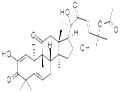
| Description | Cucurbitacin E is a plant-derived triterpene that has diverse biological activities. At a concentration of 10 pM, it reduces MPP+-induced death of neuronal PC12 cells through inhibition of autophagy in vitro. Cucurbitacin E inhibits growth of T24 bladder, MDA-MB-468 and MCF-7 breast, PC3 prostate, and colorectal cancer cell lines (IC50s = 50-1,000 nM) through induction of G2/M arrest and apoptosis. It increases bilirubin binding to human serum albumin (HSA) in human plasma in a dose-dependent manner. Cucurbitacin E also inhibits depolymerization of actin filaments isolated from rabbit skeletal muscle actin and in HeLa cells. | | Chemical Properties | white to beige powder | | Uses | Cucurbitacin E is a biochemical compound from the family of Cucurbitacins. Cucurbitacin E is a highly oxidated steroid consisting of a tetracyclic triterpene. Cucurbitacin E is known to possess broad
spectrum of potential anti-inflammatory, antitumor andantioxidant effects. | | Uses | Cucurbitacin E has been used as a cofilin inhibitor. It is also used as a F-actin stabilizer to prevent membrane-associated periodic skeleton (MPS) loss and protect from axonal fragmentation. | | Definition | ChEBI: A cucurbitacin in which a lanostane skeleton is multi-substituted with hydroxy, methyl and oxo substituents, with unsaturation at positions 1, 5 and 23. | | General Description | This substance is a primary reference substance with assigned absolute purity (considering chromatographic purity, water, residual solvents, inorganic impurities). The exact value can be found on the certificate. Produced by PhytoLab GmbH & Co. KG. | | Biochem/physiol Actions | Cucurbitacin E is a potent inhibitor of actin depolymerization. Cucurbitacin E is more active than jasplakinolide, and has a different mechanism of action, binding to a different site. Cucurbitacin E binds specifically to filamentous actin (F-actin) forming a covalent bond at residue Cys257, but not to monomeric actin (G-actin), stabilizing F-actin, without affecting actin polymerization or nucleation. | | References | [1] ANNE-MARIE AREL-DUBEAU. Cucurbitacin E has neuroprotective properties and autophagic modulating activities on dopaminergic neurons.[J]. Oxidative Medicine and Cellular Longevity, 2014, 2014: 425496. DOI: 10.1155/2014/425496
[2] Y-C HSU M J C T Y Huang. Therapeutic ROS targeting of GADD45γ in the induction of G2/M arrest in primary human colorectal cancer cell lines by cucurbitacin E[J]. Cell Death & Disease, 2014, 5 4: e1198-e1198. DOI: 10.1038/cddis.2014.151
[3] YANJIE KONG. Cucurbitacin E induces cell cycle G2/M phase arrest and apoptosis in triple negative breast cancer.[J]. PLoS ONE, 2014: e103760. DOI: 10.1371/journal.pone.0103760
[4] WEN-WEN HUANG. Cucurbitacin E Induces G(2)/M Phase Arrest through STAT3/p53/p21 Signaling and Provokes Apoptosis via Fas/CD95 and Mitochondria-Dependent Pathways in Human Bladder Cancer T24 Cells.[J]. Evidence-based Complementary and Alternative Medicine, 2012: 952762. DOI: 10.1155/2012/952762
[5] H. GREIGE-GERGES . Effect of cucurbitacins on bilirubin–albumin binding in human plasma[J]. Life sciences, 2007, 80 6: Pages 579-585. DOI: 10.1016/j.lfs.2006.10.005
[6] PIA M. SRENSEN. The Natural Product Cucurbitacin E Inhibits Depolymerization of Actin Filaments[J]. ACS Chemical Biology, 2012, 7 9: 1502-1508. DOI: 10.1021/cb300254s |
| | Cucurbitacin E Preparation Products And Raw materials |
|