|
|
| | 3,7-DIMETHOXY-3',4',5-TRIHYDROXYFLAVONE Basic information |
| Product Name: | 3,7-DIMETHOXY-3',4',5-TRIHYDROXYFLAVONE | | Synonyms: | rhamnacene;7,3'-DiMethylquercetin;NSC 678106;Quercetin 7,3'-DiMethyl Ether;RHAMNAZIN(SH);3,7-DIMETHOXY-3',4',5-TRIHYDROXYFLAVONE;QUERCETIN-3,7-DIMETHYL ETHER;3,5-Dihydroxy-2-(4-hydroxy-3-methoxyphenyl)-7-methoxy-4H-1-benzopyran-4-one | | CAS: | 552-54-5 | | MF: | C17H14O7 | | MW: | 330.29 | | EINECS: | | | Product Categories: | Aromatics;Heterocycles;Intermediates & Fine Chemicals;Metabolites & Impurities;Pharmaceuticals | | Mol File: | 552-54-5.mol | 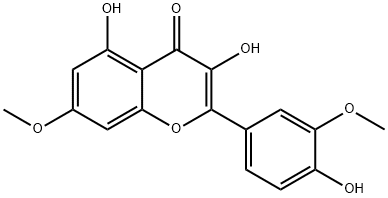 |
| | 3,7-DIMETHOXY-3',4',5-TRIHYDROXYFLAVONE Chemical Properties |
| Melting point | 214-215 °C | | Boiling point | 591.6±50.0 °C(Predicted) | | density | 1.507±0.06 g/cm3(Predicted) | | pka | 6.14±0.40(Predicted) | | form | powder | | BRN | 338203 | | InChI | InChI=1S/C17H14O7/c1-22-9-6-11(19)14-13(7-9)24-17(16(21)15(14)20)8-3-4-10(18)12(5-8)23-2/h3-7,18-19,21H,1-2H3 | | InChIKey | MYMGKIQXYXSRIJ-UHFFFAOYSA-N | | SMILES | C1(C2=CC=C(O)C(OC)=C2)OC2=CC(OC)=CC(O)=C2C(=O)C=1O |
| WGK Germany | 3 | | Storage Class | 11 - Combustible Solids |
| | 3,7-DIMETHOXY-3',4',5-TRIHYDROXYFLAVONE Usage And Synthesis |
| Uses | Di-O-methylated flavanol; a polyphenolic metabolite of Rhamnus disperma. | | Definition | ChEBI: A dimethoxyflavone that is quercetin in which the hydroxy groups at the 3' and 7 positions have been replaced by methoxy groups. | | in vivo | Rhamnazin (200 mg/kg; i.g.; daily for 25 days) inhibits breast cancer growth and angiogenesis in mice[1].
Rhamnazin (5-20 mg/kg; i.p.; once) shows strong antioxidant and anti-inflammatory properties in the rat acute lung injury model[2]. | Animal Model: | BALB/c nude mice, breast cancer xenograft model[1] | | Dosage: | 200 mg/kg | | Administration: | Intragastric administration, daily for 25 days | | Result: | Dramatically suppressed tumor volumes by 47% compared with the vehicle group. Showed a significant reduction of pVEGFR2Tyr951-positive cells in tumors. Resulted in downregulation of VEGFR2 downstream molecules phosphorylation including MAPK, AKT and STAT3. |
| | IC 50 | VEGFR2: 4.68 μM (IC50) |
| | 3,7-DIMETHOXY-3',4',5-TRIHYDROXYFLAVONE Preparation Products And Raw materials |
|