|
|
| | TCO-PEG3-acid Basic information |
| Product Name: | TCO-PEG3-acid | | Synonyms: | TCO-PEG3-acid;TCO4-PEG3-COOH;5,8,11-Trioxa-2-azatetradecanedioic acid, 1-(4-cycloocten-1-yl) ester;1-(Cyclooct-4-en-1-yloxy)-1-oxo-5,8,11-trioxa-2-azatetradecan-14-oic acid;(4E)-TCO-PEG3-acid | | CAS: | 2141981-86-2 | | MF: | C18H31NO7 | | MW: | 373.44 | | EINECS: | | | Product Categories: | SiChem | | Mol File: | 2141981-86-2.mol | 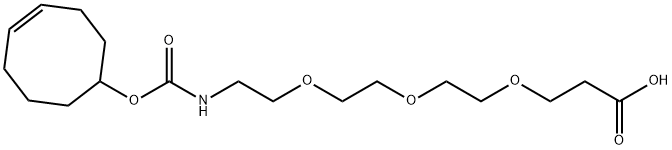 |
| | TCO-PEG3-acid Chemical Properties |
| Boiling point | 544.9±50.0 °C(Predicted) | | density | 1.15±0.1 g/cm3(Predicted) | | solubility | Soluble in DMSO, DCM, DMF | | pka | 4.28±0.10(Predicted) | | form | Oil | | color | Colorless to light yellow |
| | TCO-PEG3-acid Usage And Synthesis |
| Description | TCO-PEG3-acid is a click chemistry PEG linker with a terminal carboxylic acid(CO2H) group. The terminal carboxylic acid is reactive with primary amine groups in the presence of activators (e.g. EDC, or HATU) to form a stable amide bond. This reagent can react with tetrazine-containing compounds to form a stable covalent bond. The inverse-electron demand Diels-Alder cycloaddition reaction of TCO with tetrazines is the fastest bioorthogonal reaction with exceptional selectivity. | | Uses | TCO-PEG3-acid is a PEG-based PROTAC linker can be used in the synthesis of PROTACs[1]. TCO-PEG3-acid is a click chemistry reagent, it contains a TCO group that can undergo an inverse electron demand Diels-Alder reaction (iEDDA) with molecules containing Tetrazine groups. | | IC 50 | PEGs | | References | [1] Wang Y, et al. Degradation of proteins by PROTACs and other strategies. Acta Pharm Sin B. 2020 Feb;10(2):207-238. DOI:10.1016/j.apsb.2019.08.001 |
| | TCO-PEG3-acid Preparation Products And Raw materials |
|