- Chelerythrine
-
-
2023-02-24
- CAS:34316-15-9
- Min. Order: 5mg
- Purity: ≥98%(HPLC)
- Supply Ability: 10 g
- chelerythrine
-

- $15.00
-
2021-07-02
- CAS:34316-15-9
- Min. Order: 1KG
- Purity: 99%+ HPLC
|
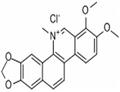
| Product Name: | Chelerythrine | | Synonyms: | 1,2-Dimethoxy-N-methyl-[1,3]benzodioxolo[5,6-c]phenanthridinium chloride;CHELERYTHRINE(TODDALINE)(RG);1,2-dimethoxy-12-methyl[1,3]benzodioxolo[5,6-c]phenanthridinium;chelerythrine/toddaline;1,2-Dimethoxy-12-methyl[1,3]benzodioxolo[5,6-c]phenanthridin-12-ium;2,3-(Epoxymethanoxy)-5-methyl-7,8-dimethoxybenzo[c]phenanthridine-5-ium;Einecs 251-930-0;helerythrine | | CAS: | 34316-15-9 | | MF: | C21H18NO4+ | | MW: | 348.37192 | | EINECS: | 251-930-0 | | Product Categories: | chemical reagent;pharmaceutical intermediate;phytochemical;reference standards from Chinese medicinal herbs (TCM).;standardized herbal extract;Natural Plant Extract | | Mol File: | 34316-15-9.mol |  |
| | Chelerythrine Chemical Properties |
| Melting point | 195-205°C | | Boiling point | 496.37°C (rough estimate) | | density | 1.2985 (rough estimate) | | refractive index | 1.5614 (estimate) | | storage temp. | Desiccate at -20°C | | solubility | Chloroform (Slightly, Sonicated), DMSO (Slightly, Sonicated), Methanol (Slightly) | | form | Solid | | color | Light Yellow to Dark Orange | | Stability: | Hygroscopic | | InChI | InChI=1S/C21H18NO4/c1-22-10-16-13(6-7-17(23-2)21(16)24-3)14-5-4-12-8-18-19(26-11-25-18)9-15(12)20(14)22/h4-10H,11H2,1-3H3/q+1 | | InChIKey | LLEJIEBFSOEYIV-UHFFFAOYSA-N | | SMILES | C[N+]1=CC2=C(C(OC)=CC=C2C2C=CC3C=C4OCOC4=CC=3C1=2)OC | | LogP | -0.401 (est) | | CAS DataBase Reference | 34316-15-9(CAS DataBase Reference) |
| | Chelerythrine Usage And Synthesis |
| Description | Chelerythrine chloride is the chloride form of Chelerythrine chloride which is a benzophenanthridine alkaloid isolated from the plant Chelidonium majus (greater celandine). It is a kind of potent, selective, and cell-permeable protein kinase C inhibitor, an efficient antagonist of G-protein-coupled CB1 receptors, and an independent activator of MAPK pathways. It has a wide range of biological activities including antiplatelet, anti-inflammatory, antibacterial and antitumor effects. It has reported of that it is capable of inducing apoptosis in HL-60 human promyelocytic leukemia cells and several other cancer cell lines. The underlying mechanism is through its effects of inhibiting the binding of BclXL to Bax or Bad.
| | References | https://en.wikipedia.org/wiki/Chelerythrine
https://www.scbt.com/scbt/product/chelerythrine-chloride-3895-92-9
https://www.tocris.com/dispprod.php?ItemId=2342#.WQmZVVNsgZQ
| | Chemical Properties | Soluble in methanol and ethanol, with some solubility in water, insoluble in petroleum ether, chloroform and other solvents. Derived from the roots and leaves of Flying Dragon's Palm Blood [Toddalia asiatica (L.) Lam. | | Uses | Chelerythrine Chloride is a cell permeable protein kinase C (PKC) inhibitor. | | Definition | ChEBI: A benzophenanthridine alkaloid isolated from the root of Zanthoxylum simulans, Chelidonium majus L., and other Papaveraceae. | | Biological Activity | Potent, cell-permeable inhibitor of protein kinase C (IC 50 = 660 nM); competitive with respect to the phosphate acceptor and non-competitive with respect to ATP. Has a wide range of biological activities, including antiplatelet, anti-inflammatory, antibacterial and antitumor effects. Activates MAPK pathways, independent of PKC inhibition. Inhibits binding of BclXL to Bak (IC 50 = 1.5 μ M) or Bad proteins and stimulates apoptosis. | | in vivo | Chelerythrine (5 mg/kg, i.p., daily) attenuates partial unilateral ureteral obstruction (UUO) induced kidney injury, and restores renal function in neonatal rats[2].
Chelerythrine (1-10 mg/kg, i.p., at 24 and 1 h before injection of 100 μg/kg LPS) shows anti-inflammatory effects (increased survival rate, decreased serum nitrite and TNF-α level) in LPS induced mice endotoxic shock model[5].
| Animal Model: | Unilateral ureteral obstruction (UUO) induced neonatal rats[2] | | Dosage: | 5 mg/kg | | Administration: | i.p., daily | | Result: | Attenuated kidney injury (Increased kidney weight and restored renal function).
Inhibited UUO-induced upregulated kidney injury molecule-1 expression, apoptosis, and renal fibrosis.
|
| | IC 50 | PKC: 0.7 μM (IC50) | | Purification Methods | Chelerythrine crystallises from CHCl3 on addition of MeOH [Manske Can J Res 21B 140 1943, UV: Hruban et al. Coll Czech Chem Commun 35 3420 1970]. The pseudo base is colourless while the salts are yellow in aqueous solution and are fluorescent. |
| | Chelerythrine Preparation Products And Raw materials |
|