| Company Name: |
LGM Pharma |
| Tel: |
1-(800)-881-8210 |
| Email: |
inquiries@lgmpharma.com |
- Rabeprazole
-
-
2026-09-11
- CAS:117976-89-3
- Min. Order: 1KG
- Purity: 98%min
- Supply Ability: 500kg
- Rabeprazole
-

-
2026-08-17
- CAS:117976-89-3
- Min. Order: 1G/Bag
- Purity: 99% up, High Density
- Supply Ability: 20 tons
- Rabeprazole
-

- $73.00
-
2026-07-15
- CAS:117976-89-3
- Purity: 99.14%
- Supply Ability: 10g
|
| | Rabeprazole Basic information |
| Product Name: | Rabeprazole | | Synonyms: | 2-[[4-(3-methoxypropoxy)-3-methyl-pyridin-2-yl]methylsulfinyl]-1h-benzoimidazole;2-[[(3-METHYL-4-(3-METHOXYPROPOXY)-2-PYRIDINYL)METHYL]SULPHINYL]-1H-BENZIMIDAZOLE;2-(CHOLROMETHYL)-4-(3-METHOXYPROPOXY)-3-METHYLPYRIDINE;ly-307640;1H-Benzimidazole,2-[[[4-(3-methoxypropoxy)-3-methyl-2-pyridinyl]methyl]sulfinyl]-;1H-1,3-benzimidazol-2-yl [4-(3-methoxypropoxy)-3-methyl-2-pyridinyl]methyl sulfoxide-sodium salt;2-[[[3-Methyl-4-(3-methoxypropoxy)-2-pyridyl]methyl]sulfinyl]-1H-benzimidazole;2-[[[4-(3-Methoxypropoxy)-3-methylpyridin-2-yl]methyl]sulfinyl]-1H-benzimidazole | | CAS: | 117976-89-3 | | MF: | C18H21N3O3S | | MW: | 359.44 | | EINECS: | 601-501-2 | | Product Categories: | Rabeprazole;API's;Active Pharmaceutical Ingredients;APIs | | Mol File: | 117976-89-3.mol | 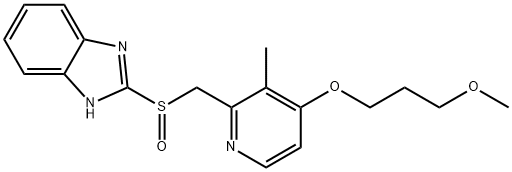 |
| | Rabeprazole Chemical Properties |
| Melting point | 99-100° (dec) | | Boiling point | 603.9±65.0 °C(Predicted) | | density | 1.33±0.1 g/cm3(Predicted) | | storage temp. | Inert atmosphere,Store in freezer, under -20°C | | solubility | DMSO (Slightly), Methanol (Slightly) | | pka | 9.57±0.10(Predicted) | | form | Solid | | color | Light Brown to Very Dark Brown | | Henry's Law Constant | 8.2×10¹¹ mol/(m3Pa) at 25℃, HSDB (2015) | | BCS Class | 1,3 | | Stability: | Hygroscopic | | InChI | InChI=1S/C18H21N3O3S/c1-13-16(19-9-8-17(13)24-11-5-10-23-2)12-25(22)18-20-14-6-3-4-7-15(14)21-18/h3-4,6-9H,5,10-12H2,1-2H3,(H,20,21) | | InChIKey | YREYEVIYCVEVJK-UHFFFAOYSA-N | | SMILES | C1(S(CC2=NC=CC(OCCCOC)=C2C)=O)NC2=CC=CC=C2N=1 | | CAS DataBase Reference | 117976-89-3(CAS DataBase Reference) |
| | Rabeprazole Usage And Synthesis |
| Description | Rabeprazole, a proton pump inhibitor (PPI), effectively lowers stomach acid production to alleviate conditions such as gastroesophageal reflux disease (GERD), ulcers, and other issues caused by excessive acid production. It belongs to the benzimidazole derivative family, sharing a structural similarity with omeprazole, another PPI. Rabeprazole hampers the activity of the gastric proton pump responsible for acid production. By binding to the pump, it obstructs the release of hydrogen ions into the stomach, ultimately reducing acid production. Furthermore, rabeprazole exhibits various biochemical and physiological effects. A study conducted on rats revealed that rabeprazole effectively decreases the gastric proton pump′s activity, leading to a decrease in gastric acid secretion. | | Uses | Rabeprazole is used to treat hyperacidity. It is a proton pump inhibitor that helps heal gastrointestinal ulcers, treats gastroesophageal reflux disease, and also treats hypersecretory disorders. | | Definition | ChEBI: Rabeprazole is a member of benzimidazoles, a sulfoxide and a member of pyridines. It has a role as an EC 3.6.3.10 (H(+)/K(+)-exchanging ATPase) inhibitor and an anti-ulcer drug. It is a conjugate acid of a rabeprazole(1-). | | Brand name | Aciphex (Eisai Medical Research)
. | | Mechanism of action | Rabeprazole is a proton pump inhibitor (PPI) and as such covalently binds with and inactivates the gastric parietal cell proton pump (H+/K+-ATPase). This inhibits in turn gastric acid production and raises gastric pH[1].
| | Pharmacokinetics |
Rabeprazole is marketed as an enterically coated formulation due to the instability of all PPIs in an acid environment. After oral ingestion, it is relatively rapidly absorbed as the maximal plasma concentration reaches between 2.8 and 5.1 postdose. The pharmacokinetics of the molecule is linear in the range 10–80 mg with an overall bioavailability of 52%. Rabeprazole does not have a saturable first-pass metabolism, and it can be absorbed in high doses.
Neither antacids nor food influences the bioavailability of the molecule, even if food intake delayed the absorption of rabeprazole 20 mg of about 1.7 h and reduced the apparent elimination half-life due to a probable delayed gastric emptying. Preclinical studies have demonstrated that rabeprazole’s volume of distribution is 0.34 L/kg in various tissues, including the gastric mucosa, stomach, kidney, bladder, liver, intestine, and thyroid. In healthy volunteers, it was demonstrated to be bound to 94.8%–97.5% of plasma proteins.
| | Side effects | The more common side effects of rabeprazole can include: headache. pain in the abdomen (stomach area) sore throat.
The serious side effects of rabeprazole can include: has stomach cramps, bloated feeling, watery and severe diarrhea which may also be bloody sometimes, fever, nausea or vomiting, or unusual tiredness or weakness. This medicine may increase your risk of having fractures of the hip, wrist, and spine. | | Synthesis | The general procedure for the synthesis of 2-(((4-(3-methoxypropoxy)-3-methylpyridin-2-yl)methyl)sulfinyl)-1H-benzo[d]imidazole from 2-(((4-(3-methoxypropoxy)-3-methylpyridin-2-yl)methyl)sulfinyl)-1H-benzo[d]imidazole was as follows:
Example 6: 2.0 g of 2-[[[4-(3-methoxypropoxy)-3-methyl-2-pyridinyl]methyl]sulfinyl]-1H-benzo[d]imidazole was suspended in 36 mL of methanol at room temperature. Subsequently, 1.93 g of a 14 mL aqueous solution of 45% NaOH was added with stirring. 0.09 g of Na2WO4-2H2O oxidizing catalyst was dissolved in 0.66 g of 50% H2O2 aqueous solution and further diluted with 10 mL of water. The oxidizer/catalyst solution was slowly added dropwise to the reactant/base solution, and the dropwise process was completed in about 30 minutes while maintaining room temperature and continuous stirring. After the dropwise addition was completed, the reaction was continued with stirring for 10 minutes. Then, 10 mL of 10% Na2S2O3 aqueous solution was added and the reaction mixture was concentrated under reduced pressure to remove methanol. Finally, the pH was adjusted to about 8 by adding dilute aqueous acetic acid to form a precipitate. The precipitate was filtered, washed with water, and dried under vacuum to give rabeprazole in about 88% yield (LC purity >95%). | | Drug interactions |
A product that may interact with this drug is: methotrexate (especially high-dose treatment).
Some products need stomach acid so that the body can absorb them properly. Rabeprazole decreases stomach acid, so it may change how well these products work. Some affected products include ampicillin, atazanavir, erlotinib, levoketoconazole, nelfinavir, pazopanib, rilpivirine, sparsentan, certain azole antifungals (itraconazole, ketoconazole, posaconazole), among others.
| | Dosage | Rabeprazole is usually taken once a day. Follow all directions on the prescription label and read all dosing instructions or instruction sheets. Use the medication exactly as directed.Rabeprazole is only suitable for short-term use, usually 4 to 8 weeks. If you need additional treatment time, your doctor may recommend a second course of treatment. | | References | [1] Fabio Pace. “A review of rabeprazole in the treatment of acid-related diseases.” Therapeutics and Clinical Risk Management 3 3 (2007): 363–79.
|
| | Rabeprazole Preparation Products And Raw materials |
|