|
|
| | 2,3,5-Tri-O-benzyl-b-D-ribofuranose Basic information |
| Product Name: | 2,3,5-Tri-O-benzyl-b-D-ribofuranose | | Synonyms: | 2,3,5-Tri-O-benzyl-b-D-ribofuranose;2,3,5-Tri-O-benzyl-beta-D-ribofuranose;β-D-Ribofuranose, 2,3,5-tris-O-(phenylmethyl)-;(2R,3R,4R,5R)-3,4-bis(benzyloxy)-5-[(benzyloxy)methyl]oxolan-2-ol;2,3,5-tri-O-benzyl-β-D-ribofuranose;2,3,5-Tri-O-benzyl-beta-D-ribofuranose-89361-52-4;(2r,3r,4r,5r)-3,4-Bis(benzyloxy)-5-((benzyloxy)methyl)tetrahydrofuran-2-ol | | CAS: | 89361-52-4 | | MF: | C26H28O5 | | MW: | 420.51 | | EINECS: | | | Product Categories: | | | Mol File: | 89361-52-4.mol | 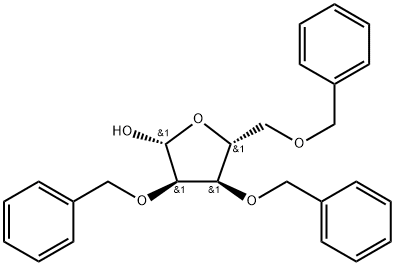 |
| | 2,3,5-Tri-O-benzyl-b-D-ribofuranose Chemical Properties |
| Boiling point | 570.5±50.0 °C(Predicted) | | density | 1.21±0.1 g/cm3(Predicted) | | solubility | Soluble in chloroform | | pka | 11.95±0.70(Predicted) | | form | Powder | | color | White |
| | 2,3,5-Tri-O-benzyl-b-D-ribofuranose Usage And Synthesis |
| Uses | 2,3,5-Tris-O-(phenylmethyl)-β-D-ribofuranose is a class of biochemical reagents used in glycobiology research. Glycobiology studies the structure, synthesis, biology, and evolution of sugars. It involves carbohydrate chemistry, enzymology of glycan formation and degradation, protein-glycan recognition, and the role of glycans in biological systems. This field is closely related to basic research, biomedicine, and biotechnology[1]. | | References | [1] Varki A, et al editors. Essentials of Glycobiology [Internet]. 4th ed. Cold Spring Harbor (NY): Cold Spring Harbor Laboratory Press; 2022. PMID:35536922 |
| | 2,3,5-Tri-O-benzyl-b-D-ribofuranose Preparation Products And Raw materials |
|