|
|
| | 4-hydroxy-3-phenyl-naphthalene-1,2-dione Basic information |
| Product Name: | 4-hydroxy-3-phenyl-naphthalene-1,2-dione | | Synonyms: | 4-hydroxy-3-phenyl-naphthalene-1,2-dione;2-hydroxy-3-phenylnaphthalene-1,4-dione;NSC 102533;2-Hydroxy-3-phenyl-1,4-naphthoquinone;low cytotoxicity,inhibit,Antimalarial agent-14,P. falciparum,Mitochondrial Metabolism,Inhibitor,Antimalarial agent 14,mitochondrial electron transport,NSC 102533,Antimalarial agent14;Antimalarial agent 14;1,4-Naphthalenedione, 2-hydroxy-3-phenyl-;4-hydroxy-3-phenyl-naphthalene-1,2-dione|||2-Hydroxy-3-phenyl-1,4-naphthoquinone | | CAS: | 1150-59-0 | | MF: | C16H10O3 | | MW: | 250.25 | | EINECS: | | | Product Categories: | | | Mol File: | 1150-59-0.mol | 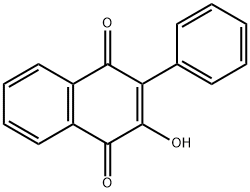 |
| | 4-hydroxy-3-phenyl-naphthalene-1,2-dione Chemical Properties |
| Melting point | 146 °C | | Boiling point | 440.5±45.0 °C(Predicted) | | density | 1.392±0.06 g/cm3(Predicted) | | solubility | DMSO: Sparingly Soluble: 1-10 mg/mL
Ethanol: Slightly Soluble: 0.1-1 mg/mL | | form | Solid | | pka | 4.26±0.10(Predicted) | | color | Yellow to brown |
| | 4-hydroxy-3-phenyl-naphthalene-1,2-dione Usage And Synthesis |
| Uses | Antimalarial agent 14 (Compound N3) is a potent inhibitor of mitochondrial electron transport. Antimalarial agent 14 can serve as an anti-malarial agent[1]. | | IC 50 | Plasmodium | | References | [1] Schuck DC, et al. Biological evaluation of hydroxynaphthoquinones as anti-malarials. Malar J. 2013 Jul 10;12:234. DOI:10.1186/1475-2875-12-234
[2] R X FARIA. 1,4-Naphthoquinones potently inhibiting P2X7 receptor activity.[J]. European Journal of Medicinal Chemistry, 2018, 143: 1361-1372. DOI: 10.1016/j.ejmech.2017.10.033
[3] MARCELO A STRAUCH. Lapachol and synthetic derivatives: in vitro and in vivo activities against Bothrops snake venoms.[J]. ACS Applied Bio Materials, 2019: e0211229. DOI: 10.1371/journal.pone.0211229 |
| | 4-hydroxy-3-phenyl-naphthalene-1,2-dione Preparation Products And Raw materials |
|