- Cytochalasin H
-

- $98.00
-
2026-07-27
- CAS:53760-19-3
- Purity: 98.72%
- Supply Ability: 10g
|
| | Cytochalasin H Basic information |
| Product Name: | Cytochalasin H | | Synonyms: | PASPALIN P1; KODOCYTOCHALASIN 1; CYTOCHALASIN O; NSC305222; 17-DEOXO-21-ACETYLZYGOSPORIN D;(11)cytochalasa-6(12),13,19-trien-1-one,21-(acetyloxy)-7,18-dihydroxy-16,18-di;(7s,13e,16s,18s,19e,21r)-methyl-10-phenyl;19-triene-1-one;21-acetoxy-7,18-dihydroxy-16,18-dimethyl-10-phenyl-(11)cytochalasa-6(12),13,;cytochalasinhfromphomopsissp.;kodocytochalasin-1;paspalinpi | | CAS: | 53760-19-3 | | MF: | C30H39NO5 | | MW: | 493.63 | | EINECS: | | | Product Categories: | Enzyme Inhibitors;Enzyme Inhibitors by Type;Other;Actin Inhibitors and ProbesCell Signaling and Neuroscience;Cell Signaling and Neuroscience;Cytoskeleton and Extracellular Matrix;Mold;Toxins and Venoms | | Mol File: | 53760-19-3.mol | 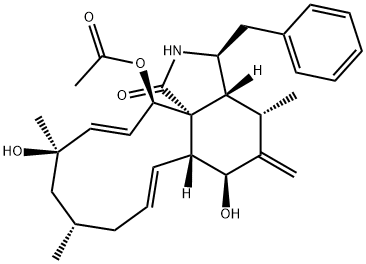 |
| | Cytochalasin H Chemical Properties |
| Melting point | 252-258 °C | | Boiling point | 587°C (rough estimate) | | density | 1.1369 (rough estimate) | | refractive index | 1.6310 (estimate) | | storage temp. | 2-8°C | | solubility | chloroform: 10 mg/mL, clear, colorless | | pka | 13.88±0.70(Predicted) | | form | A lyophilisate | | color | Long needles from CHCl3/Et2O | | BRN | 1632647 | | InChIKey | NAEWXXDGBKTIMN-QHDZSFFESA-N | | SMILES | [C@H]1(CC2=CC=CC=C2)[C@@]2([H])[C@@]3([C@H](OC(C)=O)C=C[C@@](O)(C)C[C@@H](C)CC=C[C@@]3([H])[C@H](O)C(=C)[C@H]2C)C(=O)N1 |t:17,26| | | LogP | 4.758 (est) |
| Hazard Codes | T+ | | Risk Statements | 26/27/28-63 | | Safety Statements | 28-36/37-45 | | RIDADR | UN 3462 6.1/PG 2 | | WGK Germany | 3 | | RTECS | HA5306000 | | F | 10 | | HazardClass | 6.1(a) | | PackingGroup | I | | Toxicity | cyt-hmn:lym 50 mg/L IJEBA6 16,430,78 |
| | Cytochalasin H Usage And Synthesis |
| Uses | Cytochalasin H is one of a family of potent mycotoxins produced by a range of fungi. All members of the class exhibit profound effects on cytoskeletal proteins, resulting in pronounced morphogenic changes in animals and plants. In vitro, cytochalasin H exhibits antibacterial, antifungal, nematocidal and antitumour activity. | | Safety Profile | Poison by intravenous and intraperitoneal routes. Human mutation data reported. When heated to decomposition it emits toxic fumes of NOx. | | in vivo | Cytochalasin H (2.5 mg/kg; i.p.) can delay the growth of A549 xenograft tumors in Balb/cnu/nu mice[2]. | Animal Model: | male Balb/cnu/nu mice with A549 xenograft[2] | | Dosage: | 2.5 mg/kg | | Administration: | intraperitoneal injection; 3 injections/week,for 80 days | | Result: | Attenuated tumor growth in vivo. |
| | storage | +4°C |
| | Cytochalasin H Preparation Products And Raw materials |
|