| Company Name: |
BOC Sciences |
| Tel: |
16314854226; +8616314854226 |
| Email: |
inquiry@bocsci.com |
|
| | 2,5-Pyrrolidinedione, 3-amino-, (3R)- Basic information |
| Product Name: | 2,5-Pyrrolidinedione, 3-amino-, (3R)- | | Synonyms: | 2,5-Pyrrolidinedione, 3-amino-, (3R)-;(R)-Aspartimide;(R)-3-Aminopyrrolidine-2,5-dione;3R-amino-2,5-pyrrolidinedione;(3R)-3-aminopyrrolidine-2,5-dione;Aspartimide, R- | | CAS: | 404887-22-5 | | MF: | C4H6N2O2 | | MW: | 114.1 | | EINECS: | | | Product Categories: | | | Mol File: | 404887-22-5.mol | 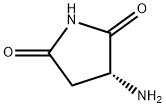 |
| | 2,5-Pyrrolidinedione, 3-amino-, (3R)- Chemical Properties |
| Boiling point | 337.0±35.0 °C(Predicted) | | density | 1.337±0.06 g/cm3(Predicted) | | pka | 8.93±0.50(Predicted) | | form | A solid |
| | 2,5-Pyrrolidinedione, 3-amino-, (3R)- Usage And Synthesis |
| Description | (R)-Aspartimide is a byproduct formed during solid-phase peptide synthesis (SPPS) of aspartic acid-containing peptides.1 Aspartimide is formed by cyclization of aspartic acid during Fmoc removal or peptide coupling.2 | | Uses | (R)-3-Aminopyrrolidine-2,5-dione is a potential anticonvulsant agent and its derivatives have comparable in vivo efficacy[1]. | | References | 1. Ruczyński, J., Lewandowska, B., Mucha, P., et al. Problem of aspartimide formation in Fmoc-based solid-phase peptide synthesis using Dmab group to protect side chain of aspartic acid J. Pept. Sci. 14(3),335-341(2008).
2. Neumann, K., Farnung, J., Baldauf, S., et al. Prevention of aspartimide formation during peptide synthesis using cyanosulfurylides as carboxylic acid-protecting groups Nat. Commun. 11(1),982(2020). |
| | 2,5-Pyrrolidinedione, 3-amino-, (3R)- Preparation Products And Raw materials |
|