Banoxantrone (dihydrochloride) manufacturers
|
| | Banoxantrone (dihydrochloride) Basic information |
| Product Name: | Banoxantrone (dihydrochloride) | | Synonyms: | Banoxantrone 2HCl;1,4-Bis[[2-(dimethyloxidoamino)ethyl]amino]-5,8-dihydroxy-9,10-anthracenedione dihydrochloride;AQ4N dihydrochloride;Banoxantrone dihydrochloride >=98% (HPLC);2,2'-((5,8-Dihydroxy-9,10-dioxo-9,10-dihydroanthracene-1,4-diyl)bis(azanediyl))bis(N,N-dimethylethanamine oxide) dihydrochloride , Banoxantrone 2HCl;2,2'-((5,8-Dihydroxy-9,10-dioxo-9,10-dihydroanthracene-1,4-diyl)bis(azanediyl))bis(N,N-dimethylethanamine oxide) dihydrochloride;Banoxantrone dihydrochloride (AQ4N), Topoisomerase II inhibitor;Banoxantrone dihydrochloride, 10 mM in DMSO | | CAS: | 252979-56-9 | | MF: | C22H29ClN4O6 | | MW: | 480.95 | | EINECS: | | | Product Categories: | | | Mol File: | 252979-56-9.mol | 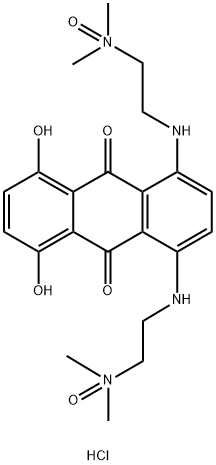 |
| | Banoxantrone (dihydrochloride) Chemical Properties |
| storage temp. | Store at -20°C, protect from light, stored under nitrogen | | solubility | Soluble to 50 mM in water and to 25 mM in DMSO | | form | Solid | | color | Blue to dark blue | | Water Solubility | Water : 25 mg/mL (48.32 mM) | | InChI | 1S/C22H28N4O6.2ClH/c1-25(2,31)11-9-23-13-5-6-14(24-10-12-26(3,4)32)18-17(13)21(29)19-15(27)7-8-16(28)20(19)22(18)30;;/h5-8,23-24,27-28H,9-12H2,1-4H3;2*1H | | InChIKey | SBWCPHUXRZRTDP-UHFFFAOYSA-N | | SMILES | O=C1C2=C(C(NCC[N+](C)([O-])C)=CC=C2NCC[N+]([O-])(C)C)C(C3=C(O)C=CC(O)=C31)=O.[H]Cl.[H]Cl |
| WGK Germany | WGK 3 | | Storage Class | 11 - Combustible Solids |
| | Banoxantrone (dihydrochloride) Usage And Synthesis |
| Uses | Banoxantrone (AQ4N) is a hypoxia-activated prodrug of topoisomerase II inhibitor AQ4 (Bioreductive AQ4 precursor). studies have shown that its has also exhibited anti-tumor efficacy in vivo when combined with oxic cell cytotoxins. | | Biological Activity | Banoxantrone (AQ4N) is a hypoxia-activated prodrug of topoisomerase II inhibitor AQ4 (Bioreductive AQ4 precursor).', 'Banoxantrone dihydrochloride enhances the anti-tumor effect caused by radiation. | | in vivo | Banoxantrone (200 mg/kg) significantly enhances the tumor growth delay caused by radiation. This occurred when radiation is administered both as a single dose (12 Gy) and in a multifraction regimen (5x3 Gy). A study of the scheduling of Banoxantrone (AQ4N) administration shows that there is a very long time period over which a maximal effect can be elicited (drug given 4 days before to 6 h after radiation). These results suggest that Banoxantrone has significant potential as a bioreductive drug[1]. The activation of banoxantrone cytotoxicity in vivo requires tumor hypoxia that is more extensive or prolonged than can readily be achieved by vasodilation or by antiangiogenic drug treatment[2]. Incorporation of banoxantrone into conventional chemoradiation protocols therefore targets both oxygenated and hypoxic regions of tumors, and potentially will increase the effectiveness of therapy. A single dose of 60 mg/kg banoxantrone enhances the response of RT112 (bladder) and Calu-6 (lung) xenografts to treatment with cisplatin and radiation therapy. Banoxantrone will increase the efficacy of chemoradiotherapy in preclinical models[3]. | | IC 50 | Topoisomerase II | | storage | Store at +4°C |
| | Banoxantrone (dihydrochloride) Preparation Products And Raw materials |
|