|
|
| | Acetyl-Amyloid β-Protein (1-6) Basic information |
| Product Name: | Acetyl-Amyloid β-Protein (1-6) | | Synonyms: | Acetyl-Amyloid β-Protein (1-6);Acetyl-Amyloid β-Protein (1-6) amide;L-Histidinamide, N-acetyl-L-α-aspartyl-L-alanyl-L-α-glutamyl-L-phenylalanyl-L-arginyl-;Acetyl-Amyloid β-Protein (1-6) amide trifluoroacetate salt;Ac-DAEFRH-NH2 | | CAS: | 903883-22-7 | | MF: | C35H50N12O11 | | MW: | 814.86 | | EINECS: | | | Product Categories: | | | Mol File: | 903883-22-7.mol | 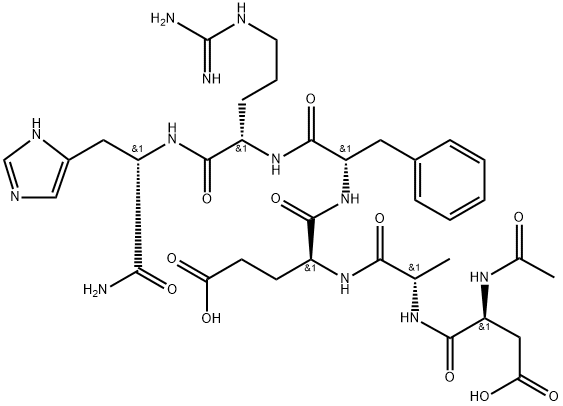 |
| | Acetyl-Amyloid β-Protein (1-6) Chemical Properties |
| density | 1.51±0.1 g/cm3(Predicted) | | pka | 4.22±0.10(Predicted) | | Sequence | Ac-Asp-Ala-Glu-Phe-Arg-His-NH2 |
| | Acetyl-Amyloid β-Protein (1-6) Usage And Synthesis |
| Uses | Acetyl-Amyloid β-Protein (1-6) amide is a hexapeptide that contains a potential copper(II) binding site. Acetyl-Amyloid β-Protein (1-6) amide can be used for research of Alzheimer's disease and related disorders[1]. | | References | [1] Damante CA, et al. The metal loading ability of beta-amyloid N-terminus: a combined potentiometric and spectroscopic study of copper(II) complexes with beta-amyloid(1-16), its short or mutated peptide fragments, and its polyethylene glycol (PEG)-ylated analogue. Inorg Chem. 2008 Oct 20;47(20):9669-83. DOI:10.1021/ic8006052 |
| | Acetyl-Amyloid β-Protein (1-6) Preparation Products And Raw materials |
|