| Company Name: |
Alfa Aesar |
| Tel: |
400-6106006 |
| Email: |
saleschina@alfa-asia.com |
| Company Name: |
Energy Chemical |
| Tel: |
400-0056266 |
| Email: |
sales8178@energy-chemical.com |
- Citiolone
-

- $50.00
-
2026-08-07
- CAS:1195-16-0
- Purity: 99.12%
- Supply Ability: 10g
- Citiolone
-

- $50.00
-
2026-08-07
- CAS:1195-16-0
- Purity: 99.12%
- Supply Ability: 10g
- Citiolone
-
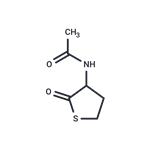
- $67.00
-
2025-04-28
- CAS:1195-16-0
- Purity: 99.78%
- Supply Ability: 10g
|
| | N-(Tetrahydro-2-oxo-3-thienyl)-acetamide Basic information | | Preparation |
| | N-(Tetrahydro-2-oxo-3-thienyl)-acetamide Chemical Properties |
| Melting point | 109-111 °C | | Boiling point | 427.3±34.0 °C(Predicted) | | density | 1.202 (estimate) | | refractive index | 1.5500 (estimate) | | storage temp. | Sealed in dry,Room Temperature | | solubility | DMSO : ≥ 50 mg/mL (314.05 mM) | | pka | 14.62±0.20(Predicted) | | form | solid | | color | White to Almost white | | Merck | 14,2320 | | InChI | 1S/C6H9NO2S/c1-4(8)7-5-2-3-10-6(5)9/h5H,2-3H2,1H3,(H,7,8) | | InChIKey | NRFJZTXWLKPZAV-UHFFFAOYSA-N | | SMILES | CC(=O)NC1CCSC1=O | | EPA Substance Registry System | Citiolone (1195-16-0) |
| Hazard Codes | T,Xi | | Risk Statements | 25-36/37/38 | | Safety Statements | 22-24/25-45-36-26 | | RIDADR | UN 2811 6.1/PG 3 | | WGK Germany | 3 | | RTECS | AC8680000 | | TSCA | TSCA listed | | HS Code | 2934.99.9001 | | Storage Class | 6.1C - Combustible acute toxic Cat.3
toxic compounds or compounds which causing chronic effects | | Hazard Classifications | Acute Tox. 3 Oral | | Toxicity | LD50 i.v. in mice: 1200 mg/kg (Kirnberger) |
| | N-(Tetrahydro-2-oxo-3-thienyl)-acetamide Usage And Synthesis |
| Preparation | Add hydrobromic acid to a three-necked flask, adding DL-methionine while stirring until the DL-methionine is completely dissolved in the hydrobromic acid. Then, add concentrated sulfuric acid dropwise. After the concentrated sulfuric acid is added, add a tail gas absorption device and react at 130 °C for 12 h. After the reaction is complete, cool to room temperature. Adjust the pH of the reaction solution to 6 with a 10% KOH aqueous solution. Filter, wash the filter cake 2-3 times with distilled water, and dry at 100 °C for 7-8 h to obtain crude DL-homocysteine. Dissolve DL-homocysteine in HCl solution, then add tin powder and react at 30 °C for 3 h. Then, pass H2S gas through to form SnS precipitate. The solution was filtered, and then concentrated under reduced pressure to obtain DL-homocysteine thiolactone hydrochloride. The DL-homocysteine thiolactone hydrochloride was washed twice with alcohol, filtered, and dried under vacuum to obtain crude DL-homocysteine thiolactone hydrochloride. The product was recrystallized in anhydrous ethanol to obtain pure DL-homocysteine thiolactone hydrochloride. DL-homocysteine thiolactone hydrochloride and acetic anhydride were reacted under reflux in 100 mL of acetic acid. The reaction progress was monitored by thin-layer chromatography. After the reaction was completed, the heating was stopped, the reaction solution was evaporated to dryness under reduced pressure, and the residue was recrystallized with water to give N-(Tetrahydro-2-oxo-3-thienyl)-acetamide. | | Chemical Properties | Acicular crystals.maximum
UV absorption 238 nm. | | Originator | Citiolase,Roussel Maestretti France,1970 | | Uses | hepatoprotectant, free radical scavenger | | Uses | Photographic antifogging agent: Dersch, US 3068100 (1962); Weber, DE 1164828 (1964 to Adox Fotowerke Schleussner GmbH), C.A. 60, 14050f (1964); protector against radiation: Langendorff, Koch, Strahlentherapie 106, 451 (1958); Braun et al., ibid. 108, 262 (1959), C.A. 52, 18841h (1958); 53, 17325e (1959). | | Definition | ChEBI: N-(2-oxo-3-thiolanyl)acetamide is a N-acyl-amino acid. | | Manufacturing Process | 12.73 kg of acetyl methionine are gradually introduced into a brine-cooled
pressure-tight apparatus provided with a stirrer and containing 140 liters of
liquid ammonia at -50°C. The amino acid is dissolved after a short time; 6.5
kg of sodium metal are then introduced over a period of from 4 to 5 hours at
a temperature of from -40°C to 60°C. Eventually, a persistent blue coloration
of the ammoniacal solution indicates the end of the reaction. The ammonia is
distilled off and the residue is taken up in 70 liters of methanol. In order to
remove ammonia which has been formed from sodium amide, 30 to 40 liters
of methanol are distilled off and the residue is made up with methanol to 80
liters. The strongly alkaline solution is neutralized with 22 liters of
concentrated aqueous hydrochloric acid. The solution is filtered off from the
precipitated sodium chloride and evaporated to dryness in vacuo. The closing
of the thiolactone ring takes place as a result of the evaporation of the
solution to dryness in the acid pH range and the N-acetyl homocystein
originally present is converted into N-acetyl homocystein thiolactone. In order
to isolate this compound, the residue is recrystallized from 25% aqueous
alcohol.
9 kg of N-acetyl homocystein thiolactone are obtained, this corresponding to a
yield of 85% of the theoretical. | | Therapeutic Function | Hepatoprotectant | | Purification Methods | Dry Citiolone in a vacuum desiccator. It recrystallises from toluene as needles. It is a ninhydrin -ve substance which gives a “slow” nitroprusside test. It has max at 238nm ( 4,400 M-1cm-1); and (nujol) 1789s and 851ms cm. [Benesch & Benesch J Am Chem Soc 78 1597max 1956, cf Laliberté J Chem Soc 2756 1963.] | | References | [1] Macromolecules, 2015, vol. 48, # 11, p. 3414 - 3421
[2] Science China Chemistry, 2015, vol. 58, # 11, p. 1734 - 1740
[3] Chemical Communications, 2013, vol. 49, # 54, p. 6057 - 6059 |
| | N-(Tetrahydro-2-oxo-3-thienyl)-acetamide Preparation Products And Raw materials |
|