| Company Name: |
Alfa Aesar |
| Tel: |
400-6106006 |
| Email: |
saleschina@alfa-asia.com |
- Fmoc-Phe(4-NO2)-OH
-

-
2026-09-11
- CAS:95753-55-2
- Min. Order: 1kg
- Purity: 98%
- Supply Ability: 1T
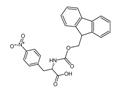
- Fmoc-Phe(4-NO2)-OH
-
- $1.00
-
2020-01-06
- CAS:95753-55-2
- Min. Order: 1g
- Purity: 98%
- Supply Ability: 100KG
|
| | Fmoc-4-nitro-L-phenylalanine Basic information |
| | Fmoc-4-nitro-L-phenylalanine Chemical Properties |
| Melting point | 213-223℃ | | Boiling point | 692.3±55.0 °C(Predicted) | | density | 1.371±0.06 g/cm3(Predicted) | | storage temp. | Sealed in dry,2-8°C | | solubility | almost transparency in N,N-DMF | | pka | 3.59±0.10(Predicted) | | form | powder to crystal | | color | White to Light yellow | | BRN | 5178656 | | Major Application | peptide synthesis | | InChIKey | RZRRJPNDKJOLHI-QFIPXVFZSA-N | | SMILES | [N+](=O)([O-])c1ccc(cc1)C[C@H](NC(=O)OCC2c3c(cccc3)c4c2cccc4)C(=O)O | | CAS DataBase Reference | 95753-55-2(CAS DataBase Reference) |
| Hazard Codes | Xi | | Safety Statements | 22-24/25 | | WGK Germany | 3 | | HS Code | 2924 29 70 | | HazardClass | IRRITANT | | Storage Class | 11 - Combustible Solids |
| | Fmoc-4-nitro-L-phenylalanine Usage And Synthesis |
| Chemical Properties | White powder | | Uses | Fmoc-Phe(4-NO2)-OH is used to prepare squaric acid derivatives as VLA-4 integrin antagonists. It is also an intermediate used in the synthesis of analogs of kahalalide F. | | reaction suitability | reaction type: Fmoc solid-phase peptide synthesis | | Synthesis | GENERAL STEPS: 37.7 g (0.179mol) of (S)-2-amino-3-(4-nitrophenyl)propionic acid was suspended in 200 mL of a 2% NaOH aqueous solution, and 80 mL of acetonitrile was added until completely dissolved. To this solution was added 61.8 g (0.183 mol) of 9-fluorenylmethyl-N-succinimidyl carbonate suspended in 100 mL of acetonitrile. The reaction mixture was stirred at room temperature for 3 h and subsequently acidified to pH 4-5 with 5% HCl. The precipitated white crystals were collected by filtration, washed with ethyl acetate and dried. The product was recrystallized by ethanol-dioxane (50:50) solvent mixture. The yields were 67% (3a) and 71% (3b), respectively. The melting point was 230 °C (literature value 233-234 °C [10]).IR spectrum (ν, cm-1): 3429, 3202, 1724, 1693, 1601, 1520, 1447, 1354, 1223, 1057, 856, 760, 741.1H NMR spectrum (DMSO-d6, δ, ppm): 2.90- 3.09 (m, 1H, CH2), 3.25 (dd, 1H, CH2, 2J=13.7, 3J=4.3 Hz), 4.13-4.34 (m, 4H, 2CH2, 2CH), 7.23-7.45 (m, 4Harom), 7.54 (d, 2Harom, 3J=8.6 Hz), 7.60-7.64 (m, 2Harom), 7.79 (d, 1H, NH, 3J=8.6 Hz), 7.88 (d, 2Harom, 3J=7.5 Hz), 8.14 (d, 2Harom, 3J=8.6 Hz), 12.93 (s, 1H, COOH).13C NMR spectra (DMSO-d6, δ, ppm): 36.62 (CH2) 47.03 (CH), 55.25 (CH), 66.03 (CH2), 120.56, 123.69, 125.62, 127.45, 128.07, 130.94, 141.16, 144.20, 146.73 (arom), 156.39 (CONH), 173.27 (COOH). Mass spectrum (ESI, m/z): 455.1214 [M+Na]+. Molecular formula C24H20N2O6, calculated molecular weight 432.1321. | | References | [1] Tetrahedron Letters, 1999, vol. 40, # 36, p. 6557 - 6560
[2] Russian Journal of Organic Chemistry, 2016, vol. 52, # 11, p. 1681 - 1685
[3] Zh. Org. Khim., 2016, vol. 52, # 11, p. 1686 - 1690,5 |
| | Fmoc-4-nitro-L-phenylalanine Preparation Products And Raw materials |
|