V-9302 manufacturers
- V-9302
-

- $56.00
-
2026-07-14
- CAS:1855871-76-9
- Purity: 99.15%
- Supply Ability: 10g
|
| Product Name: | V-9302 | | Synonyms: | V-9302 HCL;V-9302;V-9302; V9302; V 9302;Butanoic acid, 2-amino-4-[bis[[2-[(3-methylphenyl)methoxy]phenyl]methyl]amino]-, (2S)-;V-9302 1855871-76-9;proliferation,stress,mice,flux,uptake,transporter,athymic,Inhibitor,V 9302,V9302,glutamine,nude,inhibit,V-9302,oxidative,HEK-293;(S)-2-Amino-4-(bis(2-((3-methylbenzyl)oxy)benzyl)amino)butanoic acid;V-9302 ,S8818 | | CAS: | 1855871-76-9 | | MF: | C34H38N2O4 | | MW: | 538.68 | | EINECS: | | | Product Categories: | | | Mol File: | 1855871-76-9.mol | 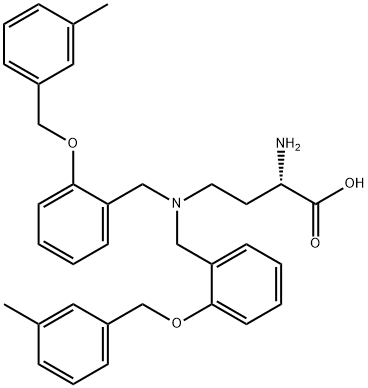 |
| | V-9302 Chemical Properties |
| Boiling point | 688.7±55.0 °C(Predicted) | | density | 1.179±0.06 g/cm3(Predicted) | | storage temp. | Store at -20°C | | solubility | DMSO:85.0(Max Conc. mg/mL);157.79(Max Conc. mM)
DMSO:PBS (pH 7.2) (1:2):0.33(Max Conc. mg/mL);0.61(Max Conc. mM)
DMF:25.0(Max Conc. mg/mL);46.41(Max Conc. mM)
Ethanol:60.0(Max Conc. mg/mL);111.38(Max Conc. mM)
Water:50.5(Max Conc. mg/mL);93.75(Max Conc. mM) | | form | A crystalline solid | | pka | 2.08±0.10(Predicted) | | color | White to yellow | | InChIKey | YGKNVAAMULVFNN-HKBQPEDESA-N | | SMILES | CC1=CC=CC(COC2=C(C=CC=C2)CN(CC3=CC=CC=C3OCC4=CC=CC(C)=C4)CC[C@@H](C(O)=O)N)=C1 |
| WGK Germany | WGK 3 | | Storage Class | 11 - Combustible Solids |
| | V-9302 Usage And Synthesis |
| Uses | V-9302 is a competitive antagonist of transmembrane glutamine flux. V-9302 selectively and potently targets the amino acid transporter ASCT2 (SLC1A5) not ASCT1. V-9302 inhibits ASCT2-mediated glutamine uptake (IC50=9.6 μM) in HEK-293 cells[1]. | | Biological Activity | V-9302 is a selective competitive antagonist of the amino acid transporter ASCT2 (SLC1A5) with anti-tumor activity. V-9302 caused reduced cellular viability and increased cell death in a panel of cancer cell lines and reduced tumor cell growth in both HCT-116 and HT29 (Fig. 5f) xenograft models. | | in vivo | V-9302 (75 mg/kg; i.p.; daily fo 21 days) prevents tumor growth in both HCT-116 and HT29 xenograft models[1].
The combination of CB-839 and V-9302 (30 mg/kg; i.p.; SNU398 and MHCC97H cells were grown as tumor xenografts in BALB/c nude mice; for 20 or 15 d, respectively) elicits a strong growth inhibition in both SNU398 and MHCC97H xenograft models, while single-drug treatment showed modest anti-tumor effects[2].
V-9302 (50 mg/kg ; i.p.; daily for 5 days) displays markedly reduced tumor growth[3]. | Animal Model: | 6-week old, female athymic nude mice (bearing HCT-116 (KRAS G13D) or HT29 (BRAF V600E) cell-line)[1] | | Dosage: | 75 mg/kg | | Administration: | Intraperitoneally; daily fo 21 days | | Result: | Prevented tumor growth.
|
| | IC 50 | ASCT2 | | References | [1] Schulte ML, et al. Pharmacological blockade of ASCT2-dependent glutamine transport leads to antitumor efficacyin preclinical models. Nat Med. 2018 Feb;24(2):194-202. DOI:10.1038/nm.4464
[2] Jin H, et al. A powerful drug combination strategy targeting glutamine addiction for the treatment of human liver cancer. Elife. 2020;9:e56749. Published 2020 Oct 5. DOI:10.7554/eLife.56749
[3] Edwards DN, et al. Selective glutamine metabolism inhibition in tumor cells improves antitumor T lymphocyte activity in triple-negative breast cancer. J Clin Invest. 2021;131(4):e140100. DOI:10.1172/JCI140100 |
| | V-9302 Preparation Products And Raw materials |
|