| Company Name: |
RYSS TECH LTD |
| Tel: |
400-188-0725 +86 21 34310725 13611771617 |
| Email: |
|
|
| | trans-2,3-Dibromo-2-butene-1,4-diol Basic information |
| Product Name: | trans-2,3-Dibromo-2-butene-1,4-diol | | Synonyms: | 2,3-dibromo-2-butene-4-diol;4-diol,2,3-dibromo-2-Butene-1;TRANS-2,3-DIBROMO-1,4-DIHYDROXY-2-BUTENE;TRANS-2,3-DIBROMO-2-BUTENE-1,4-DIOL;TRANS-2,3-DIBROMO-2-BUTEN-1,4-DIOL;DBD;DIBROMO(-2,3)-2-BUTENE-1,4-DIOL;2,3-DIBROMO-2-BUTYLENE-1,4-DIOL | | CAS: | 3234-02-4 | | MF: | C4H6Br2O2 | | MW: | 245.9 | | EINECS: | 221-779-5 | | Product Categories: | Alcohols;Monomers;Polymer Science | | Mol File: | 3234-02-4.mol | 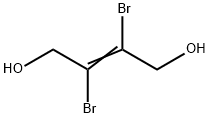 |
| | trans-2,3-Dibromo-2-butene-1,4-diol Chemical Properties |
| Melting point | 112-114 °C(lit.) | | Boiling point | 318.1±42.0 °C(Predicted) | | density | 1.9671 (rough estimate) | | vapor pressure | 0.004-0.081Pa at 25-40℃ | | refractive index | 1.5230 (estimate) | | storage temp. | Storage temp. 2-8°C | | form | Solid:crystalline | | pka | 11.91±0.10(Predicted) | | Appearance | White to off-white Solid | | Water Solubility | 1-5 g/100 mL at 21 ºC | | Stability: | Stable. Incompatible with strong oxidizing agents. | | InChI | 1S/C4H6Br2O2/c5-3(1-7)4(6)2-8/h7-8H,1-2H2/b4-3+ | | InChIKey | MELXIJRBKWTTJH-ONEGZZNKSA-N | | SMILES | OC\C(Br)=C(/Br)CO | | LogP | 0.31 at 25℃ and pH7 | | Surface tension | 67.79mN/m at 1g/L and 20℃ | | CAS DataBase Reference | 3234-02-4(CAS DataBase Reference) | | EPA Substance Registry System | 2,3-Dibromo-2-butene-1,4-diol (3234-02-4) |
| Hazard Codes | Xi | | Risk Statements | 36/37/38 | | Safety Statements | 26-37/39 | | WGK Germany | 3 | | RTECS | EM6910000 | | Hazard Note | Irritant | | TSCA | TSCA listed | | HS Code | 29055998 | | Storage Class | 11 - Combustible Solids | | Hazard Classifications | Skin Sens. 1B |
| | trans-2,3-Dibromo-2-butene-1,4-diol Usage And Synthesis |
| Chemical Properties | white crystalline powder | | Uses |
- Synthesis and Characterization of Oligomer Bis (trans-2, 3-dibromo-4-hydroxy-2-butenyl) terephthalate as a Green Corrosion Inhibitor on Mild Steel in 1 MH 3 PO 4: This study discusses the conversion of PET waste into an oligomer using trans-2,3-dibromo-2-butene-1,4-diol, exploring its efficacy as a corrosion inhibitor (Tuama, Indonesian Journal of Chemistry).
- Use of bromine and bromo-organic compounds in organic synthesis: This review highlights the role of trans-2,3-dibromo-2-butene-1,4-diol in organic synthesis, particularly its utility in bromination reactions to synthesize complex organic molecules (Saikia et al., Chemical Reviews, 2016).
| | General Description | Crystals or white powder. | | Air & Water Reactions | Water soluble. | | Reactivity Profile | A halogenated alkene and alcohol. The unsaturated aliphatic hydrocarbons are generally much more reactive than the alkanes, which are saturated aliphatic hydrocarbons. Strong oxidizers may react vigorously with them. Reducing agents can react exothermically to release gaseous hydrogen. Flammable and/or toxic gases are generated by the combination of alcohols with alkali metals, nitrides, and strong reducing agents. They react with oxoacids and carboxylic acids to form esters plus water. Oxidizing agents convert them to aldehydes or ketones. Alcohols exhibit both weak acid and weak base behavior. They may initiate the polymerization of isocyanates and epoxides. | | Fire Hazard | Flash point data for trans-2,3-Dibromo-2-butene-1,4-diol are not available, however trans-2,3-Dibromo-2-butene-1,4-diol is probably combustible. |
| | trans-2,3-Dibromo-2-butene-1,4-diol Preparation Products And Raw materials |
|