- Buparvaquone
-

- $58.00
-
2026-04-22
- CAS:88426-33-9
- Purity: 99.81%
- Supply Ability: 10g
- Buparvaquone
-

- $25.00
-
2026-03-20
- CAS:88426-33-9
- Min. Order: 100KG
- Purity: 99.5%
- Supply Ability: 100 mt
|
| | Buparvaquone Basic information |
| Product Name: | Buparvaquone | | Synonyms: | CS-1178;2-((4-(1,1-dimethylethyl)cyclohexyl)methyl)-3-hydroxy-4-naphthalenedione;butalex;2-[[4-(1,1-dimethylethyl)cyclohexyl]methyl]-3-hydroxy-1,4-naphthalenedione;BW-720C;2-((4-tert-butylcyclohexyl)Methyl)-3-hydroxynaphthalene-1,4-dione;Buparvaquone-d4;2-[[4-(1,1-DiMethylethyl)cyclohexyl]Methyl]-3-hydroxy- | | CAS: | 88426-33-9 | | MF: | C21H26O3 | | MW: | 326.43 | | EINECS: | 618-162-1 | | Product Categories: | API;Aromatics;Intermediates & Fine Chemicals;Pharmaceuticals;john's | | Mol File: | 88426-33-9.mol | 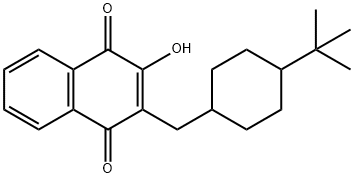 |
| | Buparvaquone Chemical Properties |
| Melting point | 178-184°C | | Boiling point | 460.7±45.0 °C(Predicted) | | density | 1.158±0.06 g/cm3(Predicted) | | storage temp. | Sealed in dry,2-8°C | | solubility | DMSO: soluble | | form | powder | | pka | 5.04±0.10(Predicted) | | color | Yellow | | Major Application | forensics and toxicology
veterinary | | InChI | InChI=1S/C21H26O3/c1-21(2,3)14-10-8-13(9-11-14)12-17-18(22)15-6-4-5-7-16(15)19(23)20(17)24/h4-7,13-14,24H,8-12H2,1-3H3 | | InChIKey | KLLIVCPQDTYMLC-UHFFFAOYSA-N | | SMILES | C1(=O)C2=C(C=CC=C2)C(=O)C(O)=C1CC1CCC(C(C)(C)C)CC1 | | CAS DataBase Reference | 88426-33-9(CAS DataBase Reference) |
| WGK Germany | 3 | | RTECS | QJ5766600 | | Storage Class | 11 - Combustible Solids | | Toxicity | LD50 orally in rats: >2 g/kg (Hudson) |
| | Buparvaquone Usage And Synthesis |
| Chemical Properties | Yellow Crystalline Solid | | Uses | Analog of antimalarial hydroxynaphthoquinones; tert-butyl derivative of Parvaquone. Antiprotozoal (Theileria) | | Biological Activity | Buparvaquone is a second-generation hydroxynaphthoquinone antiprotozoal drug related to parvaquone and atovaquone. Buparvaquone is indicated for the therapy and prophylaxis of all forms of Theileriosis and found to have an anti-Leishmanial activity. | | in vivo | Treatment of N.caninum infected mice with buparvaquone (100mg/kg) either by intraperitoneal injection or gavage prevents neosporosis symptoms in 4 out of 6 mice in the intraperitoneally treated group, and in 6 out of 7 mice in the group receiving oral treatment[1]. Both a hydrous gel and water-in-oil emulsion of buparvaquone significantly reduce cutaneous parasite burden and lesion size, compared with the untreated control[3]. |
| | Buparvaquone Preparation Products And Raw materials |
|