| Company Name: |
INTATRADE GmbH |
| Tel: |
+49 3493/605464 |
| Email: |
sales@intatrade.de |
| Company Name: |
Alfa Aesar |
| Tel: |
400-6106006 |
| Email: |
saleschina@alfa-asia.com |
- 3-Iodopyridine
-
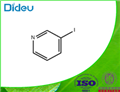
- $1.10
-
2026-08-20
- CAS:1120-90-7
- Min. Order: 1g
- Purity: 99.00%
- Supply Ability: 100 Tons min
- 3-Iodopyridine
-
- $10.00
-
2021-10-16
- CAS:1120-90-7
- Min. Order: 1KG
- Purity: 99%
- Supply Ability: 20 Tons
- 3-Iodopyridine
-
- $15.00
-
2021-07-13
- CAS:1120-90-7
- Min. Order: 1KG
- Purity: 99%+ HPLC
|
| | 3-Iodopyridine Basic information |
| | 3-Iodopyridine Chemical Properties |
| Melting point | 53-56 °C (lit.) | | Boiling point | 90-92°C 14mm | | density | 1.9668 (estimate) | | Fp | 224 °F | | storage temp. | Keep in dark place,Inert atmosphere,Room temperature | | form | powder to crystal | | pka | pK1:3.25(+1) (25°C) | | color | White to Light yellow to Light red | | Sensitive | Light Sensitive | | BRN | 106059 | | InChI | 1S/C5H4IN/c6-5-2-1-3-7-4-5/h1-4H | | InChIKey | XDELKSRGBLWMBA-UHFFFAOYSA-N | | SMILES | Ic1cccnc1 | | CAS DataBase Reference | 1120-90-7(CAS DataBase Reference) | | NIST Chemistry Reference | Pyridine, 3-iodo-(1120-90-7) |
| Hazard Codes | Xi,T | | Risk Statements | 36/37/38-23/24/25 | | Safety Statements | 26-36-45-36/37/39 | | WGK Germany | 3 | | Hazard Note | Irritant | | HazardClass | IRRITANT, LIGHT SENSITIVE | | HS Code | 29333990 | | Storage Class | 11 - Combustible Solids | | Hazard Classifications | Eye Irrit. 2
Skin Irrit. 2
STOT SE 3 |
| | 3-Iodopyridine Usage And Synthesis |
| Chemical Properties | light beige crystalline powder | | Uses | 3-Iodopyridine may be used to synthesize following pyridine alkaloids:
- theonelladins C
- theonelladins D
- niphatesine C
- xestamine D
| | Synthesis | The general procedure for the synthesis of 3-iodopyridine from 3-bromopyridine is as follows: the aromatic Finkelstein reaction is used. Since copper(I) iodide is sensitive to moisture and oxygen, the reaction needs to be carried out under argon protection using the standard Schlenk technique. The procedure is as follows: to a two-necked pear-shaped flask equipped with a reflux condenser is added 3-bromopyridine (as the aryl bromine feedstock), NaI (2 equiv. per bromine exchanged), and CuI (5 mol% per bromine exchanged). N,N'-dimethylethylenediamine (L1) or N,N'-dimethyl-1,2-cyclohexanediamine (L2) (10 mol% used per bromine exchange) and anhydrous 1,4-dioxane (0.5 mL used per 1 mmol NaI) were subsequently added. The resulting suspension was heated to 110°C and maintained for 18 hours. After completion of the reaction, it was cooled to room temperature and the mixture was poured into a 25% aqueous NH3 solution. The blue solution was diluted to twice the original volume with H2O and extracted three times with CH2Cl2. For the case of 2,2'-bipyridine, the combined organic phases were additionally washed with aqueous EDTA; otherwise, the combined organic phases were simply washed with brine and dried with MgSO4. Subsequently, the solvent is removed by distillation under reduced pressure to give pure 3-iodopyridine. If necessary, the crude product can be further purified by column chromatography or recrystallization. | | References | [1] Synthesis (Germany), 2014, vol. 46, # 8, p. 1085 - 1090
[2] Tetrahedron Letters, 1999, vol. 40, # 23, p. 4339 - 4342
[3] Tetrahedron, 2000, vol. 56, # 10, p. 1349 - 1360
[4] Chemistry - A European Journal, 2010, vol. 16, # 41, p. 12425 - 12433
[5] Chemical & Pharmaceutical Bulletin, 1982, vol. 30, # 5, p. 1731 - 1737 |
| | 3-Iodopyridine Preparation Products And Raw materials |
|