


Ammonium ferric sulfate dodecahydrate: Synthesis and Microbial Toxicity
Oct 7,2026
Ammonium ferric sulfate dodecahydrate is a pale purple or light purple crystalline inorganic double salt that is readily soluble in water; its aqueous solution is acidic. This substance is produced by the crystallisation of ferric sulphate and ammonium sulphate in an aqueous solution; it is relatively stable at room temperature but gradually loses its crystal water when heated. It is commonly used as an indicator in chemical analysis, for the determination of halogens in redox titrations, and also finds applications in fields such as mordants, water purification and metal etching.

Valorisation of acid mine drainage waste for synthesis of ammonium ferric sulfate dodecahydrate
Acid mine drainage (AMD) refers to mine waters that are acidic and contain multiple heavy metal species, a high concentration of sulfate (∼1000 mg/L), rare earth and radioactive elements, and solid precipitates with variable chemical composition and physical properties. Production of useful products such as water treatment materials from wastes like AMD is an attractive prospect, where one waste source can be utilised to remediate a secondary waste source. Recent studies in this area have used AMD to produce poly-alumino-ferric sulfate (PAFS) coagulants to treat sewage wastewater (Mwewa, 2019). Ferric ammonium sulfate is an alternative coagulant material which could be produced from AMD since these wastes are typically rich in iron and sulfate which are needed to synthesise this material. Ammonium ferric sulfate dodecahydrate is widely used in wastewater treatment, tanning and dying, adiabatic refrigeration and metal fabrication (
Chen et al., 1996). This study aimed to determine the favourable conditions for FAS synthesis from complex AMD waters, including determination of limiting factors for FAS crystallisation from AMD, yields, and material and chemical characteristics of ammonium ferric sulfate dodecahydrate products.[1]
The selectivity of FAS crystallisation was calculated using the concentrations and volumes of solutions before and after FAS crystallisation. Recovery for Fe for all tests increased (from 10 % up to 97 %) as the concentration of Fe was increased, and the higher recovery was also associated with higher crystal yields. Sulfur followed a similar trend to Fe. Although lower solution concentrations of Al resulted in less Al incorporation in ammonium ferric sulfate dodecahydrate, Al was consistently incorporated into FAS, particularly at higher H2SO4 and (NH4)2SO4 concentrations, which was attributed to similarities in the hydrolysis of Fe and Al (Mwewa, 2019). Other metals were not as easily incorporated into FAS crystals, a favourable outcome regarding product purity. Generally, both low and high acid tests had comparable recoveries when the same amount of ammonium sulfate was used. The feasibility of producing FAS from an AMD matrix has been investigated. Ammonium ferric sulfate dodecahydrate was successfully produced from solutions where the iron concentration was above 2500 mg/L. Product purity depended on material handling processes such as washing and drying. Of elements present in AMD, Fe, S, and Al were selectively retained during crystallisation, although Al incorporation was supressed at higher Fe solution concentrations. Overall, this study demonstrates that ammonium ferric sulfate dodecahydrate can be recovered from complex waste feedstocks, and it is recommended that this work be extended to other waste sources, such as pyrite, as a source for iron and sulfur for FAS synthesis.
Microcalorimetric investigation of the toxic action of ammonium ferric sulfate dodecahydrate
A series of calorimetric experiments were performed to investigate toxic action of ammonium ferric sulfate dodecahydrate (AFS) on Bacillus subtilis, Pseudomonas putida and Candida humicola. The power–time curves of micro-organism metabolism were obtained, and the action of them by addition of AFS was studied. C. humicola, B. subtilis and P. putida were inhibited completely when the concentrations were up to 320.0, 160.0 and 160.0 μg mL−1, respectively. The relationships between growth rate constant (k) and doses of ammonium ferric sulfate dodecahydrate were approximately linear for three microbes, P. putida for 10.0–160.0 μg mL−1 (R = −0.9746), B. subtilis for 0–160.0 μg mL−1 (R = −0.9868) and C. humicola for 10.0–320.0 μg mL−1 (R = −0.9955). The total heat dissipated per milliliter (QT) for three microbes remained balance approximately during the lower doses, P. putida and B. subtilis less than the dose of 20.0 μg mL−1, 0.56 ± 0.01 and 0.26 ± 0.01 J mL−1, respectively, C. humicola less than the dose of 40.0 μg mL−1, 0.58 ± 0.03 J mL−1. The biomass and OD600 of three micro-organisms growth in the absence of ammonium ferric sulfate dodecahydrate also were obtained. The power–time curve of C. humicola growth coincided with its turbidity curve. It elucidates that microcalorimetric method agreed with the routine microbiology method.[2]
References
[1]Kobal, W., Pepper, R. A., Alarco, J. A., Martens, W., & Couperthwaite, S. J. (2024). Valorisation of acid mine drainage waste for synthesis of ferric ammonium sulfate (FAS). Minerals Engineering, 205, 108462.
[2]Wang, F., Yao, J., Tian, L., Zhou, Y., Chen, H., Chen, H., Gai, N., Chen, Y., Zhuang, R., Zaray, G., Maskow, T., & Bramanti, E. (2008). Microcalorimetric investigation of the toxic action of ammonium ferric(III) sulfate on the metabolic activity of pure microbes. Environmental Toxicology and Pharmacology, 25(3), 351–357.
- Related articles
- Related Questions

Trimethylolpropane trioleate is utilised as a high-performance base fluid in industrial applications including hydraulic fluids, two-stroke engine oils and metalworking fluids.....
Oct 7,2026Esters
Ethylene glycol distearate is a cosmetic pearlescent agent and plastic lubricant which can be prepared by esterification, serving as a phase change material.....
Oct 8,2026Surfactant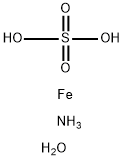
Ammonium ferric sulfate dodecahydrate
7783-83-7You may like
Ammonium ferric sulfate dodecahydrate manufacturers
- AMMoniuM iron(III) sulfate dodecahydrate, for analysis ACS
-
- $1.00
- 2026-10-10
- CAS: 7783-83-7
- Min. Order: 1KG
- Purity: 99%
- Supply Ability: 20T
- Ammonium ferric sulfate dodecahydrate
-

- $9.80
- 2025-02-13
- CAS:7783-83-7
- Min. Order: 1kg
- Purity: 99.99%
- Supply Ability: 10 tons
- Ammonium ferric sulfate dodecahydrate
-

- $1.00
- 2019-07-12
- CAS:7783-83-7
- Min. Order: 1KG
- Purity: 99%
- Supply Ability: 25kg