


Cyclohexanecarboxaldehyde as an Organometallic Reaction Substrate
May 21,2026
Cyclohexanecarboxaldehyde (cyclohexane carbaldehyde) is slightly soluble in water and readily soluble in organic solvents such as alcohols, ethers, and benzene. The molecule consists of a cyclohexane ring linked to an aldehyde group. It exhibits the typical chemical reactivity of aldehydes, is easily oxidized and condensed, and is sensitive to air. Cyclohexanecarboxaldehyde is primarily used as an organic synthesis intermediate in the production of pharmaceuticals (such as fosinopril) and the plant growth regulator bud inhibitor, and is also used in the preparation of α-diazo-β-hydroxy esters.

Reactions of a Hexahydride-Osmium Complex with Aldehydes
Scientists have recently shown that the saturated d hexahydride OsH6(PiPr3)2 can be thermally activated to generate the unsaturated short-lived dihydride-dihydrogen OsH2(η2-H2)(PiPr3)2. This species activates ortho-CH bonds of aromatic ketones and imines2 and ortho-CF bonds of partially fluorinated aromatic ketones. The reactions give complexes that are reminiscent of the intermediates proposed by Murai for the insertion of olefins into ortho-CH bonds of ketones and imines and for the arylation of aromatic ketones with arylboronates. For partially fluorinated aromatic ketones, the ortho-CH activation is preferred over the ortho-CF activation in ketones containing only one aromatic ring. However, the ortho-CF activation is preferred over the ortho-CH activation in 2,3,4,5,6-pentafluoroacetophenone. The hexahydride complex OsH6(PiPr3)2 reacts with benzaldehyde, cyclohexanecarboxaldehyde, and isobutyraldehyde in toluene under reflux to give organometallic and organic (identified by gas chromatography-MS) products, which are the result of C−Hα activation−decarbonylation tandem processes between 2 equiv of aldehyde and 1 equiv of hexahydride. The reactions of OsH6(PiPr3)2 with cyclohexanecarboxaldehyde and isobutyraldehyde lead to the previously reported cis- dihydride, cis-dicarbonyl derivative OsH2(CO)2(PiPr3)2 and the corresponding alkane, according to eq 2. It should be noted that the dimerization of cyclohexanecarboxaldehyde is faster than the dimerization of benzaldehyde. This can be due to the fact that the insertion of cyclohexanecarboxaldehyde into an Os−H bond is favored with regard to the insertion of benzaldehyde. [1]
In the absence of water, the acyl intermediates undergo deinsertion of the R substituent (alkyl or phenyl) and subsequent reductive elimination of R−H. The resulting species are capable of promoting the activation−deinsertion tandem process of a second aldehyde molecule to give OsH2(CO)2(PiPr3)2 (cyclohexanecarboxaldehyde and isobutyraldehyde) or OsHPh(CO)2(PiPr3)2 (benzaldehyde). The deinsertion of R is faster for phenyl than for alkyl. Thus, while in the presence of water and the aldehyde, the acyl group of the short-lived Os-C(O)Ph species evolves into OsHPh(CO)2(PiPr3)2, and the acyl group of the Os-C(O)alkyl intermediates undergoes nucleophilic addition of water before the deinsertion. As a result, the corresponding carboxylic acid and the starting hexahydride are formed. The subsequent reaction between both leads finally to the trithydride-acetate derivatives OsH3(κ2-O2CR)(PiPr3)2 (R = Cy, (CH3)2CH). The capacity shown by OsH2(η2-H2)(PiPr3)2 to activate the C−Hα bond of aldehydes together with the presence of hydride ligands in the resulting addition product, which have the property of inserting a second aldehyde molecule, makes the hexahydride an active catalyst precursor for the classical Tishchenko dimerization of aldehydes. The stability of the catalyst precursor during the reaction is a function of the tendency of the R substituent of the acyl group of the Os-C(O)R intermediate to undergo deinsertion. Thus, while cyclohexanecarboxaldehyde can be rapidly converted into the ester dimer (90% yield after 10 min), and the transformation of the catalyst precursor into OsH2(CO)2(PiPr3)2 occurs only at the end of the catalysis, benzaldehyde deactivates the catalyst precursor to give OsHPh(CO)2(PiPr3)2 during the first cycles of the catalysis. In conclusion, the reactions of transition metal polyhydrides with aldehydes should merit more attention than that given until now. They afford short-lived hydride-acyl species, which are the key to prepare several types of complexes and to generate catalytic processes.
References
[1]Pilar Barrio, Enrique O., Miguel A. Esteruelas. (2004). Reactions of a Hexahydride-Osmium Complex with Aldehydes: Double C−Hα Activation−Decarbonylation and Single C−Hα Activation−Hydroxylation Tandem Processes and Catalytic Tishchenko Reactions. Organometallics, 23 6, 1340–1348. https://doi.org/10.1021/om034389l
- Related articles
- Related Qustion

Silver tetrafluoroborate is a very strong Lewis acid catalyst. It exhibits a high affinity for organic halides and can be used in various organic reactions.....
May 21,2026API
Manganese chloride commonly exists as hydrate crystals with weak acidity and stable chemical properties, widely applied in industry as catalysts.....
May 21,2026Inorganic salts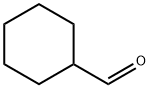
Cyclohexanecarboxaldehyde
2043-61-0You may like
Cyclohexanecarboxaldehyde manufacturers
- Cyclohexanecarboxaldehyde
-

- $100.00/ kg
- 2026-05-24
- CAS:2043-61-0
- Min. Order: 1kg
- Purity: 99%
- Supply Ability: 5000
- Cyclohexanecarboxaldehyde
-

- $10.00 / 1KG
- 2026-03-20
- CAS:2043-61-0
- Min. Order: 1KG
- Purity: 99%
- Supply Ability: 100 mt
- Cyclohexanecarboxaldehyde
-

- $10.70 / 1KG
- 2025-05-26
- CAS:2043-61-0
- Min. Order: 10KG
- Purity: 99%
- Supply Ability: 10000kg