| Identification | More | [Name]
AMINOGUANIDINE HYDROCHLORIDE | [CAS]
1937-19-5 | [Synonyms]
amino-guanidinhydrochloride
hydrazinecarboximidamidehydrochloride
carbazamidine monohydrochloride
AMINOGUANIDINE HYDROCHLORIDE, 98+%
Aminoguanidine HCL
AMINOGUANIDINE SALT
GUANYLHYDRAZINEHCL
GUANIDINE,AMINO-,MONOHYDROCHLORIDE
Aminoguanidine hydrochoride
1-Aminoguanidine·hydrochloride
Aminoguanidine salts | [EINECS(EC#)]
217-707-7 | [Molecular Formula]
CH7ClN4 | [MDL Number]
MFCD00039074 | [Molecular Weight]
110.546 | [MOL File]
1937-19-5.mol |
| Questions And Answer | Back Directory | [Synthesis]
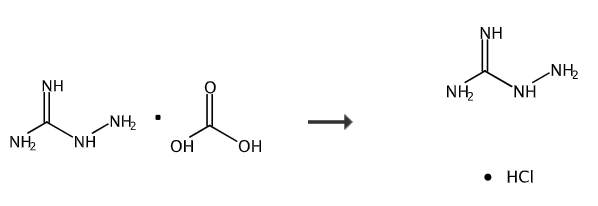
Preparation of Aminoguanidine Hydrochloride: Weigh 9g of aminoguanidine carbonate into a 250ml three-necked flask, add 20ml of anhydrous ethanol. The solid is insoluble in anhydrous ethanol, forming a suspension. While stirring at room temperature, add dropwise a mixture of 6ml of 30% concentrated hydrochloric acid and 10ml of anhydrous ethanol until no more bubbles are produced. Continue stirring at room temperature for 1 hour. Heat the resulting suspension to completely dissolve the solid, allow it to cool naturally to room temperature, transfer it to a refrigerator, and leave it overnight to obtain white rod-shaped crystals with a melting point of 166-167℃. |
| Chemical Properties | Back Directory | [Appearance]
white to off-white crystals | [Melting point ]
162-166 °C(lit.)
| [vapor pressure ]
0Pa at 25℃ | [storage temp. ]
Keep in dark place,Sealed in dry,Room Temperature | [solubility ]
Completely soluble in water | [form ]
Crystals | [color ]
White to off-white | [Water Solubility ]
506.7g/L at 20℃ | [Merck ]
13,440 | [BRN ]
3909606 | [Cosmetics Ingredients Functions]
SKIN CONDITIONING | [InChI]
InChI=1S/CH6N4.ClH/c2-1(3)5-4;/h4H2,(H4,2,3,5);1H | [InChIKey]
UBDZFAGVPPMTIT-UHFFFAOYSA-N | [SMILES]
N(N)C(=N)N.[H]Cl | [LogP]
-3.55 at 20℃ | [CAS DataBase Reference]
1937-19-5(CAS DataBase Reference) | [EPA Substance Registry System]
Hydrazinecarboximidamide, monohydrochloride (1937-19-5) |
| Safety Data | Back Directory | [Symbol(GHS) ]
 
GHS07,GHS09 | [Signal word ]
Warning | [Hazard statements ]
H317-H411 | [Precautionary statements ]
P261-P272-P273-P280-P302+P352-P333+P313 | [Hazard Codes ]
Xi | [Risk Statements ]
R36/37/38:Irritating to eyes, respiratory system and skin . | [Safety Statements ]
S26:In case of contact with eyes, rinse immediately with plenty of water and seek medical advice .
S36:Wear suitable protective clothing . | [WGK Germany ]
3
| [RTECS ]
ME8430000
| [F ]
10-21 | [TSCA ]
TSCA listed | [REACH Registrations]
Active | [HS Code ]
29280000 | [Storage Class]
13 - Non Combustible Solids | [Hazard Classifications]
Aquatic Chronic 2
Skin Sens. 1B |
| Hazard Information | Back Directory | [Description]
Aminoguanidine is equipotent to L-NMMA and L-NNA as an inhibitor of iNOS.1,2 The IC50 values for inhibition of mouse iNOS and rat nNOS are 5.4 and 160 μM, respectively.2 Aminoguanidine also inhibits induction of iNOS protein expression by endotoxin in rat macrophages.3 | [Chemical Properties]
white to off-white crystals | [Uses]
a-Glucosidase inhibitor; hydroxyethyl derivative of 1-deoxynojirimycin | [Uses]
Aminoguanidine hydrochloride may be employed as nitric oxide synthase (NOS) inhibitor to investigate its effect on the reduction of alveolar bone loss in ligature induced periodontitis in rats. It may be used in the synthesis of 5-guanylhydrazone derivatives, having antibacterial activity against antibacterial activity against both Escherichia coli and Staphylococcus aureus. | [Uses]
antitussive | [Biological Functions]
It is reported that aminoguanidine hydrochloride has two important biological effects. Firstly, it is effective for the prevention of formation of advanced glycation endproducts (AGEs) associated with pathogenesis of secondary complications to diabetes and with cardiovascular changes in aging. Aminoguanidine hydrochloride reacts rapidly with in vivo glycation α,β-dicarbonyl products such as methylglyoxal, glyoxal, and 3-deoxyglucosone to prevent the formation of AGEs.
Secondly, it inhibits of the individual isoforms of nitric oxide synthase (iNOS) which is one of three key enzymes generating nitric oxide (NO) from L-arginine. iNOS-derived nitric oxide plays an important role in numerous physiological (e.g. blood pressure regulation) and pathophysiological (e.g. inflammation) conditions. | [General Description]
Aminoguanidine hydrochloride has been reported in a study as inhibitor of animal nitric oxide (NO)-synthase. Crystal structure of aminoguanidine hydrochloride has been investigated by Fourier and least squares method. Its crystals were monoclinic and the guanidine part of the aminoguanidinium ion is planar. | [Flammability and Explosibility]
Notclassified | [Biochem/physiol Actions]
Inhibits both constitutive and inducible nitric oxide synthetase. | [References]
[1] JOLY G.A. Effects of NG-Methyl-L-arginine, NG-Nitro-L-arginine, and Aminoguanidine on Constitutive and Inducible Nitric Oxide Synthase in Rat Aorta[J]. Biochemical and biophysical research communications, 1994, 199 1: Pages 147-154. DOI: 10.1006/bbrc.1994.1207
[2] J A CORBETT M L M. Selective inhibition of inducible nitric oxide synthase by aminoguanidine.[J]. Methods in enzymology, 1996, 268: 398-408. DOI: 10.1016/s0076-6879(96)68042-2
[3] H. RUETTEN C. T. Prevention of the Expression of Inducible Nitric Oxide Synthase by Aminoguanidine or Aminoethyl-Isothiourea in Macrophages and in the Rat[J]. Biochemical and biophysical research communications, 1996, 225 2: Pages 525-530. DOI: 10.1006/bbrc.1996.1206 |
|
| Company Name: |
J & K SCIENTIFIC LTD.
|
| Telephone: |
18210857532 18210857532 |
| Website: |
https://www.jkchemical.com |
| Company Name: |
Energy Chemical
|
| Telephone: |
400-0056266 |
| Website: |
www.energy-chemical.com |
|