| Identification | More | [Name]
Cupric hydroxide | [CAS]
20427-59-2 | [Synonyms]
COPPER(+2)HYDROXIDE
copper dihydroxide
COPPER HYDRATE
COPPER HYDROXIDE
COPPER(II) HYDROXIDE
CUPRIC HYDROXIDE
Kocide 101
Chiltern kocide 101
Comac
Comac parasol
comacparasol
Copper hydrate, hydrated cupric oxide
Copper hydroxide (Cu(OH)2)
Copper hydroxide (ic)
Copper oxide hydrated
copperhydroxide(cu(oh)2)
copperoxidehydrated
Cu(OH)2
cudroxtechnical
Cupravit blau | [EINECS(EC#)]
243-815-9 | [Molecular Formula]
CuH2O2 | [MDL Number]
MFCD00010968 | [Molecular Weight]
97.56 | [MOL File]
20427-59-2.mol |
| Chemical Properties | Back Directory | [Appearance]
Blue, gelatinous or amorphous powder. Insoluble in water. | [density ]
3.4 | [vapor pressure ]
0Pa at 25℃ | [storage temp. ]
0-6°C | [solubility ]
H2O: insoluble(lit.) | [form ]
Powder | [color ]
Blue | [PH]
7.69(1 mM solution);7.69(10 mM solution);7.69(100 mM solution) | [Stability:]
Stable, but hygroscopic. Store in dry conditions. | [Water Solubility ]
Slightly soluble in waterSoluble in acids, ammonium hydroxide, dilute hydrochloric acid, concentrated alkali and potassium cyanide. Insoluble in water, ethanol, and acetone. | [Sensitive ]
Hygroscopic | [Merck ]
14,2642 | [Solubility Product Constant (Ksp)]
pKsp: 19.66 | [Exposure limits]
ACGIH: TWA 1 mg/m3
NIOSH: IDLH 100 mg/m3; TWA 1 mg/m3 | [InChI]
1S/Cu.2H2O/h;2*1H2/q+2;;/p-2 | [InChIKey]
JJLJMEJHUUYSSY-UHFFFAOYSA-L | [SMILES]
O[Cu]O | [CAS DataBase Reference]
20427-59-2(CAS DataBase Reference) | [NIST Chemistry Reference]
Copper hydroxide(20427-59-2) | [EPA Substance Registry System]
20427-59-2(EPA Substance) |
| Safety Data | Back Directory | [Symbol(GHS) ]
  
GHS05,GHS06,GHS09 | [Signal word ]
Danger | [Hazard statements ]
H302-H318-H330-H410 | [Precautionary statements ]
P260-P273-P280-P301+P312-P304+P340+P310-P305+P351+P338 | [Hazard Codes ]
Xn | [Risk Statements ]
R22:Harmful if swallowed.
R37/38:Irritating to respiratory system and skin .
R41:Risk of serious damage to eyes. | [Safety Statements ]
S26:In case of contact with eyes, rinse immediately with plenty of water and seek medical advice .
S36:Wear suitable protective clothing . | [RIDADR ]
3262 | [WGK Germany ]
3
| [RTECS ]
GL7600000
| [TSCA ]
Yes | [REACH Registrations]
Active | [HS Code ]
28255000 | [Storage Class]
6.1B - Non-combustible acute toxic Cat. 1 and 2
very toxic hazardous materials | [Hazard Classifications]
Acute Tox. 2 Inhalation
Acute Tox. 4 Oral
Aquatic Acute 1
Aquatic Chronic 1
Eye Dam. 1 | [Hazardous Substances Data]
20427-59-2(Hazardous Substances Data) |
| Hazard Information | Back Directory | [Hazard]
Toxic by ingestion and inhalation. | [Potential Exposure]
Inorganic copper fungicide, nematicide, and microbiocide | [First aid]
If this chemical gets into the eyes, remove any contact lenses at once and irrigate immediately for at least 15 minutes, occasionally lifting upper and lower lids. Seek medical attention immediately. If this chemical contacts the skin, remove contaminated clothing and wash immediately with soap and water. Seek medical attention immediately. If this chemical has been inhaled, remove from exposure, begin rescue breathing (using universal precautions) if breathing has stopped, and CPR if heart action has stopped. Transfer promptly to a medical facility. When this chemical has been swallowed, get medical attention. If victim is conscious and able to swallow, have victim drink 4 to 8 oz of water. Do not induce vomiting. | [Shipping]
UN3077 Environmentally hazardous substances, solid, n.o.s., Hazard class: 9; Labels: 9-Miscellaneous hazardous material, Technical Name Required. | [Incompatibilities]
Reacts with calcium (metal hydroxides), nitroethane, nitromethane, 1-nitropropane, zirconium | [Waste Disposal]
Copper-containing soluble wastes can be concentrated through the use of ion exchange, reverse osmosis, or evaporators to the point where copper can be electrolytically removed and sent to a reclaiming firm. If recovery is not feasible, the copper can be precipitated through the use of caustics and the sludge deposited in a chemical waste landfill Copper-containing wastes can be concentrated through the use of ion exchange, reverse osmosis, or evaporators to the point where copper can be electrolytically removed and sent to a reclaiming firm. Details of copper recovery from a variety of industrial wastes have been published. If recovery is not feasible, the copper can be precipitated by the use of caustics and the sludge deposited in a chemical waste landfill. Recommendable methods: Precipitation, solidification, landfill, discharge to sewer, & incineration. Peer-review: Precipitate copper with alkali, filter, solidify precipitate. (Do not use ammonia as alkali). Cation exchange will allow recovery of copper. Eluate from cation exchanger can be passed through anion exchanger to remove (or reduce) naphthenic acid content. Exhausted ion exchange resins can be landfilled. (Peer-review conclusions of an IRPTC expert consultation) | [General Description]
The orthorhombic nature of copper hydroxide crystals was determined by X ray diffraction. Copper hydroxide can act as a heterogeneous catalyst in the selective oxidative cross coupling of terminal alkynes to yield their corresponding ynamides.
| [Mechanism of action]
Absorbed copper disrupts the enzyme systems of the pathogens. Multi-site activity. | [Pesticide Type]
Fungicide |
| Questions And Answer | Back Directory | [Description]
Cupric hydroxide appears as a blue powder and it is not stable. Cupric hydroxide is used as a mordant and pigment, in the manufacture of many copper salts, and for staining paper. It is used as a fungicide/bactericide on fruits, vegetables, and ornamentals. It can be used as catalyst, feed additive, and a cuprammonium rayon process reagent to make the first semi-synthetic fiber product, Rayon.
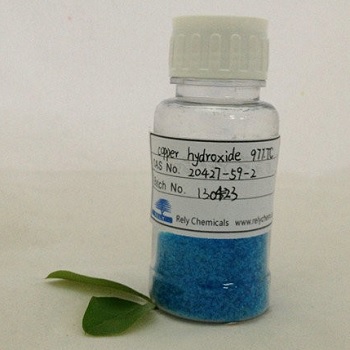
Furthermore, cupric hydroxide is used in the wood preservative products in aqueous systems.
| [Chemical Properties]
Copper(II) hydroxide, Cu(OH)2, is thermodynamically unstable with respect to decomposition to the oxide. Copper(II) hydroxide prepared by the addition of sodium hydroxide to a salt of copper decomposes at temperatures above 100°C, and in the presence of excess alkali, it decomposes at temperatures above 50°C. It is virtually insoluble in water and decomposes in hot water to the more stable copper(II) oxide and water. Copper(II) hydroxide dissolves quickly in mineral acids and ammonia solution. It is mildly amphoteric, and in concentrated alkali, it forms [Cu(OH)3]- or [Cu(OH)4]2- ions. Copper(II) hydroxides can be produced in a kinetically stabilized form depending on the method of precipitation and choice of additives. | [Uses]
Copper(II) hydroxide has been used as an alternative to the Bordeaux mixture, a fungicide and nematicide.
The orthorhombic nature of copper hydroxide crystals was determined by X ray diffraction. Copper hydroxide can act as a heterogeneous catalyst in the selective oxidative cross coupling of terminal alkynes to yield their corresponding ynamides.
Copper(II) hydroxide is also occasionally used as ceramic colorant. Used as an active precursor in the production of copper(II) compounds. Ammonia-processed copper(II) hydroxide is used in the production of copper(II) naphthenate, copper(II) 2-ethylhexanoate, and copper soaps. Ammonia-processed copper(II) hydroxide is also used in the production of rayon (Schweiter's reagent) and in the stabilization of nylon; as a feed additive, a catalyst in the vulcanization of polysulfide rubber, and an antifouling pigment.
Copper hydroxide based monoliths can be used in the synthesis of copper hydroxide-based monolithic xerogels. Potential applications of this metal organic frameworks (MOFs) include gas storage, separation, drug delivery, and biomedicine. Supported Cu(OH)x can be used as a catalyst for the aerobic cross dehydrogenative coupling of benzenethiols and cyclic amides to yield N-acylsulfenamides. | [Preparation]
Copper(II) hydroxide is produced by a reaction of copper oxychloride in an aqueous suspension with alkali hydroxide or alkaline earth metal hydroxide in the presence of a stabilizing agent and the product is separated and washed.
Cu(NO3)2 + NaOH --->Cu(OH)2 + NaNO3
Add a magnetic stirring bar to the beaker and place the flask on a microscale magnetic stirrer. At room temperature, with stirring, carefully add 6M NaOH solution dropwise until the solution is basic to red litmus paper. Use a capillary tube to remove sample for pH testing. A light blue precipitate of copper(II) hydroxide is formed as this reaction is carried out. Make sure the litmus paper has actually changed from red to blue, rather than simply being colored blue by the blue precipitate.
| [References]
[1] Michael Ash, Handbook of Preservatives, 2004
[2] Günter Joseph and Konrad J. A. Kundig, Copper: Its Trade, Manufacture, Use, and Environmental Status, 1999
[4] Bo Liu, Bin Liu, Yongbo Zhou and Wanzhi Chen, Copper(II) Hydroxide Complexes of N-Heterocyclic Carbenes and Catalytic Oxidative Amination of Arylboronic Acids, Organnometallics, 2010, vol. 29, 1457-1464
[5] George B. Kauffman, Rayon: The first semi-synthetic fiber product, Journal of Chemical Education, 1993, vol. 70, 887
|
|
| Company Name: |
JYS Gold
|
| Telephone: |
13545274181 |
| Website: |
www.geeyeschem.com/15307147230/ |
| Company Name: |
J & K SCIENTIFIC LTD.
|
| Telephone: |
18210857532 18210857532 |
| Website: |
https://www.jkchemical.com |
| Company Name: |
Alfa Aesar
|
| Telephone: |
400-6106006 |
| Website: |
http://chemicals.thermofisher.cn |
| Company Name: |
Energy Chemical
|
| Telephone: |
400-0056266 |
| Website: |
www.energy-chemical.com |
| Company Name: |
Spectrum Chemical Manufacturing Corp.
|
| Telephone: |
021-021-021-67601398-809-809-809 15221380277 |
| Website: |
www.spectrumchemical.com/oa_html/index.jsp?minisite=10020&respid=22372&language=us |
|