Ameisensäure-ethylester Chemische Eigenschaften,Einsatz,Produktion Methoden
ERSCHEINUNGSBILD
FARBLOSE FLüSSIGKEIT MIT CHARAKTERISTISCHEM GERUCH.
PHYSIKALISCHE GEFAHREN
Die Dämpfe sind schwerer als Luft und können sich am Boden ausbreiten. Fernzündung möglich.
CHEMISCHE GEFAHREN
Reagiert sehr heftig mit starken Oxidationsmitteln, Säuren und Basen.
ARBEITSPLATZGRENZWERTE
TLV: 100 ppm (als TWA) (ACGIH 2005).
MAK: 100 ppm, 310 mg/m? Spitzenbegrenzung: überschreitungsfaktor I(1); Hautresorption; Schwangerschaft: Gruppe C; (DFG 2005).
AUFNAHMEWEGE
Aufnahme in den Körper durch Inhalation der Dämpfe und durch Verschlucken.
INHALATIONSGEFAHREN
Beim Verdampfen bei 20°C kann schnell eine gesundheitsschädliche Kontamination der Luft eintreten.
WIRKUNGEN BEI KURZZEITEXPOSITION
WIRKUNGEN BEI KURZZEITEXPOSITION: Der Dampf reizt die Augen und die Haut. Möglich sind Auswirkungen auf das Zentralnervensystem. Exposition weit oberhalb der Arbeitsplatzgrenzwerte kann Bewusstseinstrübung verursachen.
Beschreibung
Der Ameisensäureethylester bildet eine farblose, wasserunlösliche, nach Arrak riechende Flüssigkeit. Die Verbindung wird in der Lebensmittelindustrie zur Herstellung künstlicher Arrak- und Rumessenzen verwendet. In der Humanmedizin wurde der Ester gegen Kehlkopf- und Rachenkatarrh angewendet. Die Veterinärmedizin setzte Ameisensäureethylester zur Behandlung der Maul- und Klauenseuche (MKS) ein.
WIRKUNGEN NACH WIEDERHOLTER ODER LANGZEITEXPOSITION
Die Flüssigkeit entfettet die Haut.
Synthese
In einem 500-ml-Dreihals-Rundkolben werden 58 ml wasserfreies Ethanol, 68 g Natriumformiat und 240 g fein gepulvertes Natriumhydrogensulfat vorgelegt. Der Kolben wird mit KPG-Rührwerk, Dimroth-Kühler und Thermometer 0 bis 100℃ versehen. Anschließend erhitzt man das Reaktionsgemisch unter Rühren 10 Stunden auf 80℃. Nach Ablauf der Zeit ersetzt man den Dimroth-Kühler durch eine Destillierbrücke mit Vorlage und destilliert den Ameisensäureethylester ab. Dieser siedet zwischen 52 und 55℃ und hat einen Brechungsindex von 1,360. Man erhält ein fast neutral reagierendes Produkt in sehr guter Ausbeute (ca. 90 % der Theorie).

LECKAGE
Belüftung. Zündquellen entfernen. Ausgelaufene Flüssigkeit in abdichtbaren Behältern sammeln. Reste mit Sand oder inertem Absorptionsmittel aufnehmen und an einen sicheren Ort bringen. NICHT in die Kanalisation spülen. Persönliche Schutzausrüstung: Vollschutzanzug mit umgebungsluftunabhängigem Atemschutzgerät.
Quelle
Deutsches Patent DE 255441
R-Sätze Betriebsanweisung:
R11:Leichtentzündlich.
R20/22:Gesundheitsschädlich beim Einatmen und Verschlucken.
R36/37:Reizt die Augen und die Atmungsorgane.
S-Sätze Betriebsanweisung:
S9:Behälter an einem gut gelüfteten Ort aufbewahren.
S16:Von Zündquellen fernhalten - Nicht rauchen.
S24:Berührung mit der Haut vermeiden.
S26:Bei Berührung mit den Augen sofort gründlich mit Wasser abspülen und Arzt konsultieren.
S33:Maßnahmen gegen elektrostatische Aufladungen treffen.
Beschreibung
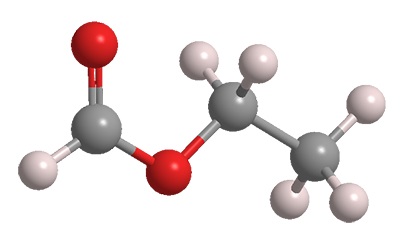
Ethyl formate is an ester formed when ethanol (an alcohol) reacts with formic acid (a carboxylic acid). It is also known as ethyl methanoate because formic acid is also known as methanoic acid. Ethyl formate has the characteristic smell of rum and is also partially responsible for the flavor of raspberries.
Physikalische Eigenschaften
Colorless and transparent liquid, volatile, with a pleasant, fruity odor. Miscible with ethanol and ether, soluble in acetone. The solubility in water is 11.8g/100ml.
Occurrence
Reported in the oil of Boronia dentigeroides; it has been identified in Florida orange juice, several varieties of
honey, apple and pear and in distilled liquors, such as rum. Also reported found in peach, raspberry, strawberry, pineapple, cabbage,
vinegar, cheeses, butter, cream, milk powder, cooked beef, beer, coffee, tea, honey, corn oil, brandy and mussels.
Verwenden
Ethyl Formate is a flavoring agent that occurs naturally in some plant oils, fruits, and juices but does not occur naturally in the ani- mal kingdom. it is used in food at a maximum level, as served, of 0.05% in baked goods; 0.04% in chewing gum, hard candy, and soft candy; 0.02% in frozen dairy desserts; 0.03% in gelatins, puddings, and fillings; and 0.01% in all other food categories.
Ethyl formate is also used as a solvent for nitrocellulose; as fungicide and larvicide for tobacco, cereals, dried fruits, etc.; in organic synthesis.
synthetische
Ethyl Formate is an ester of formic acid and is prepared by esterification of formic acid with ethyl alcohol or by distillation of ethyl acetate and formic acid in the presence of concentrated sulfuric acid.
Definition
ChEBI: Ethyl formate is a formate ester resulting from the formal condensation of formic acid with ethanol. It has a role as a fumigant and a plant metabolite. It is a formate ester and an ethyl ester.
Allgemeine Beschreibung
A clear colorless liquid with a pleasant odor. Flash point -4°F. Less dense than water. Vapors heavier than air.
Air & Water Reaktionen
Highly flammable. Soluble in water. Slowly decomposed by water to formic acid, a corrosive material and ethyl alcohol, another flammable liquid.
Reaktivität anzeigen
Ethyl formate is an ester. Esters react with acids to liberate heat along with alcohols and acids. Strong oxidizing acids may cause a vigorous reaction that is sufficiently exothermic to ignite the reaction products. Heat is also generated by the interaction of esters with caustic solutions. Flammable hydrogen is generated by mixing esters with alkali metals and hydrides. Ethyl formate is incompatible with the following: Nitrates; strong oxidizers, alkalis & acids [Note: Decomposes slowly in water to form ethyl alcohol and formic acid.] .
Health Hazard
The irritant action of ethyl formate inthe eyes, nose, and mucous membranes ismilder than that of methyl formate. How ever it is more narcotic than the methylester. Cats exposed to 10,000 ppm died after90 minutes, after deep narcosis. A 4-hourexposure to 8000 ppm was lethal to rats.Inhalation of 5000 ppm for a short periodproduces eye and nasal irritation and salivation in rats. The toxic effects from ingestion include somnolence, narcosis, gastritis,and dyspnea. The oral LD50 values in various test animals range between 1000 and2000 mg/kg.
Brandgefahr
Highly flammable liquid. Vapor is heavier than air and may travel long distance to a source of ignition and flash back. A very dangerous fire and explosion hazard when exposed to heat, flame, or oxilzers. To fight fire, use alcohol foam, spray, mist, dry chemical. When heated to decomposition it emits acrid smoke and irritating fumes.
Landwirtschaftliche Anwendung
Plant volatiles such as ethyl formate have been shown to have insecticidal properties as fumigant. The efficacy of ethyl formate against insect pests of food commodities, bagged cereals, spices, pulses, dry fruits and oilcakes had been proved. The fumigant was known to provide a high mortality of mixed stage cultures of the key stored product pests, with limited efficacy against the pupal stage of few pests like S. oryzae. The advantages of ethyl formate include natural occurrence in food; rapid kill of insects (2-4 hours); fast breakdown of residues to natural products and low human toxicity. However the fumigant exhibits poor penetration characteristics and high doses (>120 g/t of grain) were required to control internal feeders, which was higher than the flammable limit of 85 g/t. Formulations of ethyl formate in liquid carbon dioxide were found to overcome the problems of flammability and poor penetration.
Sicherheit(Safety)
Ethyl methanoate is generally recognized as safe by the U.S. Food and Drug Administration.
According to the U.S Occupational Safety and Health Administration (OSHA), ethyl formate can irritate eyes, skin, mucous membranes, and the respiratory system of humans and other animals; it is also a central nervous system depressant.
Moderately toxic by ingestion and subcutaneous routes. Mddly toxic by skin contact and inhalation. A powerful inhalation irritant in humans. A skin and eye irritant. Questionable carcinogen with experimental tumorigenic data.
mögliche Exposition
In industry, Ethyl formate is used as a solvent for cellulose nitrate, cellulose acetate, oils, and greases. It can be used as a substitute for acetone; workers may also be exposed to it under the following circumstances:
during spray, brush, or dip applications of lacquers
during the manufacture of safety glass
When fumigating tobacco, cereals, and dried fruits (as an alternative to methyl bromide under the U.S. Department of Agriculture quarantine system).
Environmental Fate
Photolytic. Reported rate constants for the reaction of ethyl formate and OH radicals in the
atmosphere (296 K) and aqueous solution are 1.02 x 10
-11 and 6.5 x 10
-13 cm
3/moleculesec,
respectively (Wallington et al., 1988b).
Chemical/Physical. Slowly hydrolyzes in water forming ethanol and formic acid (Windholz et
al., 1983).
Versand/Shipping
UN1190 Ethyl formate, Hazard Class: 3; Labels:
3-Flammable liquid
läuterung methode
Free acid or alcohol is removed by standing the ester over anhydrous K2CO3, with occasional shaking, then decanting and distilling from P2O5. Alternatively, the ester can be kept over CaH2 for several days, then distilled from fresh CaH2. It cannot be dried with CaCl2 because it reacts rapidly with the ester to form a crystalline compound. [Beilstein 2 IV 23.]
Inkompatibilitäten
May form explosive mixture with air.
Reacts violently with nitrates, strong oxidizers, strong
alkalis, and strong acids. Decomposes slowly in water,
forming ethyl alcohol and formic acid. May accumulate
static electrical charges, and may cause ignition of its
vapors
Waste disposal
Spray into a furnace in
admixture with a flammable solvent
Ameisensäure-ethylester Upstream-Materialien And Downstream Produkte
Upstream-Materialien
Downstream Produkte
Thiamin
4-CHLORO-2-(TRIFLUOROMETHYL)PYRIMIDINE
4-CHLORO-1-ETHYL-3-METHYL-1H-PYRAZOLE-5-CARBOXYLIC ACID ETHYL ESTER
2-AMINO-4-METHYLOXAZOLE
1-Methyl-2-imidazolecarboxaldehyde
METHYL 3-AMINO-6-METHYLTHIOPHENO[2,3-B]PYRIDINE-2-CARBOXYLATE
Indan-1,2,3-trion
Pyrimidin-4,5,6-triyltriamin
2-Chloro-6-methyl-3-pyridinecarbonitrile
N-(2,4-Dimethylphenyl)-N'-methylformamidinmonohydrochlorid
5-Acetamidomethyl-4-Amino-2-Methyl pyrimidine
6-Methyl-1H-pyrazolo[3,4-b]pyridin-3-amine
5-PROPYL-2-THIOURACIL
Methyl 3-amino-4-phenylthiophene-2-carboxylate
7-Aminoisoquinoline
7-Amino-1H-triazolo[4,5-d]pyrimidin
Tropasure
5-BROMO-4-HYDROXY-2-METHYLPYRIMIDINE
4-HYDROXY-2-METHYLPYRIMIDINE
2-AMINO-PYRIMIDINE-5-CARBOXYLIC ACID ETHYL ESTER
5-N-PROPYLURACIL
7-Bromoisoquinoline
4-Methoxybut-3-en-2-on
4-METHYLPYRIMIDIN-2-OL HYDROCHLORIDE
α-Dimethoxymethyl-methoxypropionitrile
(S)-(-)-α,α-Diphenyl-2-pyrrolidinemethanol
4,5-DIBROMOTHIOPHENE-2-CARBOXALDEHYDE
2-(TRIFLUOROMETHYL)PYRIMIDIN-4-AMINE
4-chloro-5-fluoropyrimidine
EPOSTANE
1,2-Dihydro-6-methyl-2-oxonicotinonitril
A-(HYDROXYMETHYL)BENZENACETIC ACID METHYL ESTER
1,1-Diethoxy-3,7-dimethylocta-2,6-dien
3,4-Dihydroisochinolin
4-Hydroxy-2-(trifluoromethyl)pyrimidine
4-Chloropyridine-3-carboxaldehyde
N-Methylformamid
7-NITRO-3,4-DIHYDROISOQUINOLINE
1-(PHENYLSULFONYL)-1H-INDOLE-2-CARBALDEHYDE
2-Aminopyrimidine-5-carbonitrile