


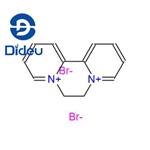
Diquat dibromide

- CAS No.
- 85-00-7
- Chemical Name:
- Diquat dibromide
- Synonyms
- DIQUAT DIBROMIDE D4;pp100;Dquat;reglon;Reward;Reglox;KIAA0571;preeglone;weedtrine-d;ortho-diquat
- CBNumber:
- CB4384274
- Molecular Formula:
- C12H12Br2N2
- Molecular Weight:
- 344.05
- MDL Number:
- MFCD01074187
- MOL File:
- 85-00-7.mol
- MSDS File:
- SDS
- TDS File:
- TDS
| Melting point | 337°C |
|---|---|
| Density | 1.25 |
| vapor pressure | 0Pa at 25℃ |
| refractive index | 1.6800 (estimate) |
| storage temp. | -20°C |
| solubility | DMSO (Slightly), Water (Slightly) |
| form | Crystals |
| color | Pale yellow |
| Water Solubility | Soluble. 70 g/100 mL |
| Henry's Law Constant | 7.0×10⁷ mol/(m3Pa) at 25℃, HSDB (2015) |
| Exposure limits | TLV-TWA 0.5 mg/m3 (ACGIH and MSHA). |
| Stability | Hygroscopic |
| LogP | -4.6 at 20℃ |
| CAS DataBase Reference | 85-00-7(CAS DataBase Reference) |
| FDA UNII | 6BDV3T272W |
| EPA Substance Registry System | Diquat dibromide (85-00-7) |
| Pesticides Freedom of Information Act (FOIA) | Diquat dibromide |
SAFETY
Risk and Safety Statements
| Symbol(GHS) |    GHS08,GHS09,GHS06 |
|||||||||
|---|---|---|---|---|---|---|---|---|---|---|
| Signal word | Danger | |||||||||
| Hazard statements | H319-H335-H410-H315-H302-H372-H317-H330 | |||||||||
| Precautionary statements | P261-P272-P280-P302+P352-P333+P313-P321-P363-P501-P260-P271-P284-P304+P340-P310-P320-P403+P233-P405-P501-P273-P391-P501-P260-P264-P270-P314-P501-P264-P280-P302+P352-P321-P332+P313-P362-P264-P280-P305+P351+P338-P337+P313P-P264-P270-P301+P312-P330-P501 | |||||||||
| Hazard Codes | T | |||||||||
| Risk Statements | 21-25 | |||||||||
| Safety Statements | 36/37-45 | |||||||||
| RIDADR | UN 2781/2811 | |||||||||
| OEB | C | |||||||||
| OEL | TWA: 0.5 mg/m3 | |||||||||
| HazardClass | 6.1(a) | |||||||||
| PackingGroup | II | |||||||||
| Hazardous Substances Data | 85-00-7(Hazardous Substances Data) | |||||||||
| Toxicity | LC50 (96-hour) for rainbow trout 21 mg/L, mirror carp 67 mg/L (Worthing and Hance, 1991), fathead minnow 14 mg/L, largemouth bass 7.8 mg/L (Surber and Pickering, 1962), bluegill sunsh 35 mg/L, walleye 2.1 mg/L (Gilderhus, 1967) and striped bass 0.25 ppm (Wellborn, 1969); LC50 (96-hour) for northern pike 16 mg/L, rainbow trout 11.2 mg/L (Gilderhus, 1967); acute oral LD50 for rats is 230 mg/kg (Ashton and Monaco, 1991), 120 mg/kg (RTECS, 1985). | |||||||||
| REACH Registrations | Active | |||||||||
| NFPA 704 |
|
Diquat dibromide price More Price(21)
| Manufacturer | Product number | Product description | CAS number | Packaging | Price | Updated | Buy |
|---|---|---|---|---|---|---|---|
| Cayman Chemical | 26251 | Diquat (bromide) ≥95% | 85-00-7 | 5mg | $49 | 2026-04-30 | Buy |
| Cayman Chemical | 26251 | Diquat (bromide) ≥95% | 85-00-7 | 10mg | $86 | 2026-04-30 | Buy |
| Cayman Chemical | 26251 | Diquat (bromide) ≥95% | 85-00-7 | 25mg | $190 | 2026-04-30 | Buy |
| TRC | TRC-D263085-500MG | Diquat Dibromide | 85-00-7 | 500mg | $130 | 2026-06-03 | Buy |
| TRC | TRC-D263085-1G | Diquat Dibromide | 85-00-7 | 1g | $211 | 2026-06-03 | Buy |
Diquat dibromide Chemical Properties, Uses, Production
Description
Diquat (DQ) is a bipyridyl herbicide that has been in use since the 1950s. It is employed as a general use herbicide that is fast acting and nonselective. Additionally, on average, 90% of DQ consumption is reported in North America, Europe, Australia, and Japan.
Chemical Properties
Pale yellow crystals; forms monohydrate; mp320°C (608 °F) (decomposes); readily solublein water, insoluble in organic solvents; stablein acids or neutral solution.
Uses
Nonselective contact herbicide used to control broad-leaved weeds in fruit and vegetable crops.
Uses
DQ is used in a manner similar to paraquat. It is found predominantly as a mixture with paraquat, sold as Weedol and Pathclear. The most widely used formulation of DQ alone, Reglone, is an aqueous solution containing 200 g l-1 DQ dibromide. Besides the use as a general weed control agent on noncrop land, DQ is used as a preharvest desiccant on crops such as cotton, flax, and alfalfa. Additionally, almost one-third of all DQ sold is used to control emergent and subemergent aquatic weeds.
Uses
Diquat Dibromide is a herbicidal desiccant.
Production Methods
The commercial production of diquat dibromide involves a multi-step process. It begins with the quaternisation of 2,2'-bipyridine with 1,2-dibromoethane in a polar solvent, such as acetonitrile, under controlled temperature and pressure to form the cyclic ethylene-bridged bipyridylium structure. The reaction mixture is then treated with bromide salts to ensure the dibromide form.
Health Hazard
The acute toxicity of diquat dibromide ismoderate to high in most species. In domes-tic animals, its toxicity is greater than thatin small laboratory animals. The oral LD50value in cows, dogs, rabbits, and mice is30, 187, 188, and 233 mg/kg, respectively.The symptoms of acute toxicity are somnolence, lethargy, pupillary dilation, and respiratory distress. Prolonged exposure to thiscompound produced cataracts in experimental animals. Intratracheal administration ofdiquat dibromide in rats showed toxic effectsin the lung and caused lung damage (Manabeand Ogata 1986). But when administered byoral or intravenous routes, there was no toxiceffect on the lung.
Flammability and Explosibility
Not classified
Mechanism of action
Non-selective, contact absorbed through foliage, some desiccant action. Photosystem I (electron transport) inhibitor.
Safety Profile
Poison by ingestion, subcutaneous, intravenous, and intraperitoneal routes. Experimental teratogenic and reproductive effects. A skin and eye irritant. Human mutation data reported. When heated to decomposition it emits very toxic fumes of NOx, and Br-. See also PARAQUAT
Environmental Fate
Biological. Under aerobic and anaerobic conditions, the rate of diquat mineralization in eutrophic water and sediments was very low. After 65 days, only 0.88 and 0.21% of the applied amount (5 μg/mL) evolved as carbon dioxide (Simsiman and Chesters, 1976). Diquat is readily mineralized to carbon dioxide in nutrient solutions containing microorganisms. The addition of montmorillonite clay in an amount equal to adsorb one-half of the diquat decreased the amount of carbon dioxide by 50%. Additions of kaolinite clay had no effect on the amount of diquat degraded by microorganisms (Weber and Coble, 1968).
Photolytic. Diquat has an absorption maximum of 310 nm (Slade and Smith, 1967). The sunlight irradiation of a diquat solution (0.4 mg/100 mL) yielded 1,2,3,4-tetrahydro1-oxopyrido[1,2-a]-5-pyrazinium chloride (TOPPS) as the principal metabolite.
Chemical/Physical. Decomposes at 320°C (Windholz et al., 1983) emitting toxic fumes of bromides and nitrogen oxides (Lewis, 1990). Diquat absorbs water forming welldened, pale yellow crystalline hydrate (Calderbank and Slade, 1976).
In aqueous alkaline solutions, diquat decomposes forming complex colored products including small amounts of dipyridone (Calderbank and Slade, 1976).
Toxicity evaluation
DQ is a dipyridyl compound that is capable of redox cycling. DQ can become reduced to produce a free radical. It can then transfer this electron to molecular oxygen to yield superoxide anion. This redox cycling mechanism allows DQ to generate reactive oxygen species (ROS) resulting in oxidative stress, damage to cellular macromolecules and even cell death. Due to its standard redox potential (E0), DQ is more likely to accept an electron compared to paraquat. Because of this property, DQ is expected to generate greater amounts of ROS compared to paraquat at equivalent concentrations. In vitro studies have shown that DQ is dependent on mitochondrial complex I and III in isolated mitochondria and primarily complex III in midbrain neuronal cultures for ROS production. DQ treatment can lead to NADPH depletion, lipid peroxidation, alteration in intracellular redox status, and liberation of ferritin-bound iron stores.
Pesticide Type
Herbicide
Diquat dibromide Preparation Products And Raw materials
Raw materials
Preparation Products
| Supplier | Tel | Country | ProdList | Advantage | |
|---|---|---|---|---|---|
| Sichuan Kulinan Technology Co., Ltd | 400-1166-196 18981987031 | cdhxsj@163.com | China | 11674 | 57 |
| Clearsynth Labs Limited | +91-22-26355700 | info@clearsynth.com | India | 9656 | 58 |
| Finetech Industry Limited | 027-87465837 19945049750 | sales@finetechnology-ind.com | China | 9331 | 58 |
| Hunan HuaTeng Pharmaceutical Co., Ltd., | 400-8592883 15367835770 | sales@huatengsci.com | China | 5869 | 58 |
| Shanghai Macklin Biochemical Co.,Ltd. | 15221275939 15221275939 | shenlinxing@macklin.cn | China | 15775 | 55 |
| Chizhou Kailong Import and Export Trade Co., Ltd. | xg01_gj@163.com | China | 9413 | 50 | |
| Taizhou Ruixin Chemical Co., Ltd. | 0576-89085261 15867635987 | jasonhu09@163.com | China | 439 | 50 |
| Shanghai YuanYe Biotechnology Co., Ltd. | 15026964105 | 2881489226@qq.com | China | 89667 | 60 |
| Amadis Chemical Company Limited | 571-89925085 | sales@amadischem.com | China | 131885 | 58 |
| Shanghai Orgchem Co.,Ltd. | +86-21-5877 1921 | info@chemofchina.com | China | 9630 | 55 |
Related articles
- Toxicity of Diquat (DQ)
- Diquat (DQ) is a bipyridyl herbicide that has been in use since the 1950s. It is employed as a general use herbicide that is f....
- Oct 15,2021
View Latest Price from Diquat dibromide manufacturers
| Image | Update time | Product | Price | Min. Order | Purity | Supply Ability | Manufacturer | |
|---|---|---|---|---|---|---|---|---|
 |
2026-06-30 | Diquat dibromide
85-00-7
|
1kg | 98% | 1000kg | Shaanxi Dideu New Materials Co. Ltd | ||
 |
2020-02-20 | Diquat dibromide
85-00-7
|
$1.00 | 1KG | 98%HPLC | 10Tons | Career Henan Chemical Co |
-
- Diquat dibromide
85-00-7
- $0.00
- 98%
- Shaanxi Dideu New Materials Co. Ltd
-
- Diquat dibromide
85-00-7
- $1.00
- 98%HPLC
- Career Henan Chemical Co
