


Triclopyr
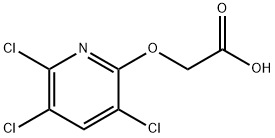
- CAS No.
- 55335-06-3
- Chemical Name:
- Triclopyr
- Synonyms
- TricL;TRICLOPYR ACID;Rely;opyr;Mutan;M 3724;Exetor;Garlon;Redeem;Remedy
- CBNumber:
- CB4666264
- Molecular Formula:
- C7H4Cl3NO3
- Molecular Weight:
- 256.47
- MDL Number:
- MFCD00072514
- MOL File:
- 55335-06-3.mol
- MSDS File:
- SDS
- TDS File:
- TDS
| Melting point | 148-150°C |
|---|---|
| Boiling point | 290°C |
| Density | 1.7626 (rough estimate) |
| refractive index | 1.6200 (estimate) |
| storage temp. | Sealed in dry,Room Temperature |
| solubility | Chloroform (Slightly), Ethyl Acetate (Slightly), Methanol (Slightly) |
| form | Liquid |
| pka | 2.68(at 25℃) |
| color | Fluffy solid |
| Water Solubility | 0.43g/L(temperature not stated) |
| Merck | 13,9730 |
| BRN | 225301 |
| Henry's Law Constant | 1.0×10⁴ mol/(m3Pa) at 25℃, Duchowicz et al. (2020) |
| Major Application |
agriculture environmental |
| InChI | 1S/C7H4Cl3NO3/c8-3-1-4(9)7(11-6(3)10)14-2-5(12)13/h1H,2H2,(H,12,13) |
| InChIKey | REEQLXCGVXDJSQ-UHFFFAOYSA-N |
| SMILES | OC(=O)COc1nc(Cl)c(Cl)cc1Cl |
| CAS DataBase Reference | 55335-06-3(CAS DataBase Reference) |
| FDA UNII | MV06PHJ6I0 |
| NIST Chemistry Reference | Acetic acid, [(3,5,6-trichloro-2-pyridinyl)oxy]-(55335-06-3) |
| EPA Substance Registry System | Triclopyr (55335-06-3) |
| Pesticides Freedom of Information Act (FOIA) | Triclopyr |
| UNSPSC Code | 41116107 |
| NACRES | NA.24 |
SAFETY
Risk and Safety Statements
| Symbol(GHS) |  GHS07 |
|||||||||
|---|---|---|---|---|---|---|---|---|---|---|
| Signal word | Warning | |||||||||
| Hazard statements | H302-H319-H371-H373-H410 | |||||||||
| Precautionary statements | P501-P273-P260-P270-P264-P280-P391-P337+P313-P305+P351+P338-P308+P311-P301+P312+P330-P405 | |||||||||
| PPE | dust mask type N95 (US), Eyeshields, Gloves | |||||||||
| Hazard Codes | Xn | |||||||||
| Risk Statements | 22 | |||||||||
| Safety Statements | 22-24/25 | |||||||||
| RIDADR | UN3082 (liquid) | |||||||||
| WGK Germany | 3 | |||||||||
| RTECS | AJ9000000 | |||||||||
| TSCA | TSCA listed | |||||||||
| HS Code | 2933.39.2500 | |||||||||
| Storage Class | 11 - Combustible Solids | |||||||||
| Hazard Classifications | Acute Tox. 4 Oral | |||||||||
| Hazardous Substances Data | 55335-06-3(Hazardous Substances Data) | |||||||||
| Toxicity | LD50 orally in rats: 713 mg/kg (Kenaga) | |||||||||
| NFPA 704 |
|
Triclopyr price More Price(45)
| Manufacturer | Product number | Product description | CAS number | Packaging | Price | Updated | Buy |
|---|---|---|---|---|---|---|---|
| Sigma-Aldrich | CRM32016 | Triclopyr certified reference material, TraceCERT?, Manufactured by: Sigma-Aldrich Production GmbH, Switzerland | 55335-06-3 | 50MG | $86.9 | 2026-04-30 | Buy |
| Sigma-Aldrich | 32016 | Triclopyr PESTANAL | 55335-06-3 | 250mg | $38.5 | 2026-04-30 | Buy |
| TCI Chemical | T3742 | Triclopyr | 55335-06-3 | 5G | $77 | 2026-04-30 | Buy |
| TCI Chemical | T3742 | Triclopyr | 55335-06-3 | 25G | $231 | 2026-04-30 | Buy |
| TRC | TRC-T773820-5G | Triclopyr | 55335-06-3 | 5g | $471 | 2026-06-03 | Buy |
Triclopyr Chemical Properties, Uses, Production
Chemical Properties
White to Off-White Solid
Uses
Selective postemergence herbicide to control many woody and broad-leaved weeds.
Uses
Triclopyr is a selective post-emergence herbicide.
Definition
ChEBI: A monocarboxylic acid that is (pyridin-2-yloxy)acetic acid substituted by chloro groups at positions 3, 5 and 6. It is an agrochemical used as a herbicide.
Agricultural Uses
Herbicide: Triclopry is a systemic herbicide used on rice, range land and pasture, rights-of-way, forestry and grasslands, including home lawns, for control of broadleaf weeds and woody plants. Triclopry is usually available as a triclopyr butoxyethyl ester (BEE) or as a triclopry triethylamine salt (TEA). Registered for use in the U.S. Some products may be classified as Restricted Use Pesticides (RUP). Registered for use in EU countries . U.S. Maximum Allowable Residue Levels for Triclopyr and its metabolites 3,5,6,-trichloro-2-pyridinol and 2-methoxy-3,5,6-trichloropyridine [40 CFR 180.417 (a)(1)]: for the combined residues of the herbicide in or on the following raw agricultural commodities: fish 3.0 ppm; grass, forage 500 ppm; grass, forage, hay 500 ppm;shellfish3.5 ppm.[40 CFR 180.417 (a)(2)]: in or on the following agricultural commodities: egg 0.05 ppm; meat, fat, and meat byproducts, except kidney and liver, of cattle, goat, hog, horse and sheep 0.05 ppm; meat, fat, and meat byproducts, except kidney, of poultry 0.1 ppm; milk 0.01 ppm; liver and kidney of cattle, goat, hog, horse and sheep 0.5 ppm; rice, grain 0.3 ppm; rice, straw10.0 ppm.
Trade name
[Note: See the following record, Triclopyr, triethylamine salt, for trade names containing the salt of triclopry] ACCESS®; CROSSBOW®, (triclopyr + 2,4-D ester); ET®; GARLON®; GRAZON® Triclopyr; PATHFINDER®; REDEEM®; RELY®; REMEDY®; RIVERDALE TAHOE® Nufarm (Australia); TURFLON®
Mechanism of action
Selective, systemic, absorbed through roots and foliage. Synthetic auxin.
Safety Profile
Moderately toxic by ingestion. Anexperimental teratogen. Experimental reproductiveeffects. Used as an herbicide. When heated todecomposition it emits toxic fumes of Clí and NOx.
Synthesis

60825-27-6

55335-06-3
The general procedure for the synthesis of 2-((3,5,6-trichloropyridin-2-yl)oxy)acetic acid from the compound (CAS: 60825-27-6) is as follows: in a reactor equipped with a mechanical stirrer, a thermometer casing, and a reflux condenser, 0.404 mol of trichloromethyl ethyl ester was added. Subsequently, an appropriate amount of water was added to prepare a 10% aqueous slurry. Next, 19.42 g (0.485 moles) of sodium hydroxide (NaOH) was added. The slurry was heated to 80°C and the reaction was maintained at this temperature for 3.5 hours. Upon completion of the reaction, the reaction mixture was cooled to room temperature. Then, 115 ml of 4% sodium hypochlorite (NaOCl) solution was added and the mixture was stirred for 30 minutes. After that, the reaction mixture was acidified with sulfuric acid to a pH of 1-2, at which point a white precipitate was produced. The precipitate was filtered and dried to give the final target product 2-((3,5,6-trichloropyridin-2-yl)oxy)acetic acid in 93% yield.
Environmental Fate
Soil. In soil, triclopyr degraded to 3,5,6-trichloro-2-pyridinol and 2-methoxy-3,5,6-
trichloropyridine (Norris et al., 1987). The major route of dissipation from soil is likely
due to microbial degradation (Newton et al., 1990).
Fifty-four days after triclopyr was applied to soil at a rate of 5.6 kg/ha, the majority
(65%) remained in the top 10 cm of soil (Lee et al., 1986a).
Ashton and Monaco (1991) reported triclopyr had an average half-life of 46 days and
is inuenced by soil type and climatic conditions.
Plant. Lewer and Owen (1989) found 3,5,6-trichloro-2-pyridinol as the major metab-
olite in plants. Cultured soybean cells metabolized triclopyr to dimethyl triclopyr-aspartate
and dimethyl triclopyr-glutamate which can be rehydrolyzed to form the parent compound.
At an application rate of 3.4 kg/ha, the dissipation half-life was 3.7 days. At an
application rate of 3.3 kg/ka, the dissipation half-lives of triclopyr in brown, browse and
litter samples were 73.5, 202.3 and 31 days, respectively (Norris et al., 1987).
Metabolic pathway
After 7 days in a soybean cell suspension culture, the major metabolites of trichlopyr are formed and identified as the aspartate (major) and glutamate (minor) amide conjugates.
Metabolism
The average half-life of triclopyr in soil is 46 days. Because triclopyr is sensitive to light, the length of time that it remains on the surface may moderate its persistence. Adsorption to soil is limited and is governed by the anion exchange capacity. Insignificant amounts are lost via volatilization. The propensity of triclopyr to translocate in the environment with soil water, is unknown.
Toxicity evaluation
The acute oral LD50 of triclopyr is 692 mg/kg and 577 mg/kg for male and female rat, respectively. It does not appear to undergo significant transformation and is excreted in the urine primarily unchanged.
References
[1] Patent: WO2010/23679, 2010, A2. Location in patent: Page/Page column 9; 10
[2] Patent: EP3210992, 2017, A1. Location in patent: Paragraph 0066; 0068
[3] Patent: CN102718700, 2016, B. Location in patent: Paragraph 0065-0067
Pesticide Type
Herbicide

Triclopyr Preparation Products And Raw materials
| Supplier | Tel | Country | ProdList | Advantage | |
|---|---|---|---|---|---|
| Maikeshi (East) Ltd. | -- | max@maxchemicals.com | China | 58 | 34 |
| J & K SCIENTIFIC LTD. | 18210857532 18210857532 | jkinfo@jkchemical.com | China | 96815 | 76 |
| TAIYUAN RHF CO.,LTD. | +86 351 7031519 | sales@RHFChem.com | China | 2334 | 56 |
| Shanghai Hanhong Scientific Co.,Ltd. | 021-54306202 13764082696 | info@hanhongsci.com | China | 42917 | 64 |
| Chemsky(shanghai)International Co.,Ltd. | 021-50135380 | shchemsky@sina.com | China | 32273 | 50 |
| Sichuan Kulinan Technology Co., Ltd | 400-1166-196 18981987031 | cdhxsj@163.com | China | 11674 | 57 |
| Shanghai Sunway Pharmaceutical Technology Co., Ltd | 13761987713 | hxzheng@sunwaypharm.cn | China | 8663 | 57 |
| TOKYO CHEMICAL INDUSTRY CO., LTD. | 03-36680489 | Sales-JP@TCIchemicals.com | Japan | 28364 | 80 |
| Shanghai Aladdin Bio-Chem Technology Co.,LTD | 400-6206333 13167063860 | anhua.mao@aladdin-e.com | China | 29985 | 65 |
| Nanjing Sunlida Biological Technology Co., Ltd. | 025-57798810 18652991625 | sales@sunlidabio.com | China | 3223 | 55 |


55335-06-3 (Triclopyr) Related Search:
1of4
