


2,4,6,8-Tetramethyl-1,3,5,7-Tetraoxacyclooctane

- CAS No.
- 108-62-3
- Chemical Name:
- 2,4,6,8-Tetramethyl-1,3,5,7-Tetraoxacyclooctane
- Synonyms
- Metaldehyde;Tetramer;1,3,5,7-Tetroxocane, 2,4,6,8-tetramethyl-;Ariotox;Halizan;Namekil;Helarion;Slug-tox;Antimilace;Metaldehyd
- CBNumber:
- CB9852756
- Molecular Formula:
- C8H16O4
- Molecular Weight:
- 176.21
- MDL Number:
- MFCD00071549
- MOL File:
- 108-62-3.mol
- MSDS File:
- SDS
- TDS File:
- TDS
| Melting point | 246 °C |
|---|---|
| Boiling point | 65°C/15mmHg(lit.) |
| Density | 1.27 |
| vapor pressure | 6.6Pa at 25℃ |
| refractive index | 1.4220 (estimate) |
| Flash point | 50°C |
| storage temp. | Keep in dark place,Sealed in dry,2-8°C |
| solubility | Chloroform (Slightly), Methanol (Slightly) |
| form | Fine Crystalline Powder |
| color | White |
| Water Solubility | 0.02 g/100 mL (20 ºC) |
| Sublimation | 112-115 ºC |
| Henry's Law Constant | 1.9×10⁻¹ mol/(m3Pa) at 25℃, HSDB (2015) |
| LogP | 0.12 at 20℃ |
| CAS DataBase Reference | 108-62-3(CAS DataBase Reference) |
| EWG's Food Scores | 1 |
| FDA UNII | 4CI033VJYG |
| NIST Chemistry Reference | Acetaldehyde, tetramer(108-62-3) |
| Pesticides Freedom of Information Act (FOIA) | Metaldehyde |
| EPA Substance Registry System | Metaldehyde (108-62-3) |
SAFETY
Risk and Safety Statements
| Symbol(GHS) |   GHS02,GHS06 |
|||||||||
|---|---|---|---|---|---|---|---|---|---|---|
| Signal word | Danger | |||||||||
| Hazard statements | H228-H301-H313-H330 | |||||||||
| Precautionary statements | P301+P310a-P304+P340-P320-P330-P405-P501a | |||||||||
| Hazard Codes | Xn | |||||||||
| Risk Statements | 10-22-2017/10/22 | |||||||||
| Safety Statements | 13-25-46-2 | |||||||||
| RIDADR | UN 1332 | |||||||||
| RTECS | XF9900000 | |||||||||
| HazardClass | 4.1 | |||||||||
| PackingGroup | III | |||||||||
| HS Code | 29125000 | |||||||||
| Hazardous Substances Data | 108-62-3(Hazardous Substances Data) | |||||||||
| REACH Registrations | Active | |||||||||
| NFPA 704 |
|
2,4,6,8-Tetramethyl-1,3,5,7-Tetraoxacyclooctane price More Price(10)
| Manufacturer | Product number | Product description | CAS number | Packaging | Price | Updated | Buy |
|---|---|---|---|---|---|---|---|
| TCI Chemical | M0076 | Metaldehyde >97.0%(T) | 108-62-3 | 25g | $32 | 2026-04-30 | Buy |
| TCI Chemical | M0076 | Metaldehyde >97.0%(T) | 108-62-3 | 500g | $118 | 2026-04-30 | Buy |
| ChemScene | CS-5210 | Metaldehyde 98.0% | 108-62-3 | 500mg | $27 | 2026-06-04 | Buy |
| TRC | M225560 | Metaldehyde | 108-62-3 | 5g | $185 | 2021-12-16 | Buy |
| Usbiological | 454428 | Metaldehyde | 108-62-3 | 1g | $319 | 2021-12-16 | Buy |
2,4,6,8-Tetramethyl-1,3,5,7-Tetraoxacyclooctane Chemical Properties,Uses,Production
Description
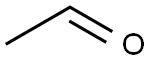
Metaldehyde (CAS: 108-62-3) is a polymer of acetaldehyde
that is used as a pesticide against snails and slugs, and also as
a fuel. It was discovered by von Liebig in 1835, and a century
later its use as a molluscicide was proposed by Gimingham and
Newton in 1937. It is manufactured by reacting acetaldehyde
with various acids at a low temperature. As a molluscicide,
metaldehyde is used for controlling slugs and snails in gardens
of a variety of vegetable and ornamental crops. For this purpose
it is available in both solid and liquid formulations with
metaldehyde concentrations ranging from 1.8 to 8% in pellet
form, or in concentrations of up to 20% in liquid formulations.
Some metaldehyde formulations may consist of other pesticides,
such as arsenic; while others may contain toxic solvents
like ethylene glycol. Therefore, a thorough forensic analysis of
the product is recommended to assess complete risk associated
with ingestion of these products.
Children under the age of 3 years and pets are most
commonly poisoned by ingestion of pellets or cakes containing
metaldehyde. Intoxication by metaldehyde is typically acute,
characterized initially by gastrointestinal and subsequently
followed predominantly by neurologic signs. Vomiting, diarrhea,
ataxia, tremors, convulsions, and hyperthermia are
among the most common toxic signs in children and animals.
Other clinical signs in children include mental confusion,
muscle cramps and tremors, loss of consciousness, and coma.
The proximate neurotoxic mechanisms are not known but
reduced levels of neurotransmitters such as serotonin and
g-aminobutryric acid (GABA) are implicated. Delayed effects of
acute exposure include hepatotoxicity characterized by hepatic
necrosis and increased serum liver enzymes. In general, males
metabolize metaldehyde twice as fast as females. Therefore,
female animals are more sensitive to metaldehyde poisoning
compared to males. Most of the neurotoxic signs are seen at
dose levels greater than 100 mg of metaldehyde per kilogram.
Developmental studies have shown that metaldehyde exposure
during pregnancy does not adversely affect fetuses.
Chronic metaldehyde exposure is unlikely. However,
experimental research has shown that metaldehyde is toxic
under chronic exposure conditions. In males, chronic metaldehyde
exposure causes testicular atrophy and is also toxic to
the prostate gland. It causes atrophy of the prostate gland. It is
not clear whether the effects on male gonads are due to
endocrine disruption or through a different mechanism. There
is also suggestive evidence of carcinogenic potential based on
the presence of benign tumors in female rats and mice of both
sexes.
Provided treatment is initiated early in cases of acute
exposure, prognosis is good. In dogs, the mortality rate in
a recently completed study was 16%. Because there is no
specific antidote, treatment consists of decontamination
measures and symptomatic therapy. Recent formulations of
metaldehyde pesticides contain denatonium benzoate,
a bittering agent. The purpose of adding the bittering agent
is to deter excessive ingestion of the products. This, along
with new labeling guidelines highlighting the risk to children
and pets has caused annual cases to drop significantly
since 2006.
Chemical Properties
white fine crystalline powder
Chemical Properties
Metaldehyde is a white crystalline powder with a mild menthol odor.
Uses
There are over 50 pesticides containing metaldehyde registered for use in the United States. It is commonly used as a pesticide against slugs and snails. It is formulated in ready to use liquid, paste, granules, pellets, minipellets, or meal baits. It is also used as a camping fuel. It may be purchased in a tablet form for the latter use.
Definition
ChEBI: Metaldehyde is a member of the class of tetroxocanes that is 1,3,5,7-tetroxocane which carries four methyl groups at positions 2,4,6 and 8. It is a potent molluscicide and the active ingredient in most slug pellets used for crop protection. It has a role as a molluscicide and a fuel.
Flammability and Explosibility
Flammable
Agricultural Uses
Molluscicide: A tetramer of acetaldehyde, metaldehyde is a molluscicide used in a variety of vegetable and ornamental crops in the field or greenhouse. It may be formulated with or without calcium arsenate and is also available in a mixed formulation with thiram. A U.S. EPA restricted Use Pesticide (RUP).
Trade name
ANTIMILACE®; ARIOTOX®; CEKUMETA®; DEADLINE®; DURHAM®; HALIZAN®; LIMATOR®; META®; METASON®; NAMEKIL®; SLUG-TOX®; TRAILS END®
Mechanism of action
Contact and stomach action. Decreases the concentration of gamma-aminobutyric acid, an inhibitory neurotransmitter that causes CNS excitation.
Safety Profile
Human poison by ingestion. Human systemic effects by ingestion: convulsions or effect on seizure threshold. Moderately toxic by inhalation and skin contact. Experimental reproductive effects. Mutation data reported. A flammable solid. When heated to decomposition it emits acrid smoke and irritating fumes. See also ALDEHYDES.
Synthesis
In a 1000-liter reactor, 560 kg of acetaldehyde at 0C is put in, and about 40 kg of ether is added and cooled to . -15C. The prepared acid catalyst, i.e., about 4 kg of hydrochloric acid, about 1 kg of ether, about 1 kg of pyridine, about of brominal. 0.5kg, pyridine about 1kg, bromoxynil about , and hydroxylamine hydrochloride about 0.3kg, were added to the polymerization kettle under constant stirring and cooling, and the temperature of the polymerization kettle was observed to control . Observe the polymerization kettle temperature control to control the rate of acid catalyst addition, so that the polymerization reaction temperature in the polymerization kettle does not exceed 0 , the acid catalyst is added to the polymerization kettle. After the acid catalyst is added, the temperature in the polymerization kettle is maintained at -10~-5 for about 3 hours with constant stirring and cooling, and then it can be released from the polymerization kettle and filtered, and the solid is removed from the polymerization kettle. Can be released from the polymerization kettle for filtration, the solids can be obtained after washing and drying white crystalline tetrameric acetaldehyde. The filtrate is sent to distillation . Kettle heating, add sulfuric acid as a catalyst, filtrate in the trimerization of acetaldehyde depolymerization, control depolymerization of the top temperature of the tower at 20 21 , acetaldehyde and ethyl ether distillation separated out, ready for the next feeding use.
Potential Exposure
It is used as a poison for slugs and snails, and as a fuel in small heaters.
First aid
If this chemical gets into the eyes, remove any contact lenses at once and irrigate immediately for at least 15 min, occasionally lifting upper and lower lids. Seek medical attention immediately. If this chemical contacts the skin, remove contaminated clothing and wash immediately with soap and water. Seek medical attention immediately. 1716 Metaldehyde If this chemical has been inhaled, remove from exposure, begin rescue breathing (using universal precautions, including resuscitation mask) if breathing has stopped and CPR if heart action has stopped. Transfer promptly to a medical facility. When this chemical has been swallowed, get medical attention. Give large quantities of water and induce vomiting. Do not make an unconscious person vomit.
Environmental Fate
Metaldehyde is of low persistence in the soil. It is degraded aerobically with a half-life of approximately 67 days to inactive residues. Metaldehyde is soluble in water. Metaldehyde undergoes rapid hydrolysis to acetaldehyde in an aquatic environment.
storage
Color Code—Red: Flammability Hazard: Store in a flammable storage area. Prior to working with metaldehyde you should be trained on its proper handling and storage. Store in tightly closed containers in a cool, wellventilated area away from strong oxidizers. Where possible, automatically transfer material from drums or other storage containers to process containers. Drums must be equipped with self-closing valves, pressure vacuum bungs, and flame arresters. Use only nonsparking tools and equipment, especially when opening and closing containers of this chemical. Wherever this chemical is used, handled, manufactured, or stored, use explosion-proof electrical equipment and fittings.
Shipping
UN1332 Metaldehyde, Hazard Class: 4.1; Labels: 4.1-Flammable solid
Toxicity evaluation
The toxic mechanism in snails and slugs is different from that in mammals and birds. Metaldehyde irreversibly damages mucous secreting cells of snails and slugs on which these organisms depend. In animals and birds, the proximate toxic mechanism of metaldehyde is not known, but is either due to toxicity of metaldehyde itself or of its metabolite acetaldehyde on the brain and other tissues. The fundamental neurotoxic molecular mechanisms are not known, but a depression of serotonin and GABA is suspected to play a role.
Incompatibilities
Incompatible with oxidizers (chlorates, nitrates, peroxides, permanganates, perchlorates, chlorine, bromine, fluorine, etc.); contact may cause fires or explosions. Keep away from alkaline materials, strong bases, strong acids, oxoacids, epoxides
Pesticide Type
Molluscicide

2,4,6,8-Tetramethyl-1,3,5,7-Tetraoxacyclooctane Preparation Products And Raw materials
| Supplier | Tel | Country | ProdList | Advantage | |
|---|---|---|---|---|---|
| Jiangsu Jialong Chemical Co., Ltd | -- | tjchun@jialongchem.com | China | 54 | 38 |
| Tianjin heowns Biochemical Technology Co., Ltd. | 400-6387771-6039 18920764717 | sales@heowns.com | China | 24636 | 60 |
| J & K SCIENTIFIC LTD. | 18210857532 18210857532 | jkinfo@jkchemical.com | China | 96815 | 76 |
| Meryer (Shanghai) Chemical Technology Co., Ltd. | 4006356688 18621169109 | market03@meryer.com | China | 40202 | 62 |
| future industrial shanghai co., ltd | 400-0066400 13621662912 | sales@jonln.com | China | 1989 | 65 |
| Alfa Aesar | 400-6106006 | saleschina@alfa-asia.com | China | 30103 | 84 |
| TCI (Shanghai) Development Co., Ltd. | 021-67121386 | Sales-CN@TCIchemicals.com | China | 24512 | 81 |
| Energy Chemical | 400-0056266 | sales8178@energy-chemical.com | China | 44850 | 61 |
| Adamas Reagent, Ltd. | 400-6009262 15618770481 | yhx@titansci.com | China | 14098 | 59 |
| Shandong Xiya Chemical Co., Ltd | 13355009207 13355009207 | 3007715519@qq.com | China | 18722 | 57 |
View Lastest Price from 2,4,6,8-Tetramethyl-1,3,5,7-Tetraoxacyclooctane manufacturers
| Image | Update time | Product | Price | Min. Order | Purity | Supply Ability | Manufacturer | |
|---|---|---|---|---|---|---|---|---|
 |
2026-09-10 | Metaldehyde
108-62-3
|
99.52% | 10g | TargetMol Chemicals Inc. | |||
 |
2025-12-24 | Metaldehyde
108-62-3
|
$49.00 | 1KG | 99.0% | 1000 tons | Shaanxi Dideu Medichem Co. Ltd | |
 |
2021-07-02 | Metaldehyde
108-62-3
|
$10.00-15.00 | 1KG | 99%+ HPLC | Zhuozhou Wenxi import and Export Co., Ltd |
-
- Metaldehyde
108-62-3
- $0.00
- 99.52%
- TargetMol Chemicals Inc.
-
- Metaldehyde
108-62-3
- $49.00
- 99.0%
- Shaanxi Dideu Medichem Co. Ltd
-
- Metaldehyde
108-62-3
- $10.00-15.00
- 99%+ HPLC
- Zhuozhou Wenxi import and Export Co., Ltd
108-62-3(2,4,6,8-Tetramethyl-1,3,5,7-Tetraoxacyclooctane)Related Search:
1of4
