|
|
| | H-Gly-Gly-AMC Basic information |
| Product Name: | H-Gly-Gly-AMC | | Synonyms: | H-Gly-Gly-AMC;Glycyl-N-(4-methyl-2-oxo-2H-1-benzopyran-7-yl)glycinamide;GG-AMC;Glycinamide, glycyl-N-(4-methyl-2-oxo-2H-1-benzopyran-7-yl)-;Gly-Gly-MCA;Gly-Gly-AMC | | CAS: | 208645-74-3 | | MF: | C14H15N3O4 | | MW: | 289.29 | | EINECS: | | | Product Categories: | | | Mol File: | 208645-74-3.mol | 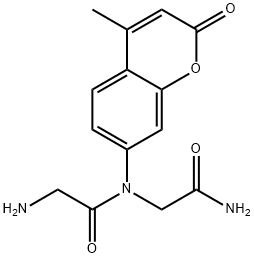 |
| | H-Gly-Gly-AMC Chemical Properties |
| Boiling point | 650.6±55.0 °C(Predicted) | | density | 1.372±0.06 g/cm3(Predicted) | | solubility | DMF: 1 mg/ml; DMSO: 20 mg/ml; Ethanol: 1 mg/ml; PBS (pH 7.2): 0.8 mg/ml | | form | A crystalline solid | | pka | 12.63±0.20(Predicted) | | Appearance | Solid Powder |
| | H-Gly-Gly-AMC Usage And Synthesis |
| Description | Gly-Gly-AMC is a fluorogenic peptide substrate. It has been used to assess the activity of bacterial proteases from P. aeruginosa and S. aureus.1 Activity can be quantified by fluorescent detection of free AMC (also known as 7-amino-4-methylcoumarin), which is excited at 340-360 nm and emits at 440-460 nm. | | Uses | Gly-Gly-AMC is a fluorogenic peptide substrate. Gly-Gly-AMC can be used to assess bacterial protease activity of P. aeruginosa and S. aureus[1][2]. | | References | 1. Wildeboer, D., Jeganathan, F., Price, R.G., et al. Characterization of bacterial proteases with a panel of fluorescent peptide substrates Anal. Biochem. 384(2),321-328(2009). | | Excitation / Emission Maximum | 340-360 nm/440-460 nm |
| | H-Gly-Gly-AMC Preparation Products And Raw materials |
|