|
|
| | Dihydrobromide Basic information |
| Product Name: | Dihydrobromide | | Synonyms: | Conessine HCl;Conessine hydrobromide;Konessin dihydrobromide;Neriine dihydrobromide | | CAS: | 5913-82-6 | | MF: | C24H41BrN2 | | MW: | 437.51 | | EINECS: | | | Product Categories: | | | Mol File: | 5913-82-6.mol | 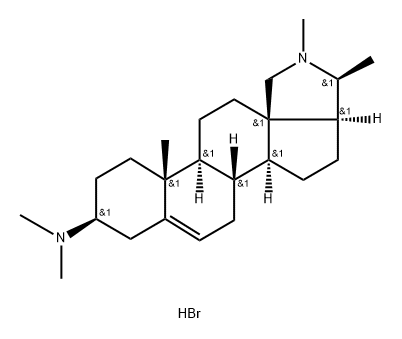 |
| | Dihydrobromide Chemical Properties |
| Melting point | 340 °C | | alpha | D20 +7.0° (c = 5 in H2O) |
| | Dihydrobromide Usage And Synthesis |
| Uses | Conessine dihydrobromide is a steroidal alkaloid and an effective, selective histamine H3 receptor antagonist with Ki values of 5.4, 6.0, 5.7, and 25 nM for human, dog, guinea pig, and rat H3 receptors, respectively. Conessine dihydrobromide exhibits antimalarial activity and can be used in infection-related research[1][2]. | | Definition | ChEBI: Conessine dihydrobromide is a steroid alkaloid. | | References | [1] Santora VJ, et al. A new family of H3 receptor antagonists based on the natural product Conessine. Bioorg Med Chem Lett. 2008;18(4):1490-1494 DOI:10.1016/j.bmcl.2007.12.059
[2] Kim H, et al. Conessine treatment reduces dexamethasone-induced muscle atrophy by regulating MuRF1 and atrogin-1 expression [published online ahead of print, 2018 Feb 1]. J Microbiol Biotechnol. 2018;10.4014.jmb.1711.11009 PMID:29385661 |
| | Dihydrobromide Preparation Products And Raw materials |
|