| Company Name: |
Alfa Chemistry |
| Tel: |
1-516-6625404 |
| Email: |
support@alfa-chemistry.com |
| Company Name: |
Alfa Chemistry |
| Tel: |
+1-5166625404; |
| Email: |
Info@alfa-chemistry.com |
3-Hydrazino-quinoxaline-2-thiol manufacturers
- HPi1
-

- $30.00
-
2026-08-08
- CAS:13080-21-2
- Purity: 98.80%
- Supply Ability: 10g
|
| | 3-Hydrazino-quinoxaline-2-thiol Basic information |
| Product Name: | 3-Hydrazino-quinoxaline-2-thiol | | Synonyms: | CHEMBRDG-BB 5215319;AKOS BBS-00008251;3-hydrazinoquinoxaline-2-thiol(SALTDATA: FREE);2(1H)-Quinoxalinethione, 3-hydrazinyl-;3-Hydrazinylquinoxaline-2-thiol;3-Hydrazinylquinoxaline-2(1H)-thione;membranes,Helicobacter,ulcer,Antimicrobial,gastric,HPi1,inhibit,Inhibitor,Bacterial,permeate,HPi 1,HPi-1,orally,pylori,peptic;3-Hydrazino-quinoxaline-2-thiol | | CAS: | 13080-21-2 | | MF: | C8H8N4S | | MW: | 192.24 | | EINECS: | | | Product Categories: | | | Mol File: | 13080-21-2.mol | 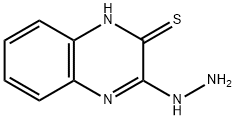 |
| | 3-Hydrazino-quinoxaline-2-thiol Chemical Properties |
| Melting point | 254 °C (decomp)(Solv: ethanol (64-17-5)) | | Boiling point | 376.1±25.0 °C(Predicted) | | density | 1.55±0.1 g/cm3(Predicted) | | pka | 7.91±0.20(Predicted) | | form | Solid | | color | Light yellow to yellow |
| | 3-Hydrazino-quinoxaline-2-thiol Usage And Synthesis |
| Uses | HPi1 is a potent, selective and orally active antimicrobial against Helicobacter pylori with an IC50 of 0.24 μM and an MIC of 0.08-0.16 μg/mL. HPi1 is inactive against other bacteria, including the gut commensals Lactobacillus casei, Lactobacillus reuteri, and Bifidobacterium longum[1]. | | Biological Activity | HPi1 is a potent, selective and orally active antibacterial agent against Helicobacter pylori with IC50 of 0.24 μM and MIC of 0.08-0.16 μg/mL. It is inactive against other bacteria, including the enteric bacteria Lactobacillus casei, Lactobacillus reuteri and Bifidobacterium longum. | | in vitro | The MIC against H. pylori isolates ranged from 0.002-0.032 μg/mL (0.01-0.17 μM) in the agar dilution assay. HPi1 is effective against the clarithromycin-resistant strains ARHp172 (MIC of 0.004–0.016 μg/mL) and ARHp246 (MIC of 0.008–0.032 μg/mL).
HPi1 has some activity against the Bacteroides species , but at concentrations at least 18- fold higher than the H. pylori MIC. More potent activity is detected for Campylobacter jejuni with an MIC of 0.3 μg/mL.
HPi1 has good physicochemical and pharmacological properties, including determining the aqueous solubility (19 μg/mL), human plasma protein binding (93% bound), stability with human liver microsomes (T 1/2 of 1.3 hours) and the ability to passively permeate membranes. | | in vivo | HPi1 (6.25-50 mg/kg; Oral gavage; once a day; for 3 days; female C57BL/6 mice) treatment decreases colony counts below the limit of detection at doses of 25 or 50 mg/kg/day[1]. | Animal Model: | Adult specific-pathogen-free female C57BL/6 mice (6-8-week-old) fed with H. pylori SS1 suspension[1] | | Dosage: | 6.25 mg/kg, 12.5 mg/kg, 25 mg/kg, 50 mg/kg | | Administration: | Oral gavage; once a day; for 3 days | | Result: | Reduced colony counts to below the limit of detection.
|
| | target | IC50: 0.24 μM ( Helicobacter pylori )
MIC: 0.08-0.16 μg/mL ( Helicobacter pylori ) | | References | [1] Gavrish E, et al. In vitro and in vivo activities of HPi1, a selective antimicrobial against Helicobacter pylori. Antimicrob Agents Chemother. 2014 Jun;58(6):3255-60. DOI:10.1128/AAC.02573-13 |
| | 3-Hydrazino-quinoxaline-2-thiol Preparation Products And Raw materials |
|