|
|
| | vanoxonin Basic information |
| Product Name: | vanoxonin | | Synonyms: | vanoxonin;(+)-N-(2,3-Dihydroxybenzoyl)-L-Thr-N5-Ac-N5-hydroxy-L-Orn-OH;Antibitic MG-245CF2A;N5-Acetyl-N2-[N-(2,3-dihydroxybenzoyl)-L-threonyl]-N5-hydroxy-L-ornithine;Antibiotic MG 245CF2A;MG-245-CF2-A;N-(2,3-dihydroxybenzoyl)-L-threonyl-N5-acetyl-N5-hydroxy-L-ornithine | | CAS: | 86933-99-5 | | MF: | C18H25N3O9 | | MW: | 427.41 | | EINECS: | | | Product Categories: | | | Mol File: | 86933-99-5.mol | 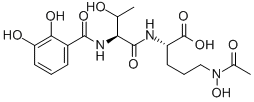 |
| | vanoxonin Chemical Properties |
| density | 1.460±0.06 g/cm3(Temp: 25 °C; Press: 760 Torr)(predicted) | | storage temp. | -20°C | | form | A solid | | pka | 3.265±0.10(predicted) |
| | vanoxonin Usage And Synthesis |
| Uses | Vanoxonin is an inhibitor of thymidylate synthase found in Saccharopolyspora hirsuta with an IC50 value of 0.7 μg/mL[1]. | | Biological Activity | Vanoxonin is a bacterial metabolite that has been found in S. hirsuta.1 It forms a complex with vanadium, and the complex inhibits thymidylate synthetase with an IC50 value of 0.7 μg/ml. The vanoxonin-vanadium complex is cytotoxic to L1210 leukemia cells (MIC = 25 μg/ml) and increases survival in Ehrlich murine spontaneous adenocarcinoma and L1210 mouse tumor models. | | References | 1.Kanai, F., Sawa, T., Hamada, M., et al.Vanoxonin, a new inhibitor of thymidylate synthetaseJ. Antibiot. (Tokyo)36(6)656-660(1983) |
| | vanoxonin Preparation Products And Raw materials |
|