|
|
| Product Name: | CM-272 | | Synonyms: | CM-272; CM 272; CM272;CM-272;4-Quinolinamine, 6-methoxy-2-(5-methyl-2-furanyl)-N-(1-methyl-4-piperidinyl)-7-[3-(1-pyrrolidinyl)propoxy]-;6-Methoxy-2-(5-methylfuran-2-yl)-N-(1-methylpiperidin-4-yl)-7-(3-pyrrolidin-1-ylpropoxy)quinolin-4-amine;DNMT1,anti-tumour,DNMTs,immunogenic,DNA MTases,CM272,DNMT3A,CM 272,G9a,H3K9me2,Inhibitor,epigenetics,Histone Methyltransferase,GLP,Apoptosis,inhibit,substrate-competitive,CM-272,DNMT3B,DNA Methyltransferase;CM-272, 10 mM in DMSO | | CAS: | 1846570-31-7 | | MF: | C28H38N4O3 | | MW: | 478.63 | | EINECS: | | | Product Categories: | | | Mol File: | 1846570-31-7.mol | 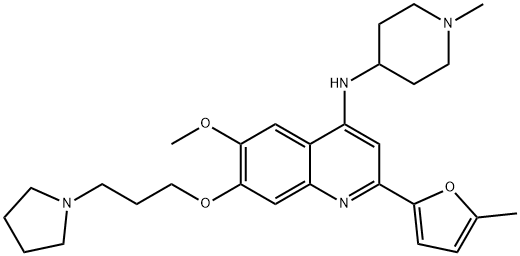 |
| | CM-272 Chemical Properties |
| Boiling point | 631.9±55.0 °C(Predicted) | | density | 1.164±0.06 g/cm3(Predicted) | | storage temp. | Store at -20°C | | solubility | DMSO:84.0(Max Conc. mg/mL);179.5(Max Conc. mM)
Ethanol:63.0(Max Conc. mg/mL);131.63(Max Conc. mM) | | form | A crystalline solid | | pka | 10.09±0.20(Predicted) | | color | Light brown to brown |
| | CM-272 Usage And Synthesis |
| Uses | CM-272 is a first-in-class, potent, selective, substrate-competitive and reversible dual G9a/DNA methyltransferases (DNMTs) inhibitor with antitumor activities. CM-272 inhibits G9a, DNMT1, DNMT3A, DNMT3B and GLP with IC50s of 8 nM, 382 nM, 85 nM, 1200 nM and 2 nM, respectively. CM-272 inhibits cell proliferation and promotes apoptosis, inducing IFN-stimulated genes and immunogenic cell death[1]. | | Biological Activity | CM272 is a novel, first-in-class dual reversible inhibitor of G9a (GLP) and DNMTs with IC50 values of 8 nM, 382 nM, 85 nM, 1200 nM, and 2 nM for G9a, DNMT1, DNMT3A, DNMT3B, and GLP, respectively. CM272 prolongs survival in in vivo models of hematological malignancies by at least partially inducing immunogenic cell death. | | in vitro | CM-272 (100-1000 nM; 12-72 hours; CEMO-1, MV4-11 and OCI-Ly10 cell lines) treatment inhibits cell proliferation in a dose- and time-dependent manner.
CM-272 (100-1000 nM; 24 hours; CEMO-1, MV4-11 and OCI-Ly10 cell lines) treatment blocks cell cycle progression.
CM-272 (100-1000 nM; 12-72 hours; CEMO-1, MV4-11 and OCI-Ly10 cell lines) treatment induces apoptosis in ALL, AML and DLBCL cell lines in a dose- and time-dependent manner.
CM-272 after 48 h of treatment CEMO -1 acute lymphoblastic leukaemia (ALL) cell line, MV4-11 acute myeloid leukaemia (AML) cell line and OCI-Ly10 diffuse large B-cell lymphoma (DLBCL) cell line, the GI 50 values of 218 nM, 269 nM and 455 nM, respectively, and is associated with a decrease in global levels of H3K9me2 and 5mC.
The therapeutic activity of CM-272 relies on the early activation of the type I IFN response in tumour cells , potentially leading to the induction of cell autonomous immunogenic death in tumou r cells. Cell Proliferation Assay | Cell Line: | CEMO-1, MV4-11 and OCI-Ly10 cell lines | | Concentration: | 125 nM, 250 nM, 500 nM (CEMO-1 cells); 135 nM, 270 nM, 540 nM (MV4-11 cells); 100 nM, 400 nM, 1000 nM (OCI-Ly10 cells) | | Incubation Time: | 12 hours, 24 hours, 48 hours and 72 hours | | Result: | Inhibited cell proliferation in a dose- and time-dependent manner. | Cell Cycle Analysis | Cell Line: | CEMO-1, MV4-11 and OCI-Ly10 cell lines | | Concentration: | | Concentration: | 125 nM, 250 nM, 500 nM (CEMO-1 cells); 135 nM, 270 nM, 540 nM (MV4-11 cells); 100 nM, 400 nM, 1000 nM (OCI-Ly10 cells) | | Incubation Time: | 24 hours | | Result: | Blocked cell cycle progression. | Apoptosis Analysis | Cell Line: | CEMO-1, MV4-11 and OCI-Ly10 cell lines | | Concentration: | 125 nM, 250 nM, 500 nM (CEMO-1 cells); 135 nM, 270 nM, 540 nM (MV4-11 cells); 100 nM, 400 nM, 1000 nM (OCI-Ly10 cells) | | Incubation Time: | 12 hours, 24 hours, 48 hours and 72 hours | < tr> Result: | Induced apoptosis in ALL, AML and DLBCL cell lines in a dose- and time-dep endent manner. | | | in vivo | CM-272 (2.5 mg/kg; injection; daily; for 28 days; female Rag2 intravenous / γc / mice) treatment significantly prolongs survival of CEMO-1 cells xenogeneic models. | Animal Model: | Female BALB/Ca-Rag2 / γc / mice (6–8-week-old) with CEMO-1 cells | | Dosage: | 2.5 mg/kg | | Administration: | Intravenous injection; daily; for 28 days | | Result: | Induced a statistically significant increase in overall survival (OS) in mice. | | | target | | Target | Value | G9a
(Cell-free assay) | 8 nM | DNMT3A
(Cell-free assay) | 85 nM | < td style="border-bottom: 1px dotted #ccc;padding: 5px;"> DNMT1
(Cell-free assay) 382 nM | DNMT3B
(Cell-free assay) | 1200 nM |
| | IC 50 | G9a: 8 nM (IC50); EHMT1/GLP/KMT1D: 2 nM (IC50); DNMT1: 382 nM (IC50); DNMT3A: 85 nM (IC50); DNMT3B: 1200 nM (IC50) | | References | [1] San José-Enériz E, et al. Discovery of first-in-class reversible dual small molecule inhibitors against G9a and DNMTs in hematological malignancies. Nat Commun. 2017 May 26;8:15424. DOI:10.1038/ncomms15424 |
| | CM-272 Preparation Products And Raw materials |
|