DWP14012 hydrochloride manufacturers
|
| | DWP14012 hydrochloride Basic information |
| Product Name: | DWP14012 hydrochloride | | Synonyms: | Abeprazan hydrochloride;DWP14012 hydrochloride;DWP 14012 HCl;DWP14012 HCl;DWP-14012 HCl;RMA-44;Fexuprazan HCI;Abeprazan HCl | | CAS: | 1902954-87-3 | | MF: | C19H18ClF3N2O3S | | MW: | 446.87 | | EINECS: | | | Product Categories: | | | Mol File: | 1902954-87-3.mol | 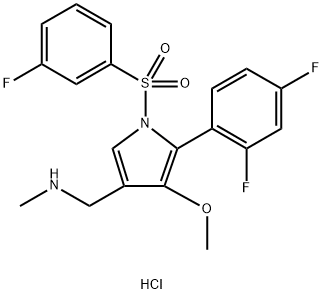 |
| | DWP14012 hydrochloride Chemical Properties |
| storage temp. | -20°C, away from moisture | | form | Solid | | color | White to light yellow |
| | DWP14012 hydrochloride Usage And Synthesis |
| Uses | Abeprazan hydrochloride (DWP14012 hydrochloride) is a potassium-competitive acid blocker. Abeprazan hydrochloride inhibits H+, K+- ATPase by reversible potassium-competitive ionic binding with no acid activation required. Abeprazan hydrochloride is developed as a potential alternative to proton pump inhibitor for the treatment of acid-related diseases[1]. | | Biological Activity | Abeprazan hydrochloride (DWP14012 hydrochloride) is a potassium-competitive acid blocker. Abeprazan hydrochloride inhibits H+, K+- ATPase by reversible potassium-competitive ionic binding with no acid activation required. Abeprazan hydrochloride is developed as a potential alternative to proton pump inhibitor for the treatment of acid-related diseases[1].
The mechanism of action of Abeprazan hydrochloride is reversibly binding to H+, K+‐ATPase, and, unlike that of PPIs, does not require acidic environment for drug activation[1].
Abeprazan hydrochloride (DWP14012 hydrochloride) inhibits acid secretion in a dose-dependent manner and the inhibition of gastric acid secretion is equal to or greater than that of vonoprazan, a previously approved P-CAB, in various in vivo studies using pylorus-ligated rats, lumen-perfused rat models and heidenhain pouch dog models[1]. | | in vivo | Abeprazan hydrochloride (DWP14012 hydrochloride) inhibits acid secretion in a dose-dependent manner and the inhibition of gastric acid secretion is equal to or greater than that of vonoprazan, a previously approved P-CAB, in various in vivo studies using pylorus-ligated rats, lumen-perfused rat models and heidenhain pouch dog models[1]. | | References | [1]. Sunwoo J, et al. Safety, tolerability, pharmacodynamics and pharmacokinetics of DWP14012, a novel potassium-competitive acid blocker, in healthy male subjects. Aliment Pharmacol Ther. 2018 Jul;48(2):206-218. |
| | DWP14012 hydrochloride Preparation Products And Raw materials |
|