Propyl Levulinate manufacturers
- Propyl Levulinate
-
- $26800.00
-
2026-09-07
- CAS:645-67-0
- Min. Order: 100g
- Purity: >98.5%
- Supply Ability: 50tons
- Propyl Levulinate
-
- $26800.00
-
2026-09-07
- CAS:645-67-0
- Min. Order: 100g
- Purity: >98.5%
- Supply Ability: 50tons
|
| | Propyl Levulinate Basic information |
| Product Name: | Propyl Levulinate | | Synonyms: | Pentanoic acid, 4-oxo-, propyl ester;N-propyl levulinate;Propyl 4-Oxovalerate;PROPYL LEVULINATE;Propyl 4-oxopentanoate | | CAS: | 645-67-0 | | MF: | C8H14O3 | | MW: | 158.2 | | EINECS: | | | Product Categories: | | | Mol File: | 645-67-0.mol | 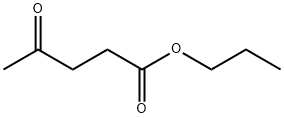 |
| | Propyl Levulinate Chemical Properties |
| Boiling point | 218°C (estimate) | | density | 0.9896 | | refractive index | 1.4258 | | FEMA | 4480 | PROPYL LEVULINATE | | storage temp. | Sealed in dry,Room Temperature | | solubility | Chloroform (Slightly), Methanol (Slightly) | | form | clear liquid | | color | Colorless to Almost colorless | | Odor | sweet caramellic | | Odor Type | caramellic | | JECFA Number | 1971 | | InChI | InChI=1S/C8H14O3/c1-3-6-11-8(10)5-4-7(2)9/h3-6H2,1-2H3 | | InChIKey | QOSMNYMQXIVWKY-UHFFFAOYSA-N | | SMILES | C(OCCC)(=O)CCC(=O)C | | LogP | 0.93 | | CAS DataBase Reference | 645-67-0 |
| | Propyl Levulinate Usage And Synthesis |
| Chemical Properties | Propyl levulinate is a colorless to pale yellow transparent liquid with a faint ester-like odor. Its molecule contains an ester group (–COO–), which gives it a certain degree of polarity. It is soluble in a variety of organic solvents, such as ethanol, diethyl ether, and acetone, but has low solubility in water. | | Definition | ChEBI: Propyl levulinate is an oxo carboxylic acid. | | Synthesis | General procedure for the synthesis of propyl 4-oxopentanoate from n-propanol and acetylpropionic acid: the esterification of acetylpropionic acid was carried out in a 50 mL round-bottomed flask fitted with a reflux condenser tube. In a typical catalyzed reaction, catalyst (40 mg) was added to a mixture of acetylpropionic acid and n-propanol, where the molar ratio of acetylpropionic acid to n-propanol was 1:8 (with n-propanol acting as both the reactant and the solvent), and the mixture was subsequently magnetically stirred for 2 hours at 333 K. The reaction was carried out in a 50 mL round bottom flask equipped with a reflux condenser tube. After the reaction reached the predetermined time, a portion of the reaction mixture was taken and separated by filtration and the filtrate was analyzed by gas chromatography (GC) equipped with a flame ionization detector and a capillary column. All the compounds were characterized by their spectral data (1H NMR) and compared with the data reported in literature. | | References | [1] RSC Advances, 2016, vol. 6, # 3, p. 2106 - 2111
[2] Journal of the American Chemical Society, 1930, vol. 52, p. 4883
[3] Journal of the American Chemical Society, 1933, vol. 55, p. 3393
[4] Patent: US2029412, 1934,
[5] Journal fuer Praktische Chemie (Leipzig), 1955, vol.<4>1, p. 153,154
[6] Ma, Yik-Ken, et al. “Effects of Synthesis Variables on SAPO-34 Crystallization Templated Using Pyridinium Supramolecule and Its Catalytic Activity in Microwave Esterification Synthesis of Propyl Levulinate.” Catalysts, 2023, https://doi.org/10.3390/catal13040680.
[7] Démolis, Alexandre, et al. “Synthesis and Applications of Alkyl Levulinates.” ACS Sustainable Chemistry & Engineering, 2 6, 2014, pp. 1338–52, https://doi.org/10.1021/sc500082n. |
| | Propyl Levulinate Preparation Products And Raw materials |
|