|
|
| | Poly(4-methyl-1-pentene) Basic information |
| | Poly(4-methyl-1-pentene) Chemical Properties |
| Melting point | 240 °C | | Boiling point | 0.83 °C | | density | 0.835 g/mL at 25 °C | | refractive index | n20/D 1.463 | | form | Beads | | color | Clear | | InChI | 1S/C6H12/c1-4-5-6(2)3/h4,6H,1,5H2,2-3H3 | | InChIKey | WSSSPWUEQFSQQG-UHFFFAOYSA-N | | SMILES | CC(C)CC=C | | CAS DataBase Reference | 25068-26-2 | | EPA Substance Registry System | 1-Pentene, 4-methyl-, homopolymer (25068-26-2) |
| Safety Statements | 24/25 | | WGK Germany | 3 | | TSCA | TSCA listed | | HS Code | 39029090 | | Storage Class | 11 - Combustible Solids |
| | Poly(4-methyl-1-pentene) Usage And Synthesis |
| Chemical Properties | off-white beads | | Chemical Properties | Poly(4-methyl-1-pentene) was first introduced in 1965 by Imperial Chemical
Industries Ltd (UK) but since 1975 the polymer has been manufactured solely
by Mitsui Petrochemical Industries Ltd. Polymerization is carried out using
a Ziegler-Natta catalyst such as titanium trichloride/diethylaluminium chloride in a hydrocarbon diluent at atmospheric pressure and 30-60°C:
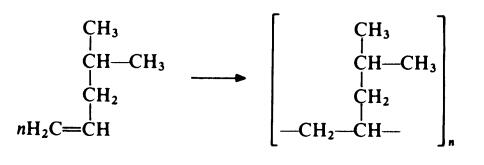
The commercial material contains a comonomer, possibly 1-hexene, which
enhances clarity. The polymer configuration is predominantly isotactic.
Generally, this material has the basic physical properties to be expected
from a crystalline polyolefin but in some respects it offers significant improvements over other polyolefins. One outstanding property of poly(4-methyl-l-pentene) is the very low specific gravity, which at 0.83 is the lowest of current
polymers. The crystalline melting point is 240°C and the Vicat softening
temperature is 179°C; these high values mean that a useful form stability is
maintained up to about 200°C. The transparency of the polymer is of a high
order, being comparable to poly(methyl methacrylate) and polystyrene.
Poly(4-methyl-l-pentene) exhibits resistance to oxidizing and other chemical
environments broadly similar to that shown by polypropylene; however,
poly(4-methyl-l-pentene) does undergo environmental stress cracking
comparable to low density polyethylene. The permeability of poly(4-methyl-I-pentene) to gases and water vapour is considerably higher than that for
other polyolefins. Poly(4-methyl-l-pentene) may be extruded and injection
moulded using standard equipment. The material has been used in several
applications where transparency and heat resistance are required, e.g. medical and laboratory ware. | | Uses | Coating for paper food containers for microwave and conventional ovens. Release coatings for food and synthetic leather. Molded into medical labware. Film for decorative laminates and printed circuit boards. |
| | Poly(4-methyl-1-pentene) Preparation Products And Raw materials |
|