| Company Name: |
Alfa Aesar |
| Tel: |
400-6106006 |
| Email: |
saleschina@alfa-asia.com |
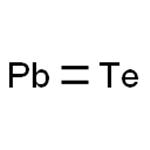
- Lead telluride
-
-
2025-12-24
- CAS:1314-91-6
- Min. Order: 1KG
- Purity: 99.0%
- Supply Ability: 10000KG
- LEAD TELLURIDE
-
- $1.00
-
2019-07-06
- CAS:1314-91-6
- Min. Order: 50 g
- Purity: 99.9%
- Supply Ability: 20kg
|
| | LEAD TELLURIDE Basic information |
| | LEAD TELLURIDE Chemical Properties |
| Melting point | 905 °C | | density | 8,164 g/cm3 | | solubility | insoluble in H2O, acid solutions | | form | Powder | | Specific Gravity | 8.164 | | color | Gray | | Water Solubility | Insoluble in water. | | Thermal Conductivity | 2.092 W/(m·K) (crystal) | | Specific Heat Capacity | Cp(crystal): 0.15 J/(g·K), at 25℃ | | Crystal Structure | Cubic, Halite Structure - Space Group Fm3m | | Merck | 14,5422 | | Exposure limits | ACGIH: TWA 0.05 mg/m3; TWA 0.1 mg/m3
NIOSH: IDLH 25 mg/m3; IDLH 100 mg/m3; TWA 0.1 mg/m3; TWA 0.050 mg/m3 | | InChI | 1S/Pb.Te | | InChIKey | OCGWQDWYSQAFTO-UHFFFAOYSA-N | | SMILES | [Te]=[PbH2] | | Hardness, Mohs | 3.0 | | CAS DataBase Reference | 1314-91-6(CAS DataBase Reference) | | EPA Substance Registry System | Lead(II) telluride (1314-91-6) |
| Hazard Codes | N-T,N,T | | Risk Statements | 62-61-50/53-33-20/22 | | Safety Statements | 61-60-53-45 | | RIDADR | 3284 | | WGK Germany | 3 | | TSCA | TSCA listed | | HazardClass | 6.1 | | PackingGroup | III | | HS Code | 28429010 | | Storage Class | 6.1C - Combustible acute toxic Cat.3
toxic compounds or compounds which causing chronic effects | | Hazard Classifications | Acute Tox. 4 Inhalation
Acute Tox. 4 Oral
Aquatic Acute 1
Aquatic Chronic 1
Carc. 2
Repr. 1A
STOT RE 2 |
| | LEAD TELLURIDE Usage And Synthesis |
| Chemical Properties | Lead telluride, PbTe, forms white cubic crystals, sp gr 8.16, and has a hardness of 3 on the Mohs’ scale. It is very slightly soluble in water, melts at 917 °C, and is prepared by melting lead and tellurium together. Lead telluride has semiconductive and photoconductive properties. | | Chemical Properties | irregular chunks with metal lustre | | Uses | In photoconductor cells; in semiconductor research. | | Uses | Lead telluride is used in pyrometry, in heat-sensing instruments such as bolometers and infrared spectroscopes, and in thermoelectric elements to convert heat directly to electricity. Lead telluride is also used in catalysts for oxygen reduction in fuel cells, as cathodes in primary batteries with lithium anodes, in electrical contacts for vacuum switches, in lead-ion selective electrodes, in tunable lasers, and in thermistors. | | Uses | In semiconductor research, photoconductor cellsLead(II) telluride is used as an infrared detector material. It is also used in spacecraft power applications. Further, it is used in infrared detection, imaging and in solar cells. In addition, it acts as a semiconductor and photoconductor in the form of single crystals. | | General Description | This product has been enhanced for energy efficiency. | | Synthesis | The high-purity Pb powder and Te powder were mixed according to the chemical dosage ratio (1:1), and the samples were loaded into the high-pressure cavity after powder pressure molding. Graphite was used as the heating tube and chlorite as the insulating tube in the assembled cavity, and the synthesis pressure was 4.0 GPa, the temperature was 1200 K. The cooling rate of the sample after stopping the heating was 60 K/s, and the average grain size of PbTe was synthesized to be 1000 nm. The electrical conductivity of the sample was 610-5 -m, and the value of thermal conductivity was 1.4 w/m.k. The sample was synthesized by the use of graphite as the heating tube and chlorite as the insulating tube, and the sample was synthesized by the use of graphite as the heating tube and chlorite as the insulating tube. | | Structure and conformation | The space lattice of PbTe belongs to the cubic system, and its rock salt structure has a lattice
constant of a=0.317 nm. |
| | LEAD TELLURIDE Preparation Products And Raw materials |
|