|
|
| | (p-Iodo-Phe)-ACTH (4-10) Basic information |
| Product Name: | (p-Iodo-Phe)-ACTH (4-10) | | Synonyms: | (p-Iodo-Phe)-ACTH (4-10);Glycine, L-methionyl-L-α-glutamyl-L-histidyl-4-iodo-L-phenylalanyl-L-arginyl-L-tryptophyl- | | CAS: | 159600-82-5 | | MF: | C44H58IN13O10S | | MW: | 1087.98189 | | EINECS: | | | Product Categories: | | | Mol File: | 159600-82-5.mol | 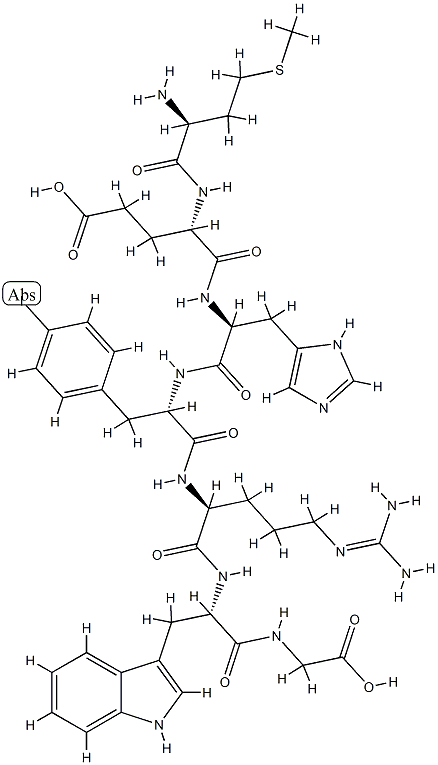 |
| | (p-Iodo-Phe)-ACTH (4-10) Chemical Properties |
| density | 1.63±0.1 g/cm3(Predicted) | | pka | 3.32±0.10(Predicted) |
| | (p-Iodo-Phe)-ACTH (4-10) Usage And Synthesis |
| Uses | (p-Iodo-Phe7)-ACTH (4-10) is a adrenocorticotrophic hormone (ACTH) derivative, which is produced and secreted by the anterior pituitary gland. (p-Iodo-Phe7)-ACTH (4-10) serves as a melanocortin (MC) receptor antagonist and inhibits α-melanocyte-stimulating hormone (α-MSH)-induced excessive grooming behavior in rats[1]. | | in vivo | (p-Iodo-Phe7)-ACTH (4-10) (15 μg per animal; i.c.v.; single dose) blocks the a-MSH-induced excessive grooming behavior in rats[1].
| Animal Model: | Male Wistar rats (150 g)[1] | | Dosage: | 1.5 or 15 μg per animal, mixed with 1.5 μg α-MSH or not | | Administration: | Intracerebroventricular injection; one week prior to the experiment | | Result: | Didn’t induce excessive grooming behavior by single dose.
Inhibited the induction of excessive grooming behavior by a-MSH. |
| | References | [1] Adan RA, et al. Identification of antagonists for melanocortin MC3, MC4 and MC5 receptors. Eur J Pharmacol. 1994 Nov 15;269(3):331-7. DOI:10.1016/0922-4106(94)90041-8
[2] Schith HB, et al. Selectivity of [Phe-I7], [Ala6], and [D-Ala4,Gln5,Tyr6] substituted ACTH(4-10) analogues for the melanocortin receptors. Peptides. 1997;18(5):761-3. DOI:10.1016/s0196-9781(97)00126-5 |
| | (p-Iodo-Phe)-ACTH (4-10) Preparation Products And Raw materials |
|