|
|
| | LIGSTROSIDE Basic information |
| Product Name: | LIGSTROSIDE | | Synonyms: | LIGSTROSIDE;(2S)-3-[(E)-Ethylidene]-2-(β-D-glucopyranosyloxy)-3,4-dihydro-5-(methoxycarbonyl)-2H-pyran-4α-acetic acid 2-(4-hydroxyphenyl)ethyl ester;(2S)-3-[(E)-Ethylidene]-2β-(β-D-glucopyranosyloxy)-3,4-dihydro-5-(methoxycarbonyl)-2H-pyran-4α-acetic acid 2-(4-hydroxyphenyl)ethyl ester;2H-Pyran-4-acetic acid, 3-ethylidene-2-(β-D-glucopyranosyloxy)-3,4-dihydro-5-(methoxycarbonyl)-, 2-(4-hydroxyphenyl)ethyl ester, (2S,3E,4S)-;Ligustroside | | CAS: | 35897-92-8 | | MF: | C25H32O12 | | MW: | 524.52 | | EINECS: | | | Product Categories: | | | Mol File: | 35897-92-8.mol | 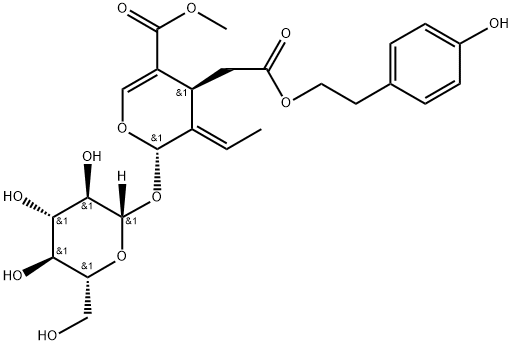 |
| | LIGSTROSIDE Chemical Properties |
| Boiling point | 736.9±60.0 °C(Predicted) | | density | 1.44±0.1 g/cm3(Predicted) | | storage temp. | 4°C, away from moisture and light | | solubility | DMSO (Slightly), Methanol (Slightly) | | form | Solid | | pka | 9.91±0.15(Predicted) | | color | White to Off-White | | biological source | plant | | Stability: | Hygroscopic | | Major Application | metabolomics
vitamins, nutraceuticals, and natural products | | InChIKey | GMQXOLRKJQWPNB-MVVLSVRYSA-N |
| WGK Germany | WGK 3 | | Storage Class | 11 - Combustible Solids |
| | LIGSTROSIDE Usage And Synthesis |
| Uses | Ligustroside is a chemical constituent isolated from the flowers of Osmanthus fragrans var. aurantiacus which significantly inhibited nitric oxide production in lipopolysaccharide-activated RAW264.7 macrophages. | | Definition | ChEBI: Ligstroside is a secoiridoid glycoside that is the methyl ester of 3,4-dihydro-2H-pyran-5-carboxylic acid which is substituted at positions 2, 3, and 4 by hydroxy, ethylidene, and carboxymethyl groups, respectively and in which the anomeric hydroxy group at position 2 has been converted into its beta-D-glucoside and the carboxylic acid moiety of the carboxymethyl substituent has been converted to the corresponding 4-hydroxyphenethyl ester (the 2S,3E,4S stereoisomer). An important phenolic compound present in olive cultivars. It has a role as a plant metabolite and an antineoplastic agent. It is a secoiridoid glycoside, a methyl ester, a diester, a member of pyrans, a member of phenols and a beta-D-glucoside. | | Biological Activity | Ligstroside is a natural product derived from leaves of Olea europaea. Ligstroside displays several potentially beneficial anti-inflammatory properties by exhibiting selective inhibition effect on COX-1 enzyme of arachidonate cascade metabolism. Ligstroside generates a reduction of the PGE2 (prostaglandin E2) levels in activated mouse macrophage (IC50 = 48.53 μM) and also reduction of the TXB2 (thromboxane B2) levels in human platelets (IC50 = 122.63 μM). Moreover, Ligstroside exhibits inhibition activity of NO production in LPS-activated RAW264.7 macrophages (17.8% at 30 μM and 40.7% at 100 μM) without any cytotoxic effect in these cells., Additionally, Ligstroside exhibits in vitro antiviral activity against parainfluenza type 3 virus (IC50 = 15.6 μM). | | in vivo | Ligstroside (50 mg/kg; a supplemented diet for 6 months) protects against mitochondrial dysfunction in models of early Alzheimer's disease and brain ageing[1]. | Animal Model: | Female NMRI mice, aged 12 months[1] | | Dosage: | 50 mg/kg | | Administration: | Received a supplemented diet for 6 months (equivalent to 6.25 mg/kg b.w.) | | Result: | Showed improved spatial working memory; Restored brain ATP levels in aged mice and led to a significant life extension compared to aged control animals.
|
| | target | EGFR | COX | LOX | PGE | Influenza virus |
| | LIGSTROSIDE Preparation Products And Raw materials |
|