| Company Name: |
NORANA GROUP Gold |
| Tel: |
027-59209883 17386138556 |
| Email: |
service@nornachem.com |
- oryzalin
-
- $1.00
-
2020-02-01
- CAS:19044-88-3
- Min. Order: 1KG
- Purity: Min98% HPLC
|
| | Oryzalin Basic information |
| | Oryzalin Chemical Properties |
| Melting point | 141°C | | Boiling point | 514.0±60.0 °C(Predicted) | | density | 1.2 | | refractive index | 1.6000 (estimate) | | storage temp. | 0-6°C | | solubility | DMSO : 250 mg/mL (721.79 mM; Need ultrasonic) | | pka | 9.14±0.60(Predicted) | | form | Crystalline Solid | | color | Deep orange | | Water Solubility | 85mg/L(25 ºC) | | BRN | 2177305 | | Henry's Law Constant | 5.2×10³ mol/(m3Pa) at 25℃, HSDB (2015) | | Major Application | agriculture
environmental | | InChI | 1S/C12H18N4O6S/c1-3-5-14(6-4-2)12-10(15(17)18)7-9(23(13,21)22)8-11(12)16(19)20/h7-8H,3-6H2,1-2H3,(H2,13,21,22) | | InChIKey | UNAHYJYOSSSJHH-UHFFFAOYSA-N | | SMILES | CCCN(CCC)c1c(cc(cc1[N+]([O-])=O)S(N)(=O)=O)[N+]([O-])=O | | LogP | 3.730 | | CAS DataBase Reference | 19044-88-3(CAS DataBase Reference) | | NIST Chemistry Reference | Oryzalin(19044-88-3) | | EPA Substance Registry System | Oryzalin (19044-88-3) |
| Hazard Codes | N | | Risk Statements | 51/53 | | Safety Statements | 60 | | RIDADR | UN 3077 | | WGK Germany | 2 | | RTECS | WO9350000 | | HS Code | 29350090 | | Storage Class | 11 - Combustible Solids | | Hazard Classifications | Aquatic Acute 1
Aquatic Chronic 1
Carc. 2
Skin Sens. 1
STOT RE 2 | | Hazardous Substances Data | 19044-88-3(Hazardous Substances Data) | | Toxicity | LD50 orally in rats: >10 g/kg (Decker, Johnson) |
| | Oryzalin Usage And Synthesis |
| Description | Oryzalin is a pre-emergence surface-applied herbicide. It has a low aqueous solubility, is not volatile and, based on its chemical properties, is not expected to leach to groundwater. However, groundwater monitoring programmes have identified it as a pollutant. It generally tends not to be persistent in soil or water systems. It has a low mammalian toxicity and is a potential carcinogen. It is moderately toxic to birds, most aquatic organisms, honeybees and earthworms. | | Chemical Properties | Yellow�orange crystalline solid or powder.
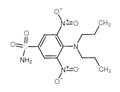
Odorless. | | Uses | Herbicide. | | Definition | ChEBI: A sulfonamide that is benzenesulfonamide substituted at positions 3 and 5 by nitro groups and at position 4 by a dipropylamino group. | | General Description | Yellow-orange crystals. Non corrosive. Used as an herbicide. | | Reactivity Profile | A dinitroaniline derivative. | | Agricultural Uses | Herbicide: Oryzalin is used to control annual grasses, herbaceous
plants, woody shrubs, vines and broadleaf weeds
on fruit and nut trees, soya beans, peas, sweet potatoes,
berries, vine and crops, cotton, Christmas tree plantations,
commercial/industrial and recreation area lawns, golf
course turf, residential lawns and turf, ornamental and/or
shade trees, nonagricultural rights-of-way, nonagricultural
uncultivated and industrial areas, power stations, paths/patios
and paved areas. | | Trade name | AGVALUE®; COMPOUND 67019®;
DIRIMAL®; EL-119®; EXCEL-S-PLUS®; EXPEDITE®;
FLEXLAN®; NATIONS AG II®; ORYZA®; PRO-TECK®;
ROUT®; RYCELAN®; RYZELAN®; SNAPSHOT®;
SURFLAN®; TURF FERTILIZER®; XL 2G® | | Mechanism of action | Selective affecting physiological growth process. Microtubule assembly inhibition. | | Safety Profile | Low toxicity by ingestion and skin contact. Mutation data reported. When heated to decomposition emits toxic fumes of NOx, SOx. | | Synthesis |
The synthesis method of oryzalin is as follows: Add PCl5 (624 mg, 3 mmol) to a suspension of 3,5-dinitro-N4,N4-di-n-propylsulfonate (347 mg) in dichloromethane (10 mL). Stir the reaction mixture for 2 hours. Wash the mixture with water. Collect the dichloromethane layer. Dry the dichloromethane layer with Na2SO4. Add 10 mL of 7N ammonia in methanol to the product. Stir the mixture for 3 hours at 40°C. Evaporate the solvent. Purify the product by silica gel column chromatography, eluting with hexane/ethyl acetate (2:1). Crystallize the product in dichloromethane/hexane.
| | Potential Exposure | Oryzalin is a 2,6-dinitroaniline herbicide
used to control annual grasses, herbaceous plants,
woody shrubs, vines, and broad leaf weeds on fruit and nut
trees, soya beans, peas, sweet potatoes, berries, vine and
crops, cotton, Christmas tree plantations, commercial/industrial
and recreation area lawns, golf course turf, residential
lawns and turf, ornamental, and/or shade trees, nonagricultural
rights-of-way, nonagricultural uncultivated and industrial
areas, power stations, paths/patios, and paved areas. | | Shipping | UN3077 Environmentally hazardous substances,
solid, n.o.s., Hazard class: 9; Labels: 9-Miscellaneoushazardous
material, Technical Name Required. UN1596 Dinotoanilines,
Hazard Class: 6.1; Labels: 6.1-Poisonous materials. | | Incompatibilities | Incompatible with oxidizers (chlorates,
nitrates, peroxides, permanganates, perchlorates, chlorine,
bromine, fluorine, etc.); contact may cause fires or explosions.
Keep away from alkaline materials, strong bases,
strong acids, oxoacids, and epoxides. Slowly hydrolyzes in
water, releasing ammonia, and forming acetate salts.
Decomposes at 265�C releasing toxic oxides of nitrogen,
sulfur, and carbon. Decomposed by strong ultraviolet light. | | Waste Disposal | Do not discharge into drains
or sewers. Dispose of waste material as hazardous waste
using a licensed disposal contractor to an approved landfill.
Consult with environmental regulatory agencies for guidance
on acceptable disposal practices. Incineration with
effluent gas scrubbing is recommended. Containers must be
disposed of properly by following package label directions
or by contacting your local or federal environmental control
agency, or by contacting your regional EPA office. | | References |
[1] GAUTAM BHATTACHARYA. Synthesis and Antitubulin Activity of N1- and N4-Substituted 3,5-Dinitro Sulfanilamides against African Trypanosomes and Leishmania[J]. Journal of Medicinal Chemistry, 2004, 47 7: 1823-1832. DOI:10.1021/jm0304461.
| | Pesticide Type | Herbicide |
| | Oryzalin Preparation Products And Raw materials |
|