| Company Name: |
Energy Chemical |
| Tel: |
400-0056266 |
| Email: |
sales8178@energy-chemical.com |
|
| | 6-(4,4,5,5-Tetramethyl-1,3,2-dioxaborolan-2-yl)quinoxaline Basic information |
| Product Name: | 6-(4,4,5,5-Tetramethyl-1,3,2-dioxaborolan-2-yl)quinoxaline | | Synonyms: | 6-(4,4,5,5-Tetramethyl-1,3,2-dioxaborolan-2-yl)quinoxaline;6-(4,4,5,5-Tetramethyl-1,3,2-dioxaborolan-2-yl)quinoxaline 97%;6-(tetraMethyl-1,3,2-dioxaborolan-2-yl)quinoxaline;2-dioxaborolan-2-yl)quinoxaline;Quinoxaline-6-boronic acid picol ester;Quinoxaline, 6-(4,4,5,5-tetramethyl-1,3,2-dioxaborolan-2-yl)-;6-(4,4,5,5-Tetramethyl-1,3,2-dioxaborolan-2-yl)quinoxaline - [T4861] | | CAS: | 1167418-13-4 | | MF: | C14H17BN2O2 | | MW: | 256.11 | | EINECS: | | | Product Categories: | | | Mol File: | 1167418-13-4.mol | 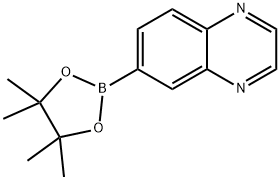 |
| | 6-(4,4,5,5-Tetramethyl-1,3,2-dioxaborolan-2-yl)quinoxaline Chemical Properties |
| Boiling point | 387.8±22.0 °C(Predicted) | | density | 1.123 g/mL at 25℃ | | refractive index | n20/D1.560 | | Fp | >110℃ | | storage temp. | under inert gas (nitrogen or Argon) at 2-8°C | | form | liquid | | pka | 0.93±0.30(Predicted) | | Appearance | Light yellow to yellow Viscous Liquid | | InChI | 1S/C14H17BN2O2/c1-13(2)14(3,4)19-15(18-13)10-5-6-11-12(9-10)17-8-7-16-11/h5-9H,1-4H3 | | InChIKey | ZYWICCYXTGRUNM-UHFFFAOYSA-N | | SMILES | CC1(C)OB(OC1(C)C)c2ccc3nccnc3c2 |
| Risk Statements | 36/37/38 | | Safety Statements | 26 | | WGK Germany | 3 | | HS Code | 2933998090 | | Storage Class | 10 - Combustible liquids | | Hazard Classifications | Eye Irrit. 2
Skin Irrit. 2
STOT SE 3 |
| | 6-(4,4,5,5-Tetramethyl-1,3,2-dioxaborolan-2-yl)quinoxaline Usage And Synthesis |
| Uses | Quinoxaline-6-boronic acid pinacol ester is a common reactant of a Suzuki coupling reaction that can be used:
- To prepare quinoxalin based PI3Kδ inhibitors.
- As a substrate in the Cu(II) catalyzed [11C]-radiocyanation of arylboronic acids.
- To prepare 6-quinoxaline boronic acid, which is used as a substrate in the silver-mediated fluorination of boronic acids.
| | Synthesis | To a solution of 6-bromoquinoxaline (418 mg, 2.00 mmol, 1.00 eq.) in dioxane (10 mL) at 23 °C was sequentially added PdCl2(dppf)-CH2Cl2 (163 mg, 0.200 mmol, 0.100 eq.), bis(pinacolide)diboron (610 mg, 2.40 mmol, 1.20 eq.) and KOAc (392 mg, 4.00 mmol, 2.00 equiv). The reaction mixture was stirred at 90 °C for 1.5 h, subsequently cooled to 23 °C and concentrated in vacuum. The residue was dissolved with CH2Cl2 and filtered through a diatomaceous earth plug. The filtrate was concentrated under reduced pressure and purified by silica gel column chromatography with hexane/EtOAc (4:1, v/v) as eluent to give 500 mg of quinoxaline-6-boronic acid pinacol ester as a colorless solid (98% yield). Thin layer chromatography Rf = 0.45 (unfolding agent: hexane/EtOAc, 1:1, v/v). Nuclear magnetic resonance hydrogen spectrum (1H NMR, 500 MHz, CDCl3, 23°C) δ: 8.86-8.82 (m, 2H), 8.59 (s, 1H), 8.12 (dd, J = 8.0 Hz, 2.0 Hz, 1H), 8.06 (d, J = 8.0 Hz, 1H), 1.37 (s, 12H). Nuclear magnetic resonance carbon spectrum (13C NMR, 125 MHz, CDCl3, 23°C) δ: 145.53, 145.03, 144.37, 142.41, 137.31, 134.75, 131.90 (br), 128.44, 84.36, 24.86. high-resolution mass spectra (HRMS-FIA) m/z: [M + H]+ Calculated value 257.14558, measured value 257.14440. | | References | [1] Organic Letters, 2009, vol. 11, # 13, p. 2860 - 2863
[2] Patent: WO2010/59943, 2010, A2. Location in patent: Page/Page column 86
[3] Journal of Medicinal Chemistry, 2011, vol. 54, # 13, p. 4735 - 4751
[4] Journal of the American Chemical Society, 2017, vol. 139, # 24, p. 8267 - 8276
[5] Organic Letters, 2018, vol. 20, # 6, p. 1530 - 1533 |
| | 6-(4,4,5,5-Tetramethyl-1,3,2-dioxaborolan-2-yl)quinoxaline Preparation Products And Raw materials |
|