CZC-25146 hydrochloride manufacturers
|
| | CZC-25146 hydrochloride Basic information |
| Product Name: | CZC-25146 hydrochloride | | Synonyms: | CZC-25146 hydrochloride;CZC-25146.HCl;CZC-25146.HCL;N-[2-[[5-FLUORO-2-[[2-METHOXY-4-(4-MORPHOLINYL)PHENYL]AMINO]-4-PYRIMIDINYL]AMINO]PHENYL]-METHANESULFONAMIDE HYDROCHLORIDE;N-[2-[[5-Fluoro-2-[[2-Methoxy-4-(4-Morpholinyl)phenyl]aMino]-4-pyriMidinyl]aMino]phenyl]-MethanesulfonaMide hydrochloride;CS-1206;CS-1074;CZC-25146; CZC 25146; CZC25146;CZC25146 HYDROCHLORIDE;CZC 25146 HYDROCHLORIDE;CZC-25146 hydrochL | | CAS: | 1330003-04-7 | | MF: | C22H26ClFN6O4S | | MW: | 524.9960432 | | EINECS: | 604-604-1 | | Product Categories: | | | Mol File: | 1330003-04-7.mol | 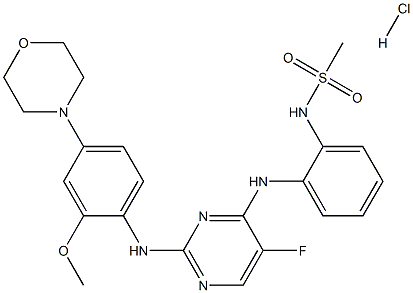 |
| | CZC-25146 hydrochloride Chemical Properties |
| storage temp. | 2-8°C | | solubility | DMSO: >15mg/mL (warmed) | | form | powder | | color | white to beige |
| Hazard Codes | T,Xi | | Risk Statements | 25-36 | | Safety Statements | 26-45 | | RIDADR | UN 2811 6.1 / PGIII | | WGK Germany | 3 |
| | CZC-25146 hydrochloride Usage And Synthesis |
| Uses | N-(2-(2-(2-Methoxy-4-morpholinophenylamino)-5-fluoropyrimidin-4-ylamino)phenyl)methanesulfonamide is a compound that acts as an inhibitor of LRRK2, a factor in the expression of Parkinsons’s disease, and is ATP-competitive. | | in vivo | CZC-25146 (1 mg/kg for i.v.; 5 mg/kg for p.o.; single dosage) exhibits relatively good pharmacokinetic properties and an extensive distribution throughout animal body following intravenous injection into mice[1].
CZC-25146 (250 mg/kg; p.o.; 14 days) reduces the ATZ polymer levels in over expressing human polymeric ATZ mice[3]. | Animal Model: | Male CD-1 mice[1] | | Dosage: | 1 mg/kg for i.v.; 5 mg/kg for p.o. | | Administration: | i.v. and p.o.; single dosage | | Result: | Pharmacokinetic Parameters of CZC-25146 in male CD-1 mice[1].
| i.v. (1 mg/kg) | p.o. (5 mg/kg) | | CL (L/h/kg) | 2.3 | | | Vss (L/kg) | 5.4 | | | t1/2 (h) | 1.6 | 1 | | tmax (h) | 0 | 0.25 | | Cmax (ng/mL) | 154 | 1357 | | AUClast (ng/mL·h) | 419 | 2878 | | AUCinf (ng/mL·h) | 434 | 2894 | | F (%) | | 133 |
|
| Animal Model: | Genetically modified male mice (6 weeks; over expressing human polymeric ATZ)[3] | | Dosage: | 250 mg/kg | | Administration: | p.o.; 14 days | | Result: | Dramatically and reproducibly reduced the ATZ polymer levels with an overall reduction from 60% in the control group to 37% |
|
| | CZC-25146 hydrochloride Preparation Products And Raw materials |
|