| Company Name: |
Sigma-Aldrich |
| Tel: |
021-61415566 800-8193336 |
| Email: |
orderCN@merckgroup.com |
1-(5-Chloro-2-hydroxyphenyl)-ethanone 2-(2,4,6-trichlorophenyl)hydrazone manufacturers
|
| | 1-(5-Chloro-2-hydroxyphenyl)-ethanone 2-(2,4,6-trichlorophenyl)hydrazone Basic information | | Background |
| Product Name: | 1-(5-Chloro-2-hydroxyphenyl)-ethanone 2-(2,4,6-trichlorophenyl)hydrazone | | Synonyms: | (E)-4-Chloro-2-(1-(2-(2,4,6-trichlorophenyl)hydrazono)ethyl)phenol;1-(5-Chloro-2-hydroxyphenyl)-ethanone 2-(2,4,6-trichlorophenyl)hydrazone;Mitochondrial Fusion Promoter M1;Mitochondrial Fusion Promoter, M1 - CAS 219315-22-7 - Calbiochem;Ethanone, 1-(5-chloro-2-hydroxyphenyl)-, 2-(2,4,6-trichlorophenyl)hydrazone;Mitochondrial Fusion Promoter M1 >=95% (HPLC);Mitochondrial Metabolism,ischemia,cardiac,inhibit,brain,damage,injury,reperfusion,Mitochondrial fusion promoter M 1,Mitochondrial fusion promoter M-1,Mitochondrial fusion promoter M1,Inhibitor;1-(5-Chloro-2-hydroxyphenyl)ethanone (2,4,6-trichlorophenyl)hydrazone | | CAS: | 219315-22-7 | | MF: | C14H10Cl4N2O | | MW: | 364.05 | | EINECS: | | | Product Categories: | | | Mol File: | 219315-22-7.mol | 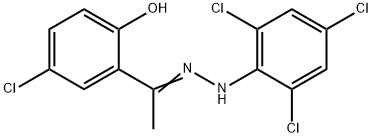 |
| | 1-(5-Chloro-2-hydroxyphenyl)-ethanone 2-(2,4,6-trichlorophenyl)hydrazone Chemical Properties |
| Boiling point | 464.769±55.00 °C(Press: 760.00 Torr)(predicted) | | density | 1.492±0.14 g/cm3(Temp: 25 °C; Press: 760 Torr)(predicted) | | storage temp. | 2-8°C | | solubility | DMSO: soluble10mg/mL, clear | | pka | 7.857±0.48(predicted) | | form | powder | | color | white to beige | | Stability: | Stable for 1 year from date of purchase as supplied. Solutions in DMSO or ethanol may be stored at -20°C for up to 2 months. | | InChIKey | WMAGOVJOXMBLHY-UHFFFAOYSA-N | | SMILES | Clc1c(c(cc(c1)Cl)Cl)NNC(=C)c2c(ccc(c2)Cl)O |
| WGK Germany | 3 | | HS Code | 2928009090 | | Storage Class | 11 - Combustible Solids |
| | 1-(5-Chloro-2-hydroxyphenyl)-ethanone 2-(2,4,6-trichlorophenyl)hydrazone Usage And Synthesis |
| Description | M-1 (219315-22-7) enhances mitochondrial fusion without interfering with endoplasmic reticulum (ER) and lysosome morphology.1 M-1 protects cells from mitochondrial fragmentation-associated cell death.2 Promotion of mitochondrial fusion has protective effects in rotenone-induced neurotoxicity.3 Cell permeable. | | Uses | Mitochondrial Fusion Promoter M1 has been used as a fusion promoter:
- to study its effects on peroxisome proliferator-activated receptor-γ coactivator (PGC)-1α expression in breast cancer cells
- to study the link between nucleoside diphosphate kinase 3 (NME3)-regulated mitochondrial fluctuations and stability of genome in NME3 knockdown cells
- to study its effects on mitochondrial fusion in neuronal cells
| | General Description | A cell-permeable phenylhydrazone compound that restores mitochondrial tubular network formation from the fragmented mitochondria seen in MEF lacking either one of the two outer mitochondrial membrane (OMM) mitofusins (EC50 = 5.3 and 4.42 μM, respectively, in Mfn1 or Mfn2 knockout MEF cells) or MPP+-treated SH-SY5Y cells (5 μM 24 h), while displaying no effect on ER or lysosome morphology in Mfn1 knockout MEF. The effect of M1 is limited to enhancing weakened mitochondrial fusion machinery and M1 cannot by itself rebuild interconnected tubular mitochondria in MEF lacking both Mfn1/2 or the inner mitochondrial membrane (IMM) fusion mediator Opa1 (optic atrophy1). M1 (5 μM 24 h) is reported to boost the downregulated ATP5A and ATP5B protein level in either Mfn1 or Mfn2 knockout MEF to the wild-type MEF level and ATPase inhibitor oligomycin (Cat. No. 495455) at 5 μM is shown to completely offset the mitochondrial fusion effect by 5 μM M1 in Mfn1 knockout MEF. Both M1 and Z-VAD-FMK (Cat. No. 219007) are shown to protect SH-SY5Y against MPP+-induced neuronal toxicity and additive protection can be achieved via a combined treatment (62%, 73%, 77%, and 89% survival rate, respectively, with DMSO, 5 μM M1, 1 μM Z-VAD-FMK, and combined treatment). Comparing to mdivi-1 (Cat. No. 475856), M1 exerts its effect via promoting fusion rather than inhibiting fission or division. | | Biochem/physiol Actions | Cell permeable: yes | | storage | Store at -20°C | | Background | Mitochondrial Fusion Promoter M1 is a hydrazone compound that promotes mitochondrial fusion in fragmented mitochondria. In a study of human induced pluripotent stem cells, M1 fused fragmented mitochondria and promoted the differentiation of iPSCs into an early mesodermal cardiac lineage. Pancreatic β cells treated with soluble cholesterol triggers increased total cholesterol accumulation, diminished cellular respiration, and compromised glucose-stimulated insulin secretion. Treatment of these cells with M1 prevents cholesterol-mediated suppression of cellular respiration and increases glucose-stimulated insulin secretion. M1 is also seen to protect against brain damage in rats with induced cardiac ischemia/reperfusion injury and against diabetic cardiomyopathy in a rat model of diabetes. Treatment of donor microvascular endothelial cells with M1 and the fission inhibitor Mdivi1 promotes mitochondrial fusion and reduces recipient T cell responses, which may lead to improved cardiac transplant survival. | | References | [1] PÉNÉLOPE A. ANDREUX Johan A Riekelt H Houtkooper. Pharmacological approaches to restore mitochondrial function[J]. Nature Reviews. Drug Discovery, 2013, 12 6: 465-483. DOI:10.1038/nrd4023
[2] LIANG YANG. Mitochondrial fusion provides an “initial metabolic complementation” controlled by mtDNA.[J]. Cellular and Molecular Life Sciences, 2015, 72 13: 2585-2598. DOI:10.1007/s00018-015-1863-9
[3] KAIGE PENG. The Interaction of Mitochondrial Biogenesis and Fission/Fusion Mediated by PGC-1α Regulates Rotenone-Induced Dopaminergic Neurotoxicity.[J]. Molecular Neurobiology, 2017, 54 5: 3783-3797. DOI:10.1007/s12035-016-9944-9 |
| | 1-(5-Chloro-2-hydroxyphenyl)-ethanone 2-(2,4,6-trichlorophenyl)hydrazone Preparation Products And Raw materials |
|